


Sharing one roll forming line across two roofing profiles is practical only when four conditions hold together: the same forming family and coil path; changeover time small against the minority profile's run time; a building and supply that can serve the combined line; and an approved first-article condition after every change. Fail any one and two dedicated lines are usually the lower-risk purchase.
What 'Shared Equipment' Means for a Double-Layer Roofing Machine
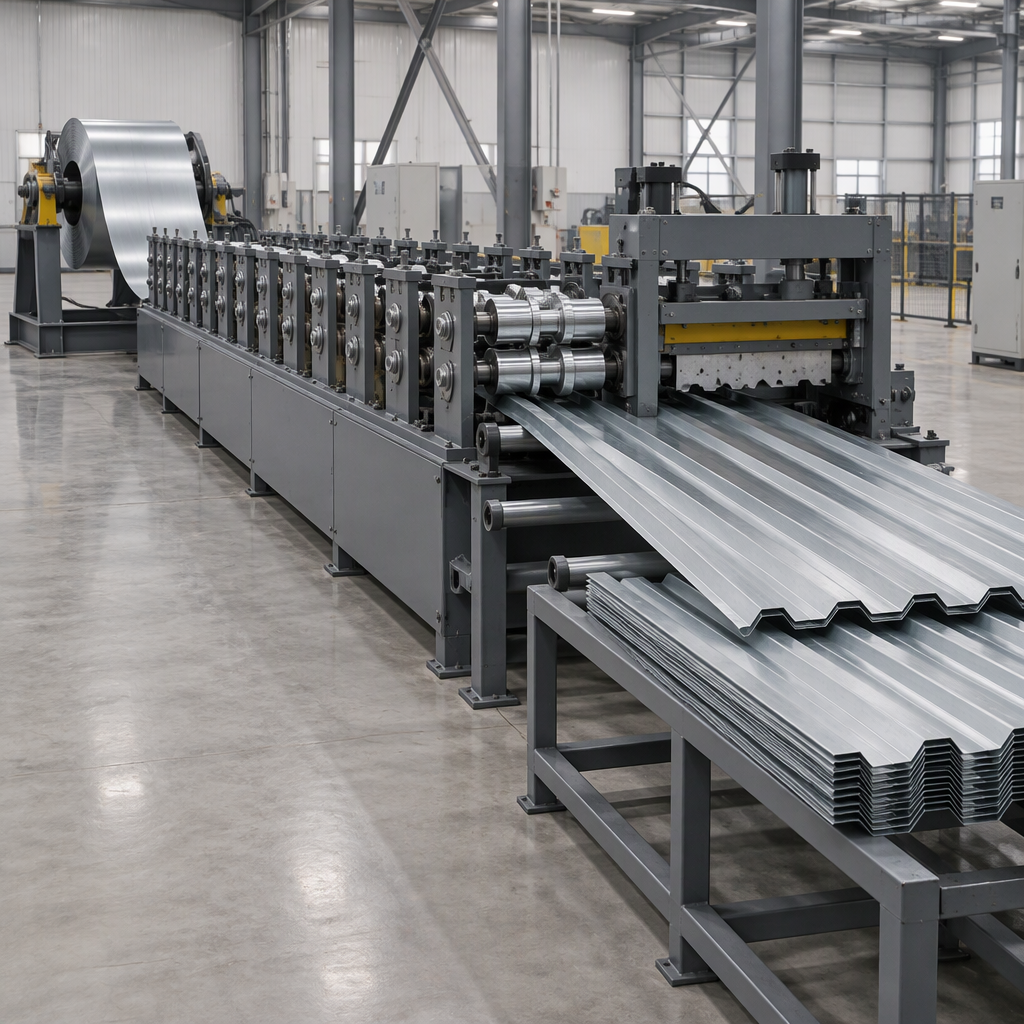
In this guide a double-layer (also called double-deck) roofing machine means one forming line that carries two sets of profiling stations and produces one of the two roofing profiles at a time. The profiles share the frame, drive, coil feed, cut-off and controls; what changes is the tooling, the settings and the setup work. The term describes that shared-capability arrangement, not a particular model, station count, line speed or tolerance.
Equipment catalogues treat the arrangement as a separate product family: BMS Machinery lists a double deck roll forming machine in its own category, alongside metal roofing, purlin, stud-and-track, roof panel crimping, gutter and ridge cap machines.
One shared machine
What is shared: frame, drive, coil feed, cut-off and controls; the second profile is added through tooling and settings.
Setup work: each switch between profiles must be repeated and re-proven.
Space and supply: one footprint and one connection point, but a longer machine envelope and working space for changeovers.
Planning: both profiles compete for the same machine time.
Exposure: one breakdown or one wrong setting stops both products.
Two dedicated lines
What is shared: nothing; each line is built and tuned for one profile.
Setup work: no routine profile changeover; setup is limited to coil changes and normal maintenance.
Space and supply: two footprints, two connection points and two installations.
Planning: both profiles run independently, including in the same shift.
Exposure: one breakdown stops one product, not both.
Screen the Profile Pair Before You Screen the Machine
Two roofing profiles can share one machine only when they belong to the same forming family and can run through the same coil path, feed entry, drive and cut-off arrangement. Screen the pair first: different material bands, panel widths, forming-pass counts or cut-off work make the shared frame a permanent compromise.
Metal building components are normally fabricated to order and shipped to site ready to assemble, so the profile mix follows the project schedule rather than one steady output.
The profile pair decides the answer.
- Do both profiles sit in the same forming family, with compatible rib geometry and panel width?
- Do their material thickness and coating ranges overlap across the products you actually sell?
- Can both run through the same coil width and feed entry without changing the coil path?
- Can one profile tolerate the forming-pass count the other needs?
- Is the cut-off, notching or punching work the same for both?
- How many metres, orders and production runs does each profile generate in a month?
- Are the two profiles ever required in the same shift or on the same delivery date?
- Might either profile be changed or discontinued within the life of the machine?
Changeover, Setup and Throughput: Collect Data Before You Compare
Do not compare options on a quoted changeover figure. Measure the time your own crew takes, from the last good panel of profile A to the first approved panel of profile B, then multiply it by the changeovers your order book really produces.
Before any manual work on the line, isolate it: switch off and disconnect the applicable power supply, apply your lockout and tagout procedure, and then carry out only the access and adjustment steps the machine manual permits. Guards stay fitted, and no change should be made by reaching into a running line or by defeating an interlock.
- Fix the definition. Last good panel of profile A to first approved panel of profile B.
- List every element. Coil change, threading, tooling exchange, roll-gap and station setting, cut-off length, test pieces, measurement and sign-off.
- Time it repeatedly. At least three changeovers in each direction, and note which direction is slower.
- Count real changeovers. Use the count your order book produced in a typical month, not the count you would prefer.
- Add the hidden time. Start-up scrap, test lengths, re-measurement and waiting for a quality decision.
- Compare with run time. Put monthly changeover hours beside the minority profile's running hours.
Site, Footprint and Utility Limits That Decide the Layout
A shared line usually needs a longer frame, more coil positions and more clear floor for changeover access than a single-profile machine. If the building cannot provide that space, or the supply cannot serve the combined load, sharing can lose on construction before it wins on equipment.
Check these before comparing quotations:
- Frame length and the run-in and run-out space in front of and behind the line.
- Coil storage, loading and threading access beside the machine.
- Crane or forklift access to the positions where tooling is exchanged.
- Incoming supply capacity, connection point and any upgrade the local supply authority must approve.
- Foundation, floor loading and drainage requirements set by the machine supplier.
- Compressed air, lighting and ventilation at the working positions.
- Clear, guarded access at every point an operator must reach during a changeover.
Take every dimension, load and rating from the supplier and have your plant engineer check them against the actual building; local building and electrical approvals remain with your own authorities.
Safety, Inspection and Maintenance Duties to Confirm Before You Buy
Work equipment duties begin before the line is delivered: designers, installers, purchasers, suppliers and users all have a part in assessing risk and choosing machinery that can be operated, inspected and maintained safely. A shared machine adds duty points rather than removing them: two products mean more setting positions, more frequent intervention and a changeover procedure that must itself be safe.
The United Kingdom's Health and Safety Executive frames work equipment decisions around assessing risk, choosing the right machine and applying control measures, and its overview of equipment and machinery guidance addresses designers, installers, purchasers, suppliers and users.
The same regulator's PUWER guidance covers inspection of work equipment, maintenance, training and competence, and mobile work equipment. For a shared line that translates into a documented changeover procedure, guarding that stays complete through every change, operators trained on both profiles, and planned inspection of rolls and settings against the more demanding product.
These duties are set out for the United Kingdom. If your plant operates elsewhere, ask your own regulator, insurer or safety adviser which duties apply locally, and confirm the machine's compliance documentation for your market before shipment.
Quality and Tolerance Risks When Two Profiles Share One Asset
The main quality risk of a shared line is that settings drift between products. Every changeover re-establishes roll gaps and station alignment, so each return to a profile must be proven again before production continues.
- Record reference settings per profile. Lock the values for roll gaps, station positions and cut-off length so a changeover is repeatable rather than re-invented.
- Watch roll condition. Wear affects both profiles, but the more demanding product usually shows it first; plan roll inspection and replacement against that profile.
- Protect tooling during changeover. Repeated handling of cassettes and rolls is where damage and misalignment appear.
- Define first-article approval. Agree the measurements and the acceptance criteria for each profile, and record them after every changeover.
- Keep approved samples. A retained panel per profile makes drift visible in a way numbers alone may not.
- Count the scrap. Start-up scrap and re-measurement time are real costs of sharing and belong in the comparison.
Comparing Cost Scope: Shared Capability Versus Two Dedicated Lines
Compare the two options on one identical scope list, not on machine price alone. Sharing concentrates spending in a single larger asset and shifts cost into changeover labour, start-up scrap and single-point failure exposure; two dedicated lines spread spending across two assets but remove routine changeover and let each line be tuned to one product.
| Scope item | One shared machine | Two dedicated lines |
|---|---|---|
| Equipment scope | One frame with tooling and settings for both profiles | Two complete lines, each with its own tooling |
| Foundation and floor | One installation, longer envelope, changeover access | Two installations and two working areas |
| Incoming supply | One connection serving the combined load | Two connections, which may be easier to site separately |
| Coil handling | Coil positions must suit both profiles; more coil changes per shift | Each line keeps its own coil sequence |
| Changeover labour | Recurring cost on every switch between profiles | No routine profile changeover |
| Start-up scrap | Test lengths and first-article panels on every switch | Concentrated at initial setup and material changes |
| Maintenance and spares | One programme, one spares list, one machine to keep available | Two programmes and two spares holdings |
| Planning flexibility | Profiles compete for machine time and must be sequenced | Profiles can run in parallel or in the same shift |
| Breakdown exposure | One fault stops both products | A fault stops one product |
| Future products | New profile must fit the existing frame and tooling envelope | New profile may need a third line or a line conversion |
Prices, duties, installation and energy costs differ by market, configuration and supplier, so totals must come from written quotations. Ask each supplier to price both configurations on the same line items and to state what installation, commissioning and training each price includes.
Decision Path: When Shared Equipment Is Practical
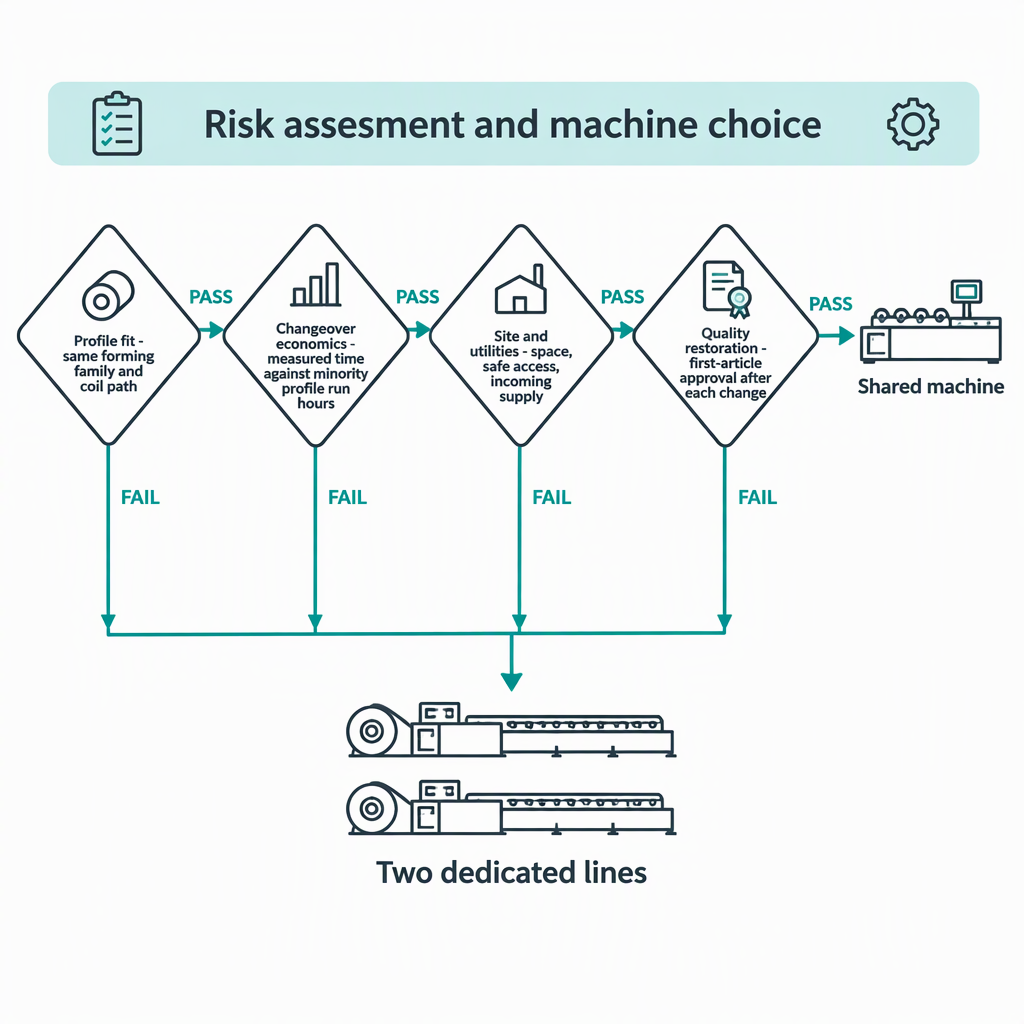
Shared equipment is practical only when all four gates below pass on your own data. If any gate fails, two dedicated lines are the safer purchase.
| Gate | Question to answer with your own data | If it passes | If it fails |
|---|---|---|---|
| Profile fit | Do both profiles share a forming family, coil path, material band and cut-off work? | Continue to the changeover gate | Plan two dedicated lines |
| Changeover economics | Is measured changeover time, times the real changeover count, small against the minority profile's running hours? | Continue to the site gate | Consider a dedicated line for the minority profile |
| Site and utilities | Can the building and its supply serve one combined line with safe working access? | Continue to the quality gate | Two smaller lines may fit where one large line cannot, or building work must be costed in |
| Quality restoration | After every changeover, can both profiles be re-proven against agreed first-article criteria? | Shared capability is the practical choice | Keep the profiles on separate assets until the setup is proven repeatable |
Treat a gate you cannot answer from your own data as open, not passed, and verify quoted changeover times and quality assurances before you order.
Pre-Purchase Checklist for a Shared Roofing Machine
Before ordering, turn every assumption into something a supplier must answer in writing and you can verify on your own profiles. Nothing about the changeover procedure, guarding, first-article criteria or installation duties should rest on a verbal assurance.
- Ask for a demonstration on your own profile drawings and material, and time the changeover yourself.
- Request the written changeover procedure: what is exchanged, what is adjusted and what each step involves.
- Confirm the energy-isolation and access steps in the manual, and that all guards remain fitted during normal production.
- Agree the first-article criteria and the measuring method for both profiles before the machine is built.
- Obtain the site requirements in writing, covering floor loading, foundation, supply capacity, compressed air and working clearances, and pass them to your plant engineer.
- Confirm what training is included and who will supervise the first production changeovers.
- Ask for the wear-part and roll spare list, and the recommended inspection intervals for the more demanding profile.
- Ask for installations you can contact or visit, and check the answers independently.
- Have both configurations quoted on the same scope list so the comparison is like for like.
- Confirm in writing who handles transport, installation, commissioning and acceptance testing, and confirm local approvals with your own authorities.
Conclusion
Choosing between one shared roofing machine and two dedicated lines is a scheduling question before an equipment one. Where profile fit, measured changeover time, site and supply limits and post-changeover quality cannot all be proven from your own data, two dedicated lines remove the risk instead of managing it, and that cost belongs in the comparison.
Frequently Asked Questions
Buyers weighing a shared roofing line usually ask the same practical questions.
How long does changeover between two roofing profiles take?
There is no universal figure. It depends on how much of the tooling is exchanged rather than adjusted, how many settings must be re-established, how the coil is changed and how long first-article approval takes in your plant. Treat a single number quoted without those conditions as unusable. Ask the supplier to demonstrate a changeover on your own profiles, time it with your own crew in both directions, and use that measured time in the cost comparison.
Does sharing still make sense for low-volume or custom roofing work?
It can, and low volume is often where sharing looks most attractive, because a second line may never stay busy enough to justify itself. Changeover frequency decides the answer: small orders of two profiles many times a month accumulate changeover labour and scrap, so cost a dedicated line for the higher-frequency profile, while long campaigns a few times a year keep sharing practical.
How do we verify a supplier's capability claims before believing them?
Ask for evidence you can check independently rather than a description: a timed demonstration on your material, the written changeover procedure, the machine's compliance documentation for your market, the first-article criteria, and installations you can contact. Put the agreed performance items into the purchase documents as acceptance criteria, and where a claim cannot be demonstrated before purchase, treat it as unproven and price the risk accordingly.
When should we choose two dedicated lines instead?
Choose two dedicated lines when the profiles do not share a forming family or coil path, when measured changeover time is significant against the minority profile's running hours, when the building or supply cannot serve one combined line, or when first-article quality cannot be reliably restored after every change. Two lines also make sense when both profiles must be produced in parallel, or when one breakdown stopping both products would be unacceptable to your customers.
What makes two roofing profiles compatible enough to share one machine?
The practical test is the shared path: the same coil width and feed entry, material thickness and coating bands that overlap across the profiles you actually sell, a compatible rib geometry family, and cut-off, notching or punching work that both products can go through. If one profile needs extra operations or a different material band, those operations must be handled elsewhere or the shared frame has to be specified around the more demanding product.
How do coil changes affect the shared-equipment decision?
Every profile change usually brings a coil change with it, so the shared case carries both costs on the same switch. Measure the coil change as part of the changeover, check how many coil positions the line can hold, and confirm the entry accepts both coil widths without a rebuild.
What must we confirm about our building before buying a shared machine?
Confirm the machine envelope and working clearances, the foundation and floor loading, the incoming electrical capacity and connection point, compressed air, and safe access at every position an operator must reach during a changeover. These come from the supplier's data and your plant engineer's assessment, and any building modification or supply upgrade needs local approval before installation begins.


