


Specify roll formed profile tolerances by naming one governing tolerance document and its current edition, confirming that its scope covers your section shape and your steel, listing every characteristic you will accept or reject, and writing the measurement condition and the non-conformance route into the purchase order. A tolerance table that cannot be traced to a named document and edition is an opinion, not an acceptance rule.
Is there a published standard for roll formed profile tolerances?
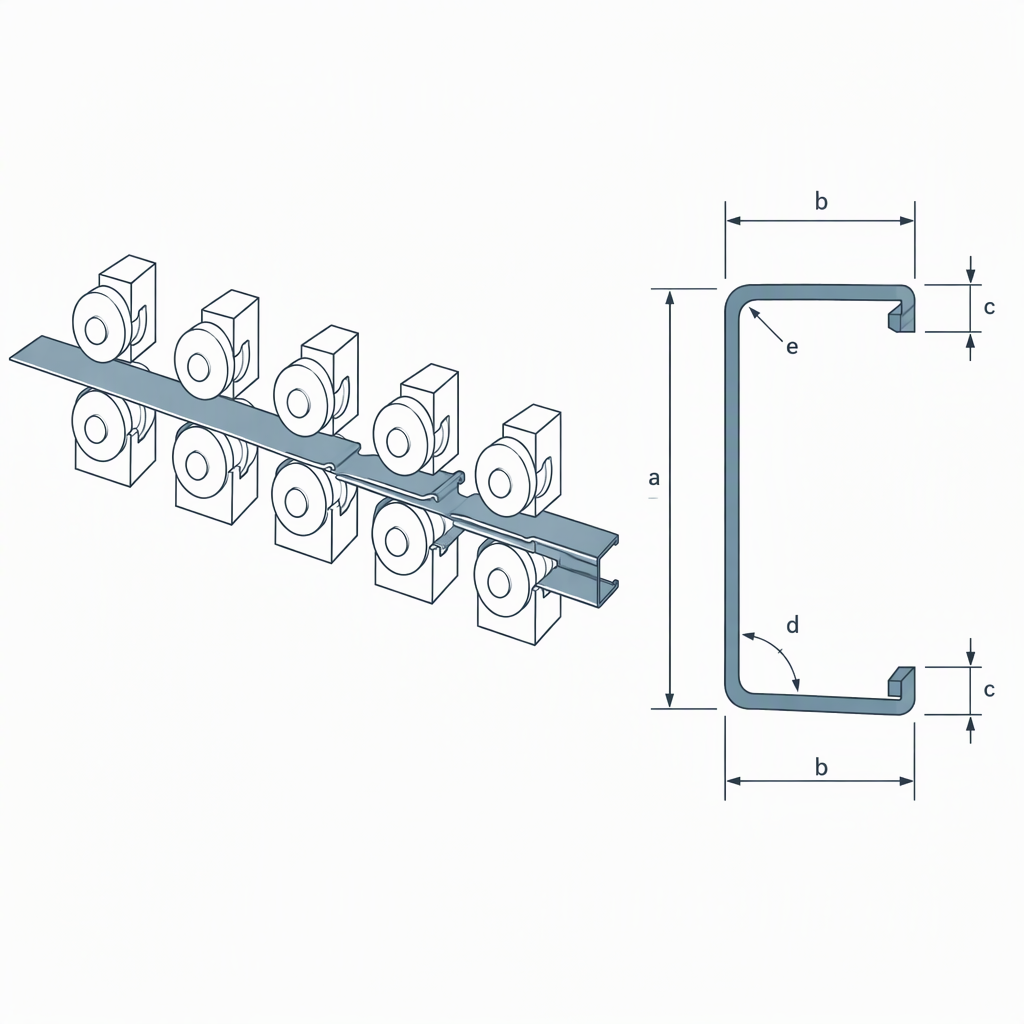
Yes. You do not have to invent a tolerance table. BS EN 10162:2003, Cold rolled steel sections. Technical delivery conditions. Dimensional and cross-sectional tolerances, is the published standard for cold rolled steel sections produced on roll forming machines. Its subject matter covers dimensions, thickness, radius, bending and form tolerances together with ordering information, designations and delivery, so it frames both the drawing and the order.
What the standard itself sets out. The publisher's catalogue entry for BS EN 10162:2003 records a publication date of 30 April 2003, a status of “Current, Under Review”, and the same subject list: dimensions, thickness, radius, bending and form tolerances, ordering, designations and delivery. That list is the commercial point. The document is a framework for the information you supply as well as a set of acceptance values.
The edition trap. Withdrawn editions stay listed in many catalogues, so a tolerance table can look official and still be obsolete: BSI records the 2008 edition of BS EN 1090-2 as withdrawn on 20 June 2018 while its catalogue page remains live. Treat any table that does not name a year as unconfirmed, and re-check the publisher's status before a long supply agreement.
Does the standard's scope match your section and your steel?
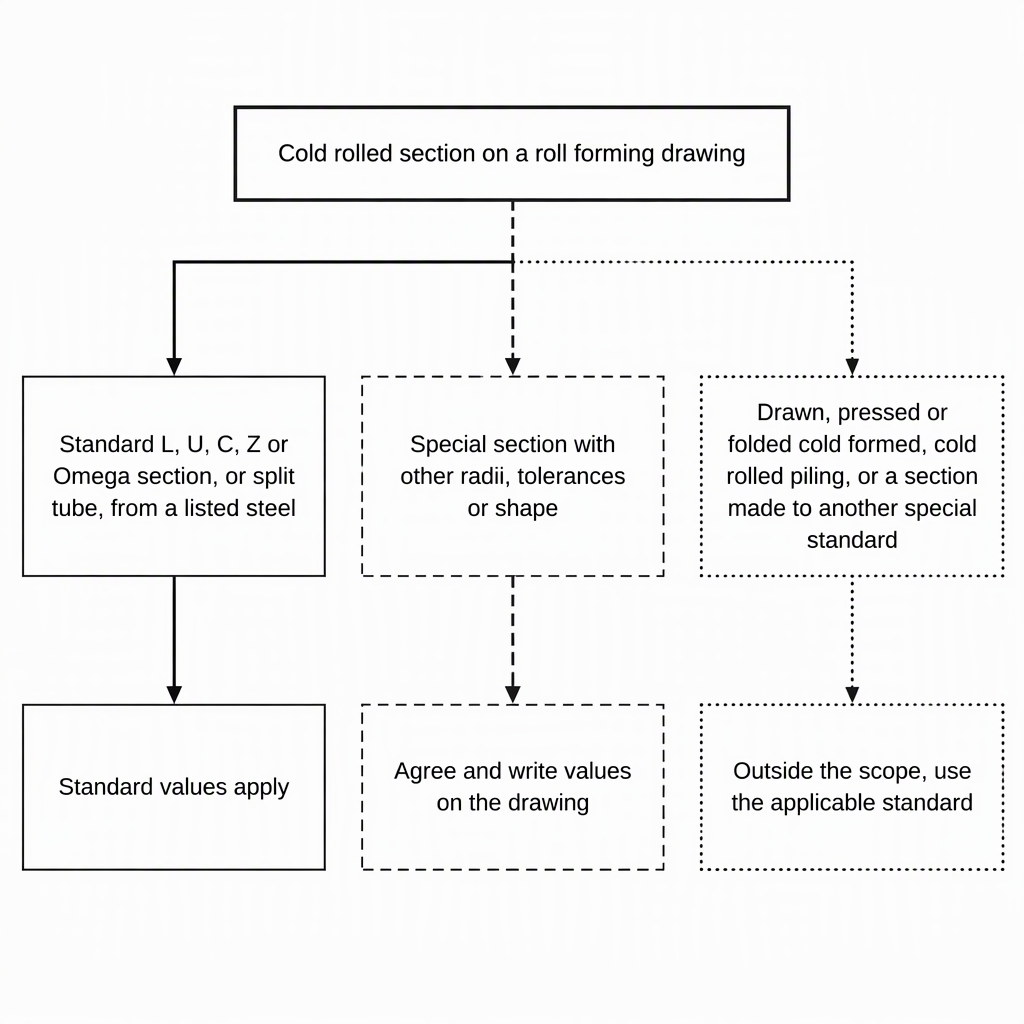
Not automatically. BS EN 10162:2003 is written for standard L, U, C, Z and Omega cross sections and for split tubes made from the steels it specifies, and for special sections with other radii, tolerances or shapes. Drawn, pressed or folded cold formed sections, cold rolled steel piling and sections manufactured to other special standards fall outside it, so citing the standard on those drawings proves nothing.
| What you are ordering | Position under BS EN 10162:2003 | What to write on the drawing |
|---|---|---|
| Standard L, U, C, Z or Omega section from a listed steel | Inside the scope | Name the standard with its edition year and add the section designation. |
| Split tube formed on a roll forming line | Inside the scope | Name the standard and state the datums you will measure from. |
| Special section with other radii, tolerances or shape | Covered as a special section | Agree the values in writing and attach them to the drawing. |
| Drawn, pressed or folded cold formed section | Outside the scope | Do not cite this standard; use the product standard for that forming route. |
| Cold rolled steel piling | Outside the scope | Use piling-specific requirements and state them explicitly. |
| Section made to another special standard | Outside the scope | Name that standard and its edition instead. |
The substrate is a second scope check. The section standard is written around particular steels, so name the coil separately. Delivery standards for coated flat products carry a clause on the information the purchaser must supply. BSI records the 2009 edition of BS EN 10346 for continuously hot-dip coated steel flat products as withdrawn on 31 July 2015. Ask which current edition of the substrate standard your coil is supplied to, and put it on the order next to the profile tolerance document.
Which characteristics should carry a tolerance on the drawing?
Put an acceptance value on every characteristic that decides whether the profile assembles: cross-section dimensions and thickness, corner radii, bend angles and lip depth in the transverse plane, plus twist, bow, camber and cut length along the piece. BS EN 10162:2003 treats dimensions, thickness, radius, bending and form tolerances as separate subject areas.
Transverse: the shape of the section
- Characteristics: web and flange dimensions, lip depth, thickness, internal bend radius, bend angle, squareness of the section.
- Why it matters: these values govern fit with sheeting, cleats, fixings and mating parts.
- How to check: measure a cut length on an agreed gauge from the datums printed on the drawing.
- Where it goes wrong: a value quoted against a nominal dimension with no datum lets two inspectors measure from two places.
Longitudinal: the straightness of the run
- Characteristics: twist, bow, camber, straightness over a stated length, and cut length.
- Why it matters: form deviations accumulate along the piece and appear on site as gaps and fixings that will not line up.
- How to check: support the piece as it will be stored, measure over the stated length, and record the condition at receipt.
- Where it goes wrong: a reading taken after bundles have been re-stacked and stood on edge can differ from the piece that left the line.
When does execution class enter the tolerance conversation?
When the profile becomes part of an executed steel structure. Product tolerances tell you whether a section left the line correctly; the execution standard tells you what the assembled structure must achieve, who inspects it and what documentation travels with it. BS EN 1090-2:2018+A1:2024 sets out execution classes EXC1 to EXC4 with the geometrical tolerances, inspection, documentation, traceability and CE marking that follow.
What the execution standard does and does not do. The publisher lists BS EN 1090-2:2018+A1:2024 as current and published on 31 May 2024. It governs how a steel structure is executed and verified, but it does not set tolerance values for a profile as it leaves a roll forming machine. A project that names an execution class therefore needs two references: the product tolerance document for the section and the execution standard for the structure.
Do not let a superseded execution edition survive in the paperwork. BSI records BS EN 1090-2:2008+A1:2011 as withdrawn on 20 June 2018, yet older quality plans and project specifications still quote it, so ask for the edition year in writing. The execution class belongs to the party specifying the structure, not to the machine builder.
What has to be written into the order for tolerances to be enforceable?
The order needs five elements: the governing tolerance document with its edition year, the section designation and shape family, the substrate steel and coating with its delivery standard, the characteristic list with acceptance values and measurement conditions, and the inspection, documentation and non-conformance route. BS EN 10162:2003 covers ordering information and designations, which signals that these details belong on the order, not in a side email.
- Name the document and the edition. Write the standard number and year on both the drawing and the purchase order, and keep them identical.
- State the shape family. L, U, C, Z, Omega, split tube or special section, because this is the supplier's first scope test and it decides whether standard values or agreed values apply.
- State the substrate. Steel grade, coating and thickness, with the edition of the coil delivery standard.
- List characteristics and measurement conditions. For each characteristic give the acceptance value, the datum, the gauge, the length it is assessed over, and whether the reading is taken on a cut length or a full-length piece.
- Fix inspection, records and the disposition route. Who inspects, at which stage, what record accompanies each lot, and whether an out-of-tolerance lot is reworked, replaced or accepted by written concession.
- The drawing revision quoted on the order matches the revision you approved.
- The edition status of the tolerance document was checked with the publisher, not copied from an older project file.
- Special sections carry written values instead of a pointer to a table that does not cover them.
- Ordering data is contractual, not courtesy: flat-product delivery standards include a clause on the information the purchaser must supply.
- If the profile feeds a steel structure, the execution class is stated in the project documents.
- The non-conformance route is agreed before the first production lot, not after the first rejection.
What should you verify before you accept a supplier's tolerance table?
Check four things before the table reaches a purchase order: the edition it comes from, whether its scope matches your section and steel, whether every characteristic you care about has a value, and whether it states how each value is measured and what happens when a lot misses it. A table that is silent on measurement is not enforceable as written, because the same profile can pass one method and fail another.
- Edition: does the table name the document and its year, and is that edition current with the publisher?
- Scope: is your section a standard shape family or a special section, and is the steel the table assumes the steel you are buying?
- Coverage: are thickness, radius, bend angle, twist, bow, camber and length all addressed, or only the dimensions that are easy to hold?
- Measurement condition: gauge, datum, cut length against full length, and the condition of the piece when it is measured.
- Disposition: rework, replacement or concession, with who decides and in what timeframe.
- Traceability: a lot or heat reference linking the inspection record to the bundles actually delivered.
A table without an edition is a marketing table. If a supplier's table is tighter than the standard, ask for that as a written contractual commitment, because an internal target is not an acceptance limit.
Conclusion: make the tolerance scheme a contract term, not a note
Finalise four things before you release a roll forming project: one governing tolerance document with its current edition, a confirmed scope match for your section family and steel, a characteristic list with acceptance values and measurement conditions, and an inspection and disposition route written into the order. Everything else in a tolerance discussion hangs off those four decisions.
Buyers who get this right do not argue about numbers at goods-in. They settle them on the drawing, before tooling is made, while there is still room to change a radius, a datum or a straightness value that the process cannot hold at the line speed the order assumes. The two references do different jobs. BS EN 10162:2003 governs the section as it leaves the line. BS EN 1090-2:2018+A1:2024 governs the executed structure it becomes. A project that mixes them up ends in acceptance arguments nobody can win.
Keep the paper trail short and specific: standard number and year, section designation, substrate and coating, the characteristic list with measurement conditions, and the name of the person who decides a concession.
Frequently asked questions about roll formed profile tolerances
The questions below decide whether a tolerance statement survives contact with a purchase order: what the form terms mean, how the measurement condition gets agreed, which document governs which product, and what to do when a supplier's table arrives without an edition.
What do twist, bow and camber mean for a formed profile?
They are the classic longitudinal form deviations, and BS EN 10162:2003 treats form tolerances as their own subject area alongside dimensions, thickness, radius and bending. Twist is a rotation of the section about its own length, so the flanges no longer sit in one plane at both ends. Bow is curvature in the plane of the web, camber is curvature in the perpendicular plane, and both are usually described as a maximum deviation over a stated length. Always state that length: a piece can pass a value quoted per metre and fail the same value quoted over the full piece.
How should the measurement condition be agreed and recorded?
Put it on the drawing rather than in a conversation: the datum, the gauge or calliper type, the length over which a form deviation is assessed, whether the reading is taken on a cut length or a full-length piece, and how the piece is supported when it is measured. Record each lot's result against the drawing revision. Two inspectors can agree on a number and disagree on the method, and the method is what makes the number repeatable.
Can we simply write “tolerances to BS EN 10162” on the drawing?
You can, provided the section sits inside the standard's scope and you add the edition year. A bare reference leaves the inspector to choose which subject areas apply; a reference with edition, section designation and characteristic list is enforceable.
Does one tolerance document cover both the coil and the formed profile?
No. The coil is supplied against a flat-product delivery standard, while the formed profile is accepted against the section tolerance document. Editions change: BSI records the 2009 edition of BS EN 10346 as withdrawn on 31 July 2015. Name the current edition of each document separately instead of assuming one reference covers both.
What if our profile is a special section outside the standard shapes?
Then treat it as a special section. BS EN 10162:2003 includes special sections with other radii, tolerances or shapes as special cases rather than as standard sections, so agree the acceptance values and measurement method in writing with the supplier, draw them, and attach them to the order.
Who decides the execution class if the profile goes into a steel structure?
The party specifying the structure names the execution class, and BS EN 1090-2:2018+A1:2024 defines classes EXC1 to EXC4 together with the geometrical tolerances, inspection and testing, documentation and traceability that follow from them. Do not let the class be inferred from a supplier's standard quality plan. Ask for it in writing at enquiry stage, because it changes the inspection records you should expect with each delivery.
What should we do when a delivered lot is out of tolerance?
Segregate the lot, record the measured values together with the method used, and route the decision through the disposition clause agreed before the order: rework, replacement or written concession. Hold the disputed pieces until the decision is closed, and quote the drawing revision and tolerance edition in the record. Without that trail, the argument returns to whether the measurement method was fair.


