Flying Cutoff vs. Stop-to-Cut: Where the Two Approaches Actually Differ
The difference is when the cut is made. A flying cutoff cuts while the strip is still running, with the cutting head travelling at strip speed, so the line does not stop for every length. A stop-to-cut arrangement cuts after the strip has been brought to a stop, so each piece carries a stop, a cut and a restart. Cycle time, length tolerance, cut-edge quality and surface condition all follow from that one difference and from the material and order mix the line has to run.
Flying cutoff
When the cut is made
While the strip is running
What the strip does
Keeps moving through the cut
What the cutting head does
Travels with the strip
What to require in the offer
Cut-cycle time and tolerance quoted for your material, thickness and lengths
What to check on sample parts
Length and squareness on parts cut at your normal and highest speed
Stop-to-cut
When the cut is made
After the strip has stopped
What the strip does
Stops for each cut, then restarts
What the cutting head does
Stays in position for the cut
What to require in the offer
Stop-cut-restart time per piece, tolerance and repeatability for your length list
What to check on sample parts
Length, squareness and surface on the first and last parts of a run
Whichever arrangement you choose, the cut-off is one station inside a complete line, so the enquiry has to cover the line it sits in. Xiamen BMS Group, for example, publishes slitting lines, cut-to-length lines and electric cutting machines alongside its roll forming machine ranges.
What the two names do not tell you
Neither label states a cycle time, a length tolerance or a surface result. A cutting system has to be matched to the order mix the line will run, and a maximum thickness rating says little about how well a line handles the thinnest coil.
Treat a cut-off claim that is not tied to a defined material, thickness, length and running speed as unconfirmed until the builder writes it into the offer and demonstrates it on sample parts.
Throughput and Cycle Time: What Has to Be Measured Rather Than Assumed
Compare output on cycle time at the cut, not on a general claim that one arrangement is faster. Ask each builder for the time from one cut to the next at the lengths, thicknesses and speeds you actually run, then apply those figures to your own length list. The same cut-off can be the stronger choice on long runs of one length and the weaker one on a mixed order book.
Values to obtain before comparing cut-off cycle time
Comparison point
Flying cutoff
Stop-to-cut
Time lost at the cut
Ask for the cut-cycle time and any speed limit at the cut, with the cut made in motion
Ask for the stop-cut-restart time that is added to every piece
Tolerance statement
Quoted for a defined speed, thickness and material
Quoted for a defined length, thickness and material
Short lengths and frequent changes
Ask how your shortest length and most frequent changes are handled with the cut in motion
Ask how repeated stops affect your shortest length and how a length change is made
Order-mix fit
A cutting system has to be matched to the order mix, so the offer must reflect the lengths and materials you run
Same criterion: judge both offers on your order mix, not on a general speed claim
Length Accuracy and Cut-Edge Quality: Setting Tolerances You Can Accept
Write the tolerance you need rather than accepting the tolerance you are offered. One figure such as plus or minus one millimetre means little without the running speed, material, thickness and length band it was measured at, so require each offer to state the tolerance for the lengths you produce most, including your shortest and longest. Then confirm the cut edge: squareness, burr and coating damage at the cut are separate acceptance points that a length measurement will not reveal.
State a tolerance for each length band, with the material, thickness and line speed at which it applies.
Send your real order mix, including the thinnest coil, because a maximum thickness rating does not describe how a line handles the thinnest material.
Agree how length will be measured: instrument, reference temperature, and whether the reference is the cut face or the strip end.
Agree acceptance for squareness, burr height and coating damage at the cut face.
Agree sample positions: first piece, last piece, and the first piece after each restart or speed change.
Agree what happens to a part outside tolerance, and who carries the cost of re-cutting it.
Strip Surface, Coating and Tooling Wear: Checks to Run on Real Parts
Judge surface and wear questions on parts, not on descriptions. Roll forming depends on more than the line and its tooling; the material's yield strength and elasticity matter as much. A run of your own pre-painted or sensitive material through the candidate arrangement, followed by inspection of the same faces, edges and cut zones on every sample, tells you more than any description of how the strip is handled.
Flying cutoff: what to inspect
Where to look first
Guides and supports that carry the strip, and the cut zone
What to inspect on a sample
The visible face and both edges before and after the cut
What to record
Location and type of each mark, on the same numbered part
What to ask the builder
Which surfaces touch the coated face, and what tooling inspection the cutting station needs
Stop-to-cut: what to inspect
Where to look first
Where the strip slows to a stop and where the cut is made
What to inspect on a sample
The same visible face and both edges, before and after the cut
What to record
Location and type of each mark, at the first and last piece of a run
What to ask the builder
Whether the strip is held for the cut, and what touches the coated face
Wear checks that require access to the cutting station come with one prerequisite: switch the line off and disconnect its power source under your plant's lockout procedure before anyone reaches the blades, and work only within the access the builder's manual permits.
Which Arrangement Fits Your Order Mix
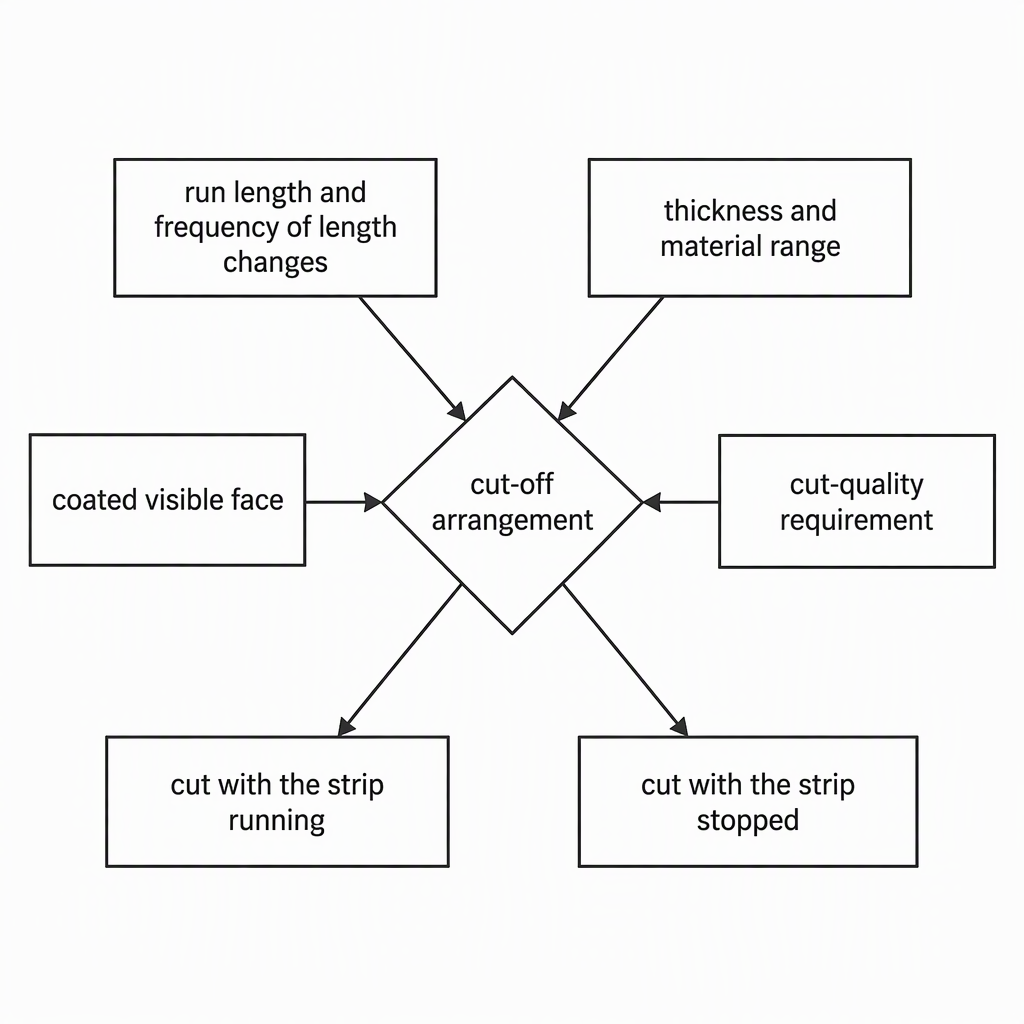
Start with the order mix rather than with the machine. Write down your run lengths, how often the cut length changes, your thickness and material range, and whether the visible face is coated, then use those four points as questions for both builders. The answers usually separate the two arrangements for your plant more clearly than a general speed comparison.
Points to check, by production pattern
Your production pattern
Question that decides it
What a good answer must contain
Long runs of a few lengths
How much time is lost per cut at my running speed?
Cut-cycle time and tolerance quoted at that speed, thickness and length
Short lengths, frequent changes
How much time is lost per restart, and how long does a length change take?
Stop-cut-restart time per piece and the changeover time between lengths
Thin gauge across a wide range
How does the line handle my thinnest coil?
A minimum thickness statement, plus how the thinnest material is fed and supported, not only a maximum thickness rating
Pre-painted or visible-face product
What touches the coated face from coil to cut?
Named contact surfaces, sample parts showing the coated face after cutting, and agreed inspection criteria
What to Put in the Specification and the RFQ
Write one specification and send it to both builders, so the two offers can be read side by side. It should fix the material and thickness range, the length bands and their tolerances, the surface requirement, the measurement method, the acceptance test and the scope you want quoted.
Material and thickness range, including your thinnest coil and your strongest material.
The minimum thickness the line must handle, stated as a value rather than left as a maximum rating.
Length bands with a tolerance for each, and the running conditions each tolerance applies to.
Surface requirement: which face is visible and what marking is unacceptable.
Cut quality: squareness, burr and edge condition at the cut.
The definition of cycle time you want quoted, for example cut to cut at a stated speed.
Scope: cutting station, controls and measuring system, tooling, guards, documentation, installation, commissioning, training and spares.
Acceptance test: material supplied, sample size, what is measured and the pass or fail criteria.
The values the builder guarantees, and how a shortfall will be handled.
How to Verify the Choice Before Sign-Off
Verify with a trial on your own material and your own length list before the order is placed. The trial should reproduce the conditions you will run in production, and the results should be recorded in the same units as the specification so both offers are judged against one set of criteria.
Write the trial plan: material and thickness samples, length bands, running speeds and the values to be measured.
Supply material from production coils, including the thinnest gauge and any pre-painted stock.
Run your production length list, including the shortest and longest lengths.
Measure length and squareness at the agreed sample positions and record the results.
Inspect the visible face along the whole line and note the location of any mark.
Repeat the run at the ends of your thickness range and compare every result with the guaranteed values in the offer.
Record any difference in writing before you sign, and agree how it will be resolved.
Making the Trade-Off Decision
Close the decision on measured values, not on architecture alone. If both offers meet your tolerance, cut-quality and surface requirements, compare the scope each one includes, the values each one guarantees in writing, and the maintenance the cutting station will need in your plant.
The two names describe when the cut is made, not what performance you will get.
Compare cycle time, tolerance and cut quality at your own lengths, thicknesses and speeds.
Judge surface, edge and tooling questions on sample parts rather than on descriptions.
Send one specification to both builders and hold a trial to the guaranteed values.
Conclusion
A flying cutoff and a stop-to-cut arrangement are two answers to the same question, and the answer that suits your plant is the one whose quoted numbers, sample parts and guaranteed values match your order mix, your tolerance and your surface requirement. Decide on those, keep the guarantees in the purchase documents, and the trade-off becomes a documented choice rather than a preference.
Frequently Asked Questions
These are the questions buyers raise most often when they compare a cut made with the strip running against a cut made with the strip stopped. Each answer points to the value, test or written guarantee that settles it.
What is a flying cutoff?
A flying cutoff is a cutting station whose head travels with the strip, so the cut is made while the strip is still running and the line does not stop for each length. The cut-cycle time, the speed range it covers and the tolerance quoted at that speed are the values to compare.
What does stop-to-cut mean?
It means the strip is brought to a stop and the cut is made while it is stationary. Every length therefore carries a stop, a cut and a restart, so compare the stop-cut-restart time and the effect of repeated stops on length tolerance and the visible surface.
Which arrangement is faster?
Neither name settles that. Ask both builders for cut-cycle time at your own speed, thickness and length, and for the stop-cut-restart time per piece on the alternative, then apply those figures to your length list. A choice that wins on a long run of one length can lose on a mixed order book.
How should I write a length-tolerance requirement?
State a tolerance for each length band and name the material, thickness and running speed at which it applies. Add the measuring method, the sample positions and what happens to a part outside the band. Without those conditions, a tolerance can be neither guaranteed by the builder nor checked by you.
What changes for thin-gauge or pre-painted strip?
Both move the check to the edges of your range. For thin gauge, ask for a stated minimum thickness and for how the strip is fed and supported, because a maximum thickness rating says little about the thinnest coil you run. For pre-painted strip, name the visible face, agree what may touch it from coil to cut, and inspect sample parts.
Can an existing stop-to-cut line be converted to a flying cutoff?
That cannot be answered from the arrangement alone, because it depends on the structure, drive, controls, space and tooling of your existing line. Ask the original builder or a qualified line integrator to inspect the line and give you a written assessment listing the scope, the guaranteed values and the changes to the existing equipment.
What should I ask a machine builder?
Ask for cut-cycle time and tolerance at your stated conditions, the stop-cut-restart time for the alternative, the minimum thickness the line handles, which values are guaranteed, how length is measured, what maintenance the cutting station needs, and a trial on your own material.
What drives the difference in quoted cost?
The difference you are quoted reflects the scope each supplier includes rather than a published list price. Ask both to itemise the same scope, covering cutting station, controls and measuring system, tooling, guards, documentation, installation, commissioning, training and spares, then compare the totals against that identical list.
Founded in 1992, BMS Machinery joined XIAMEN BMS GROUP in 2017. Our manufacturing network in China includes 8 factories, 6 machining centers and 1 steel structure company, covering over 30,000 m². Supporting credentials include ISO9001:2015 quality management certification and SGS-issued CE/UKCA machinery compliance verifications. XIAMEN BMS GROUP’s Dun & Bradstreet D‑U‑N‑S Number is 55-379-8879.