


Select a gutter roll forming machine by first defining the gutter profile and the sheet or coil material, because roll forming uses successive roller dies and the required roll pairs depend on material grade, part complexity, and mill design. Then confirm the site drainage assumptions, including gutter length served by each downspout and the relationship between downspout size and gutter bottom width, before treating any machine configuration as fit for the project.
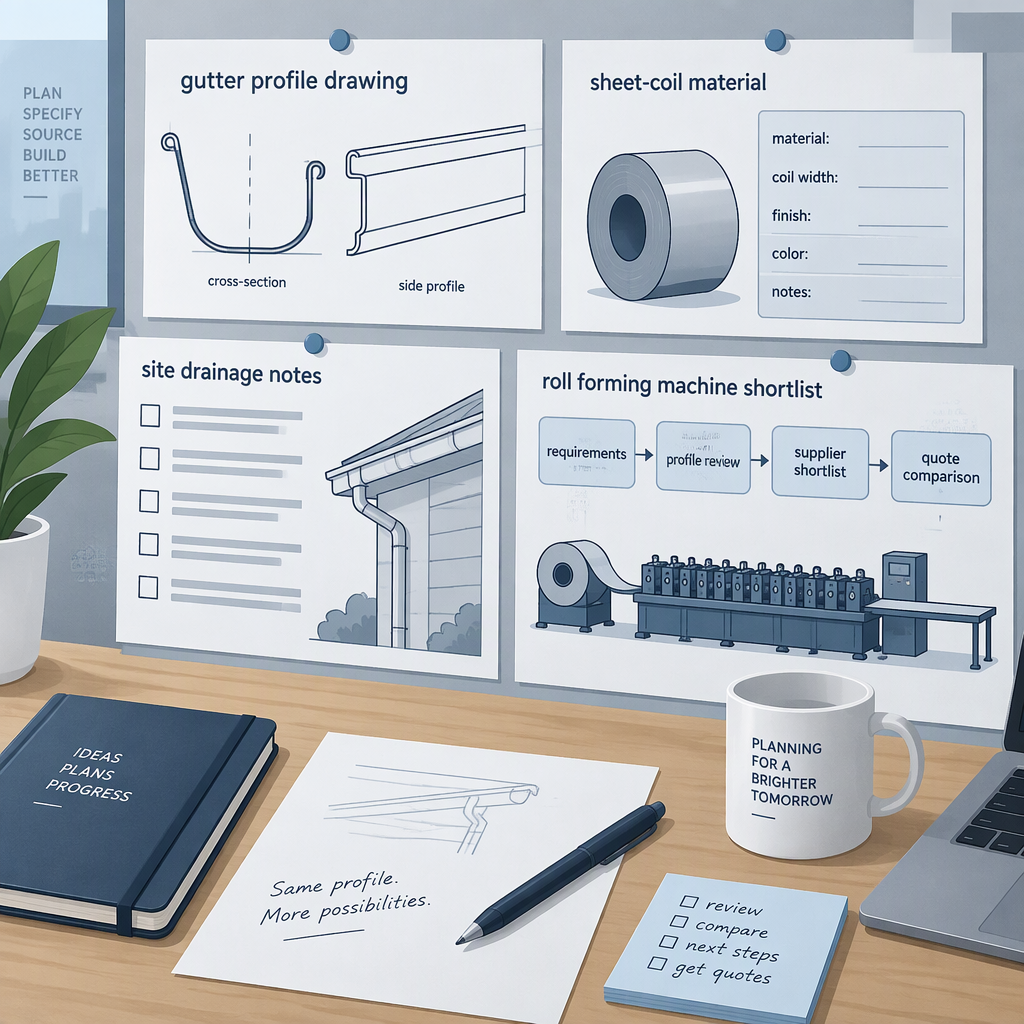
Match the gutter profile before discussing machine options
The profile decision comes first because a gutter shape is formed through a sequence of paired roller dies, and more complex finished parts can require different roll-pair counts and mill design choices.
For a gutter roll forming machine discussion, do not begin with a generic request for a line. Begin with the profile drawing or target profile family: K-style, half-round, box, fascia, or a custom architectural section. The supplier needs to understand the bends, return lips, bead details, and finished-part complexity before discussing tooling and line configuration.
| Profile question | What the buyer should define | Why it affects the machine discussion |
|---|---|---|
| Finished shape | Provide a drawing, sample, or approved profile reference rather than only a profile name. | Roll forming reaches the final shape through incremental bends made by successive roller dies. |
| Complexity | Identify hemmed edges, decorative ribs, tight bends, and unusual transitions. | Finished-part complexity is one factor that affects the number of roll pairs and mill design. |
| Interfacing parts | Confirm the gutter bottom width needed to work with the intended downspout size. | SMACNA’s sizing calculator states that downspout sizes must not exceed the gutter bottom width. |
For the forming principle, see the AHSS Guidelines explanation of roll forming, which describes strip passing longitudinally through successive paired roller dies.
Confirm material fit from project and supplier documents
Material fit should be handled as an engineering input, not a guess: sheet-metal grade and strength influence forming forces, roll-pair needs, and the loads imposed on rollers and frames.
A buyer can shortlist more responsibly by stating the intended material family and grade, then asking the supplier to confirm compatibility for that exact application. Avoid assuming that one machine setup will run every steel, aluminum, copper, painted coil, or coated material option equally well.
| Material input | Buyer action | Selection impact |
|---|---|---|
| Sheet-metal grade | State the exact grade or project-approved material designation in the RFQ. | Material grade is one factor that affects the number of roll pairs and forming setup. |
| Strength level | Ask how the supplier evaluates forming loads for the proposed material. | Higher-strength steel increases forces on rollers and frames. |
| Coating or surface finish | Ask for handling and tooling guidance for the specified finish. | Surface protection is a project-quality issue and should be confirmed against the supplier’s documented capability. |
Do not write an RFQ around an assumed thickness range, coil width, speed, motor power, or tooling-change time unless the project specification or supplier documentation states those values. Ask for the current technical sheet for the proposed configuration.
The material-dependence point is supported by AHSS Guidelines, which links roll-pair count to sheet-metal grade, finished-part complexity, and mill design, and notes that higher-strength steel increases forces on rollers and frames.
Match site needs before locking the machine configuration
Site needs matter because gutter profile selection is tied to drainage assumptions, downspout sizing, and the practical length of gutter served by each downspout.
SMACNA’s Downspout & Gutter Sizing Calculator states that its sizing basis comes from Chapter 1 of the Architectural Sheet Metal Manual, 7th Edition, and uses rainfall data and standard downspout dimensions. Treat that type of sizing work as a project-design input, not as a machine feature.
- Confirm the rainfall basis or project drainage requirement for the installation location before choosing the profile depth and downspout arrangement.
- Check that the selected downspout size does not exceed the gutter bottom width.
- Review the gutter length served by each downspout; SMACNA notes a practical maximum of 50 ft. / 15 m of gutter length served by a downspout to limit thermal expansion effects.
- Translate those project decisions into the RFQ as profile drawings, intended material, and site constraints rather than asking only for a generic gutter roll forming machine.
Machine selection does not replace local project review. For installed gutter work, confirm the governing design criteria, adopted rules, and any local amendments with the project professional or local authority before production.
For drainage boundary checks, buyers can review the SMACNA Downspout & Gutter Sizing Calculator, which explains the assumptions behind gutter and downspout sizing.
Build an RFQ checklist for application selection
A useful RFQ should describe the profile, material, and site assumptions clearly enough for the supplier to respond with a configuration that matches the application instead of a generic machine description.
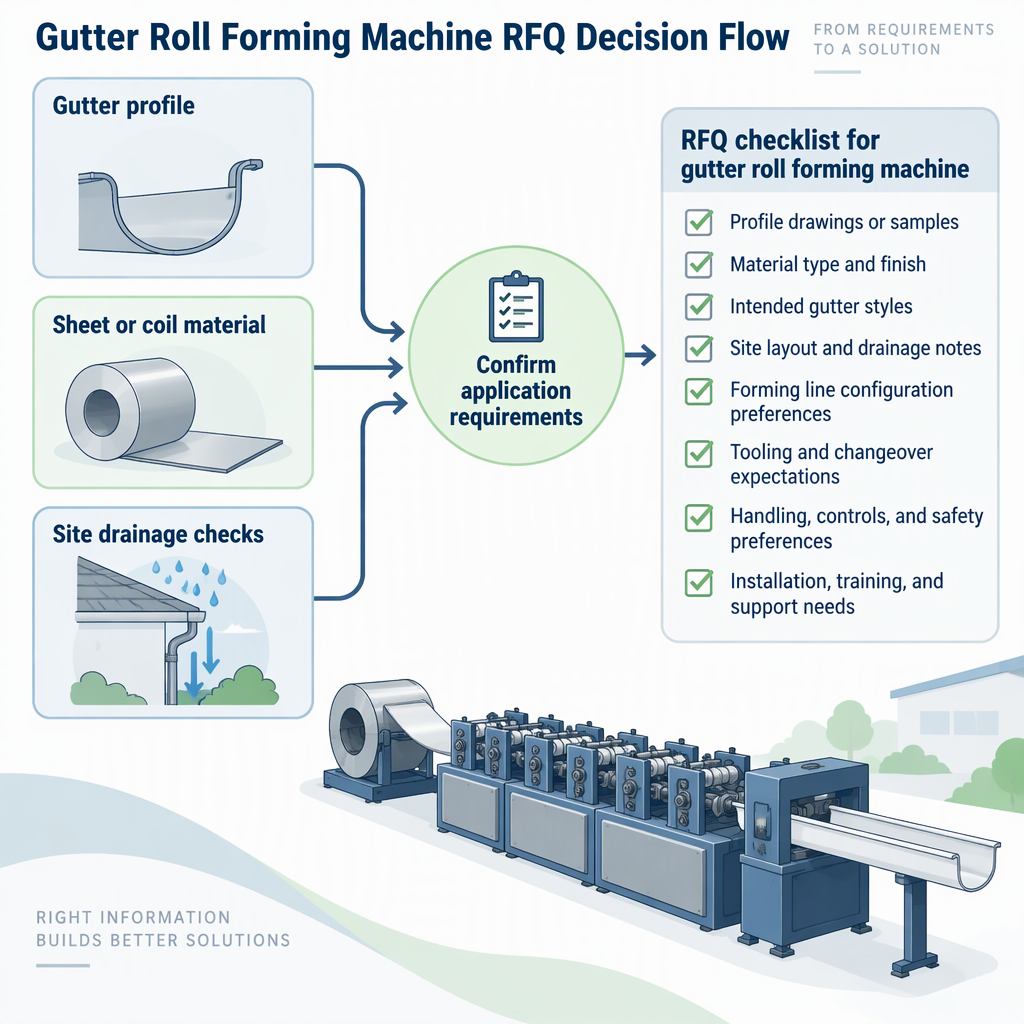
- Attach the target gutter profile drawing, sample, or approved section reference, including bends and decorative features.
- State the intended sheet or coil material, grade, finish, and project quality expectations.
- Ask the supplier to confirm how material grade, strength, and profile complexity affect the recommended mill design.
- Include the intended downspout size and confirm that it is compatible with the gutter bottom width.
- Include the expected gutter length served by each downspout and any project drainage assumptions.
- Request the supplier’s current technical documents for machine configuration, safety requirements, utility needs, installation space, commissioning scope, and maintenance instructions.
- Ask for all commercial terms directly: price, delivery time, warranty, spare parts support, training scope, and acceptance criteria.
| If your project priority is... | Ask the supplier to confirm... | Do not assume... |
|---|---|---|
| A complex architectural gutter profile | Tooling approach, roll-pair implications, and sample approval process | That a standard line can form the profile without engineering review |
| A higher-strength sheet material | Roller and frame load suitability for that material | That a machine suited to one material grade will suit another |
| A long gutter run on site | Downspout spacing and drainage assumptions before finalizing profile selection | That machine purchase decisions can replace gutter sizing checks |
Avoid selection risks that create downstream rework
The biggest selection risk is treating profile, material, and site drainage as separate decisions when the forming line and the installed gutter system need to be compatible.
- Do not buy around a profile name alone; finished-part complexity can affect roll-pair count and mill design.
- Do not substitute a material family label for the actual grade and strength level; material properties affect forming forces.
- Do not treat downspout sizing as an afterthought; downspout size must fit within the gutter bottom width.
- Do not ignore gutter length served by each downspout; SMACNA notes a practical 50 ft. / 15 m maximum for limiting thermal expansion effects.
- Do not rely on unsupported claims about certifications, speed, output, pricing, or delivery. Ask the supplier for current documents that match the quoted machine.
For any machine that requires manual cleaning, adjustment, coil-path access, or jam clearing during evaluation or later operation, switch off the machine and disconnect the applicable power source before manual access, then follow only the access and service steps allowed in the model manual.
Conclusion
Shortlist a gutter roll forming machine only after the profile drawing, material input, and site drainage assumptions are clear.
The forming line must match the shape and material demands created by the finished gutter profile. The installed gutter design must also respect drainage and downspout limits, including bottom-width compatibility and the practical length served by each downspout. With those inputs documented, the RFQ can focus on a supplier’s actual configuration, documents, safety requirements, and commercial terms.
FAQs about gutter roll forming machine selection
These questions help buyers clarify the boundary between machine selection, forming engineering, and project gutter sizing.
Can one gutter roll forming machine make every gutter profile?
Do not assume one machine can make every profile. Roll forming depends on successive roller dies, and the number of roll pairs depends on sheet-metal grade, finished-part complexity, and mill design.
Does a gutter roll forming machine selection replace gutter sizing calculations?
No. Machine selection does not replace gutter and downspout sizing work. SMACNA’s calculator bases sizing on rainfall data, standard downspout dimensions, and Architectural Sheet Metal Manual assumptions.
What profile information should be sent before asking for a quote?
Send a drawing, sample, or approved profile reference that shows the finished shape, bend sequence concerns, return lips, and decorative details. Finished-part complexity can affect the mill design discussion.
What material information matters most?
State the material grade, strength level, finish, and project quality expectations. Higher-strength steel increases forces on rollers and frames, so the supplier should evaluate the exact material rather than a broad category.
Why should downspout information be included in a machine RFQ?
Downspout information helps confirm whether the selected gutter bottom width and installed drainage layout are compatible. SMACNA states that downspout sizes must not exceed the gutter bottom width.
How should a buyer handle a custom gutter profile?
Treat a custom profile as an engineering review item. Provide the drawing and intended material, then ask the supplier to explain tooling, sample approval, and mill-design implications for that finished shape.
Where do price, delivery time, and warranty fit in the selection process?
Ask for price, delivery time, warranty, and support terms after the supplier has the profile, material, and site inputs. Those terms should come from the supplier’s current quotation and documents, not from assumptions.


