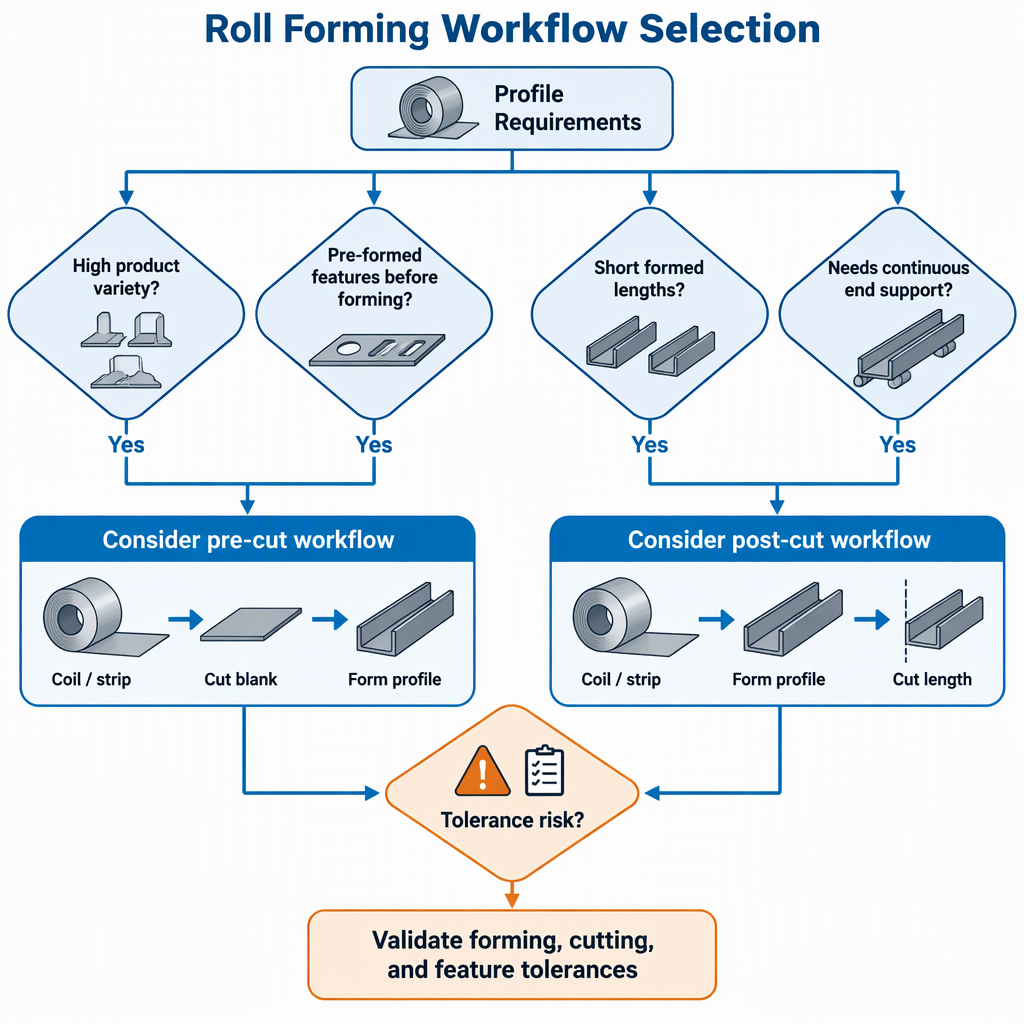
Choose pre-cut roll forming when flat-sheet operations, multi-width planning, or pre-formed features dominate the product family; choose post-cut roll forming when continuous forming support, short formed lengths, and end-quality control are the bigger risks.
What changes when the cut happens before or after forming?
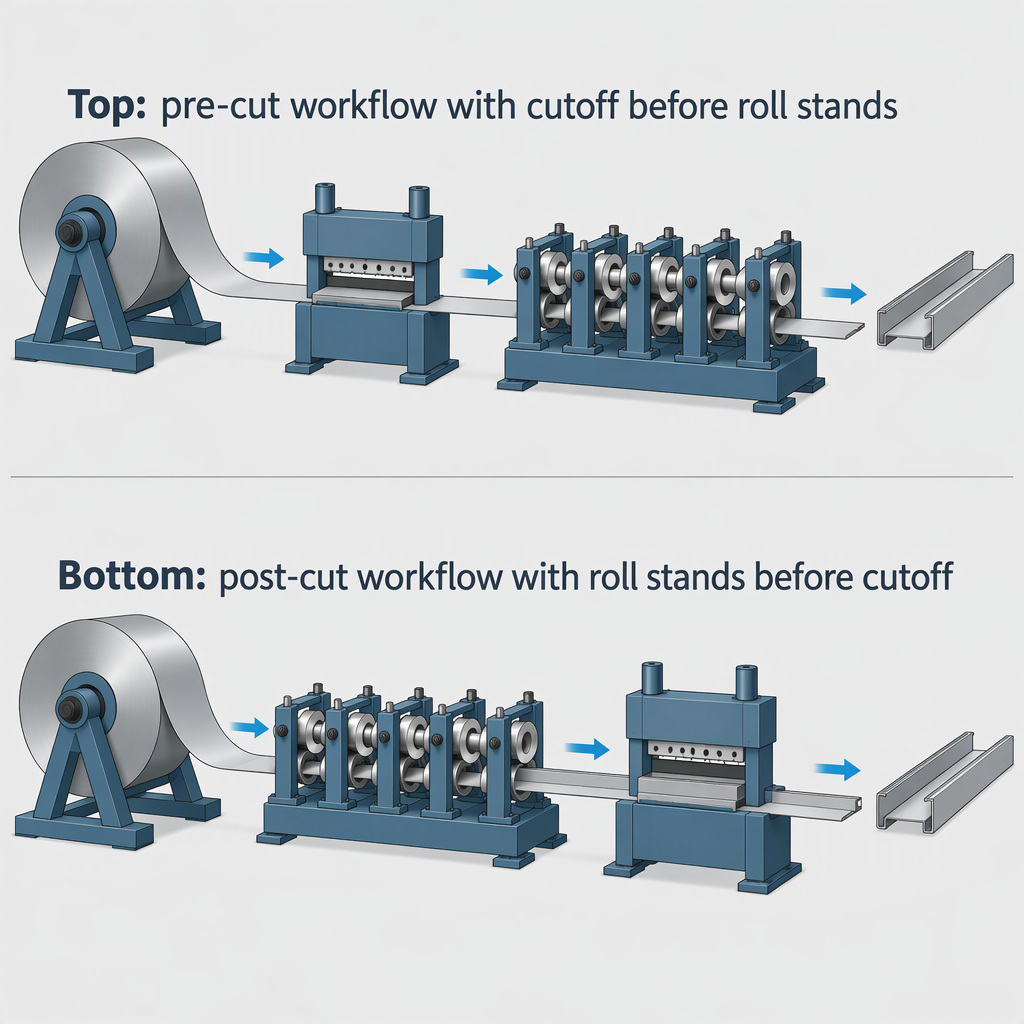
In a pre-cut workflow, the coil is cut to length before the strip enters the rollformer; in a post-cut workflow, the strip is formed first and then a profile shear cuts the finished section.
Roll forming itself is a continuous bending process: flat sheet or strip is fed longitudinally through successive paired roller dies, which gradually bend the material into the required cross-section. Technical guidance from AHSS Insights on roll forming also notes that feeding, forming, and cutting can be combined with in-line operations such as notching, slotting, punching, embossing, and curving.
Pre-cut line logic
The flat strip is measured and cut first, so the rollformer receives individual blanks instead of one continuous coil stream.
This makes the upstream cutting decision part of the product recipe, especially where blank length, flat-end conditions, or pre-form features matter.
Post-cut line logic
The coil runs through the roll stands continuously, and the finished profile is cut after forming by a shear shaped for that profile.
This places more importance on profile-shear tooling, but it can keep the part supported through the forming operation until the final cut.
When pre-cut roll forming fits best
Pre-cut roll forming fits best when the product plan benefits from cutting while the material is still flat, especially for families that need flat-sheet preparation before forming.
Good-fit applications
Pre-cut can be attractive when the line must accommodate multiple profiles or frequent width variations without making every decision depend on a formed-profile shear.
It also belongs in the discussion when notching, punching, slotting, or other in-line operations must be coordinated with the forming sequence.
Buyer questions
Ask whether the product family gains more from flat cutting and blank handling than it loses from feeding individual cut pieces through the forming stands.
Also ask how the supplier manages end flare and part control after the leading and trailing ends are no longer supported by a continuous strip.
When post-cut roll forming fits best
Post-cut roll forming fits best when continuous material support through the roll stands is more important than cutting the blank while it is flat.
Good-fit applications
Post-cut layouts are commonly considered for short formed sheets and product types where cutting after forming helps manage end condition and handling concerns.
They can be a strong option when one formed profile runs repeatedly enough to justify a profile-specific cutoff approach.
Buyer questions
Ask how many distinct profiles need their own cutoff tooling, how changeover is handled, and whether the shear design matches every profile in the intended product family.
For purchasing, the key tradeoff is not simply machine count; it is whether the downstream profile cut reduces the most expensive quality and handling risks for that product.
How product variety affects the choice
A varied product family often pushes the decision toward the workflow that reduces the number of profile-specific constraints in the line.
Product-variety condition
Pre-cut implication
Post-cut implication
Many profiles in one planning group
May reduce dependence on a separate formed-profile shear for every profile, depending on the line design.
May require more attention to profile-shear tooling and changeover planning.
Frequent width variation
Can be useful where flat blank preparation is central to the product strategy.
Can still work, but the buyer should confirm shear and guide compatibility across the width range.
Features made before or during forming
Coordinate cutoff, punching, notching, slotting, and forming order before finalizing the line concept.
Confirm whether those operations are practical before the final profile cut and whether registration stays controlled.
For metal building products, variety is often a bigger selection driver than the name of the workflow. A stable, high-volume profile may justify a dedicated post-cut approach, while a family with many widths or feature combinations may deserve a deeper pre-cut review.
How part length and short-sheet production affect the choice
Short formed lengths tend to make handling, threading, and end condition more important, so they should be evaluated early rather than treated as a minor scheduling issue.
Length-related question
Why it matters
Workflow signal
Will very short blanks enter the rollformer?
Short pre-cut blanks can create practical feeding and support questions inside the forming stands.
Consider whether post-cut better supports the material until forming is complete.
Are soffit, wainscot, ridge cap, or other short sections in scope?
Short formed parts were identified as a decision factor for post-cut line evaluation.
Require the supplier to show how the line handles the shortest commercial part.
Does length change frequently?
Frequent length changes affect measuring, cutting, and recipe control in either workflow.
Compare control logic and validation samples, not only the mechanical layout.
Tolerance and end-quality risks to validate early
Validate end flare, twist, bow, camber, springback sensitivity, and cutoff quality before choosing the workflow, because these risks can outweigh a simple layout preference.
Roll forming changes shape gradually through successive tooling passes, so material properties, roll design, and any added operations should be reviewed together rather than as isolated purchasing line items.
Springback is an elastic recovery effect after bending and can create dimensional differences between a formed part and its intended geometry; the PLOS One springback study is useful as general forming context, not as a direct rule for architectural roll forming line selection.
When controls or hybrid layouts change the answer
Modern controls and hybrid layouts can narrow the difference between pre-cut and post-cut, but they do not remove the need to validate the product family against the actual line concept.
Option to discuss
What it may help with
Buyer limitation
Servo or closed-loop controls
May improve coordination of measuring, cutting, and line motion.
Controls do not eliminate mechanical limits, tooling needs, or material response.
Anti-flare or end-control fixtures
May help manage end-quality concerns that influence pre-cut decisions.
Confirm the solution on the actual profile and length range.
Lines with both shear concepts
May support a broader product mix where one workflow is not enough.
The added layout must be justified by real product variety, not by a vague desire for flexibility.
The practical question is whether the added control or hybrid capability solves a defined product problem: short parts, multiple profiles, end flare, changeover pressure, or feature registration.
RFQ checklist for choosing the workflow
Before requesting a quotation, describe the product family in enough detail for the supplier to evaluate forming sequence, cutoff location, material behavior, and in-line operations together.
List every profile, width, and length family, including the shortest formed parts and any products that may need their own profile shear.
Define the material range, including grade, thickness, coating considerations, and any forming-sensitive features that must remain stable.
Map all operations that may happen in line, such as punching, notching, slotting, embossing, curving, forming, and cutoff.
Ask how the proposed workflow manages end flare, twist, bow, camber, and cutoff quality on the most difficult part, not only on the easiest sample.
Request a tooling and changeover explanation for every major profile or width variation in the intended product family.
Ask whether controls, fixtures, or a hybrid layout are being proposed to solve a specific product risk, and require the supplier to name that risk clearly.
Keep price, speed, and delivery comparisons separate from workflow selection unless the supplier provides line-specific documentation for the quoted configuration.
Conclusion
The best workflow is the one that controls the most difficult product condition with the least unnecessary tooling, handling, and changeover complexity.
Choose pre-cut when flat cutting, product variety, or pre-form features are central to the production plan.
Choose post-cut when continuous forming support, short formed lengths, and end-quality control are the stronger priorities.
Review material, tooling, in-line operations, and cutoff location as one process system.
For a serious equipment purchase, do not ask which workflow is universally better. Ask which workflow best fits the actual profile family, length range, feature plan, and validation samples you need to make.
FAQs about pre-cut vs. post-cut roll forming
These questions help manufacturers and process engineers turn the comparison into a practical specification discussion.
What is the main difference between pre-cut and post-cut roll forming?
Pre-cut lines cut the strip before forming, while post-cut lines form the profile first and then cut the finished section with a profile shear.
Which workflow is better for multiple profiles?
Multiple profiles often make pre-cut worth evaluating because the buyer may want to reduce dependence on profile-specific cutoff tooling, but the final choice should still reflect the actual profile mix and changeover plan.
Which workflow is better for short sheets?
Short formed lengths often favor a post-cut review because the material can stay continuous through forming before final cutoff.
Does pre-cut always cause end flare?
No single statement fits every line, but end flare and end-quality control are important pre-cut validation topics and should be checked on the actual profile and length range.
Why does post-cut need special attention to the shear?
Because the cut happens after the profile is formed, the shear must match the formed geometry and the intended product family.
How does springback affect the decision?
Springback is an elastic recovery effect after bending, so it belongs in the dimensional-control review for any forming workflow, but it should be validated with the actual material and profile rather than assumed from a general rule.
Can a hybrid line use both approaches?
Hybrid concepts may be considered when the product family has genuinely different workflow needs, but the added complexity should be tied to a clear production reason such as profile variety, short lengths, or end-quality control.
What should be included in an RFQ?
Include profiles, widths, lengths, material range, feature operations, cutoff expectations, and sample-validation requirements so the supplier can evaluate the whole roll forming process rather than a cutoff choice alone.
Founded in 1992, BMS Machinery joined XIAMEN BMS GROUP in 2017. Our manufacturing network in China includes 8 factories, 6 machining centers and 1 steel structure company, covering over 30,000 m². Supporting credentials include ISO9001:2015 quality management certification and SGS-issued CE/UKCA machinery compliance verifications. XIAMEN BMS GROUP’s Dun & Bradstreet D‑U‑N‑S Number is 55-379-8879.