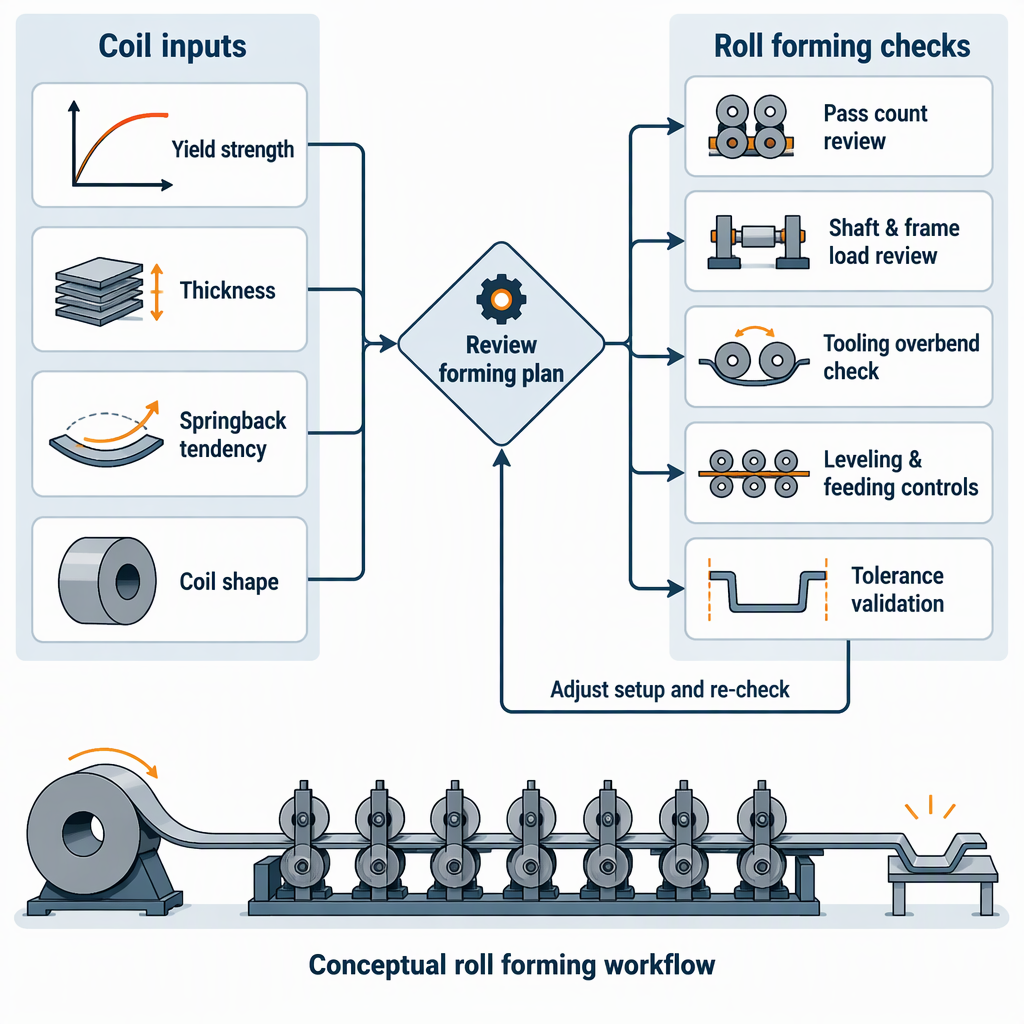
Coil material properties should be treated as machine-selection inputs, not only purchasing data: steel grade and thickness affect forming load and pass design, higher yield strength and work hardening increase springback risk, and coil-shape conditions such as camber, crossbow, coil set, and center buckle can affect dimensional stability before the strip reaches the forming stands.
Why coil properties change roll forming machine requirements
Machine selection for roll forming changes with coil properties because the line must incrementally bend the strip through successive roll dies while keeping force, alignment, profile complexity, and dimensional control within the process window.
The AHSS Guidelines roll forming guidance describes roll forming as a process that uses successive roller dies to form coil or strip into the final profile, with the number of roll pairs depending on sheet grade, profile complexity, and mill design.
For equipment buyers, that means a coil change is not just a raw-material substitution. A higher-strength coil can require more forming force, a different pass schedule, stronger tooling support, and a closer look at shaft, frame, and drive assumptions. AHSS guidance also notes a rule of thumb that force is proportional to material strength and to thickness squared, so small thickness changes can matter when the grade is already demanding.
Yield Strength, Springback, and Dimensional Control
Yield strength matters because permanent forming begins only after the material exceeds its yield point, and higher yield strength is a core input when estimating relative springback.
The AHSS Guidelines definition of yield strength explains yield strength as the stress level at which plastic deformation begins, and it connects yield strength to springback estimation.
The AHSS Guidelines springback guidance describes springback as elastic stress relief after forming and notes that springback increases with higher steel yield strength and work hardening or flow stress.
Lower-strength or familiar coil range
When yield strength and work hardening are lower, springback risk is generally easier to control for the same part shape and thickness.
Machine discussions can focus on normal pass design, tolerance expectations, and whether the same coil range has already been proven on similar profiles.
Higher-strength or new coil range
When yield strength and flow stress rise, springback can become a larger dimensional accuracy issue after forming.
Machine discussions should include overbend strategy, roll design margin, trial planning, and how the supplier will validate profile dimensions across coil lots.
Yield-strength variability also matters: AHSS roll forming guidance identifies yield strength and flow stress as important steel characteristics for dimensional control, and limited yield-strength variability supports more consistent part dimensions and pre-pierced-hole locations.
Thickness, Bend Radius, and Forming Load
Thickness and bend radius affect equipment requirements because forming load rises with thickness, while tight or complex bends can increase the number of passes and the precision required from roll tooling.
Coil or profile condition
Machine-selection implication
Buyer check
Higher material strength
Higher forming forces may act on rollers and frames.
Ask how the quoted line accounts for the grade range, not only nominal thickness.
Greater thickness
Forming force can increase sharply because AHSS guidance notes a strength-and-thickness-squared relationship as a rule of thumb.
Confirm shaft, frame, drive, and tooling assumptions for maximum thickness.
More complex profile geometry
More roll pairs may be needed depending on sheet grade, profile complexity, and mill design.
Review the proposed pass count and forming sequence before purchase approval.
Springback-sensitive bend geometry
Dimensional recovery after forming may require compensation in tooling and setup.
Ask how overbend, trial parts, and tolerance validation will be handled.
Coil Shape, Flatness, and Feeding Stability
Procurement should check coil shape and flatness because incoming strip imperfections can become feeding, alignment, and finished-profile problems even when grade and thickness look correct on the material order.
Screen incoming coil for shape conditions such as center buckle, coil set, crossbow, and camber before treating the coil as suitable for a precision roll forming line.
Connect the observed shape condition to likely profile deviations, because AHSS guidance links coil-shape imperfections with possible bow, twist, flare, center wave, and edge wave in roll formed products.
Decide whether the line needs stronger incoming-material controls, leveling capability, improved feeding support, or a tighter agreement with the coil supplier.
For pre-pierced parts, review whether coil variation could move hole locations after forming, especially where yield-strength consistency and dimensional repeatability are important.
Selection Decision Table for Coil-Driven Requirements
Use coil data to drive the specification conversation: each material property should lead to a specific machine, tooling, feeding, or validation question before the buyer compares offers.
Coil input
Why it matters
Specification question to ask
Yield strength
Permanent deformation begins after yield strength is exceeded.
What grade range was used to size tooling support, forming sequence, and dimensional trials?
Springback tendency
Springback increases with higher yield strength and work hardening for comparable part conditions.
How will the tooling compensate for springback, and how will dimensions be checked after forming?
Thickness range
Forming force is strongly affected by thickness as well as material strength.
Is the line specified for the maximum thickness and strength combination, not just average coil thickness?
Coil shape condition
Camber, crossbow, coil set, and related imperfections can influence profile quality.
What incoming-coil limits, leveling expectations, and feeding controls are required?
Yield-strength variability
Limited variability supports more consistent part dimensions and pre-pierced-hole locations.
What coil certificate data and lot-to-lot tolerance assumptions should be shared before final design?
Coil-fed roll forming is commonly used for long profiles and complex sections, but that general process advantage does not remove the need to match coil properties with the intended profile and tolerance target.
Selection Checklist for Coil-Driven Specification Review
Before requesting or approving a roll former quote, give suppliers enough coil and profile data to check force, springback, feeding stability, and dimensional repeatability.
Provide the steel grade and yield-strength range, because yield strength defines the start of plastic deformation and affects springback estimates.
Identify whether the material family is mild steel, HSLA, AHSS, or another high-strength range, because higher yield strength and work hardening can increase springback risk.
State minimum, nominal, and maximum thickness so the supplier can review forming-load assumptions across the real coil range.
Share the profile drawing, bend radii, and tolerance targets so pass count and roll design can be discussed against profile complexity.
Describe known coil-shape issues such as camber, crossbow, coil set, or center buckle, and ask what incoming-coil controls are required.
If the strip is pre-pierced, provide hole locations and tolerance targets so the supplier can consider dimensional stability after forming.
Ask how springback compensation will be proven, including trial parts, measurement points, and acceptance criteria.
Confirm that the quote addresses the strongest and thickest planned coil combination rather than a convenient nominal case.
Conclusion
The safest buying approach is to translate coil properties into machine requirements before comparing roll forming offers.
Strength, thickness, profile complexity, and mill design influence the forming sequence and the load that rollers and frames must carry.
Yield strength and work hardening influence springback, so dimensional-control planning should be part of the tooling discussion rather than an afterthought.
Coil shape and lot-to-lot consistency also deserve attention because strip imperfections and yield-strength variation can affect finished-profile quality.
Start the specification review with real coil data, not only product category.
Ask suppliers to check maximum strength and thickness together.
Include springback, coil shape, and tolerance validation in the purchase discussion.
FAQs about roll forming coil properties
These buyer questions help turn roll forming coil properties into practical equipment-selection checks.
Can one roll forming line run mild steel, HSLA, and AHSS coils without changes?
Do not assume that it can. Higher yield strength and work hardening can increase springback, so the same line and tooling approach may need review when the material family changes.
Which coil property should procurement check first?
Start with yield strength, thickness range, and the full grade specification. Yield strength defines when plastic deformation begins, while thickness affects forming load.
Why is thickness more than a simple capacity number?
Thickness interacts with strength. AHSS roll forming guidance notes a rule of thumb that force is proportional to strength and thickness squared, so the maximum strength-and-thickness combination should be checked.
How does springback affect tooling decisions?
Springback is elastic recovery after forming. When springback risk rises, the tooling discussion should include overbend, trial validation, and measurement of finished dimensions.
Why do camber, crossbow, and coil set matter?
These incoming coil-shape conditions can influence roll forming and may contribute to bow, twist, flare, center wave, or edge wave in the finished profile.
Should pre-pierced holes be discussed before machine selection?
Yes. AHSS guidance links consistent yield strength with stable dimensions and pre-pierced-hole locations, so hole patterns and tolerance targets should be included in the specification review.
What should a buyer ask when future coil grades may change?
Ask the supplier to define the approved grade, thickness, and profile range for the quoted line, and request a review before adding a stronger or thicker coil to production.
Founded in 1992, BMS Machinery joined XIAMEN BMS GROUP in 2017. Our manufacturing network in China includes 8 factories, 6 machining centers and 1 steel structure company, covering over 30,000 m². Supporting credentials include ISO9001:2015 quality management certification and SGS-issued CE/UKCA machinery compliance verifications. XIAMEN BMS GROUP’s Dun & Bradstreet D‑U‑N‑S Number is 55-379-8879.