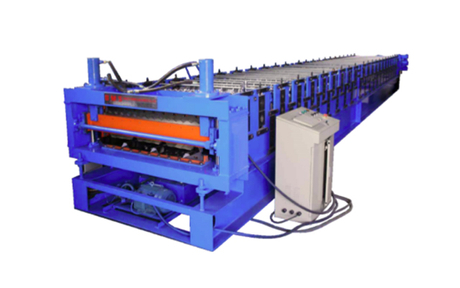


Twist and bow in roll-formed profiles should be diagnosed as separate shape symptoms, because roll-forming defects including vertical bow, horizontal bow, and twist are associated with non-uniform longitudinal strain across the profile cross-section.
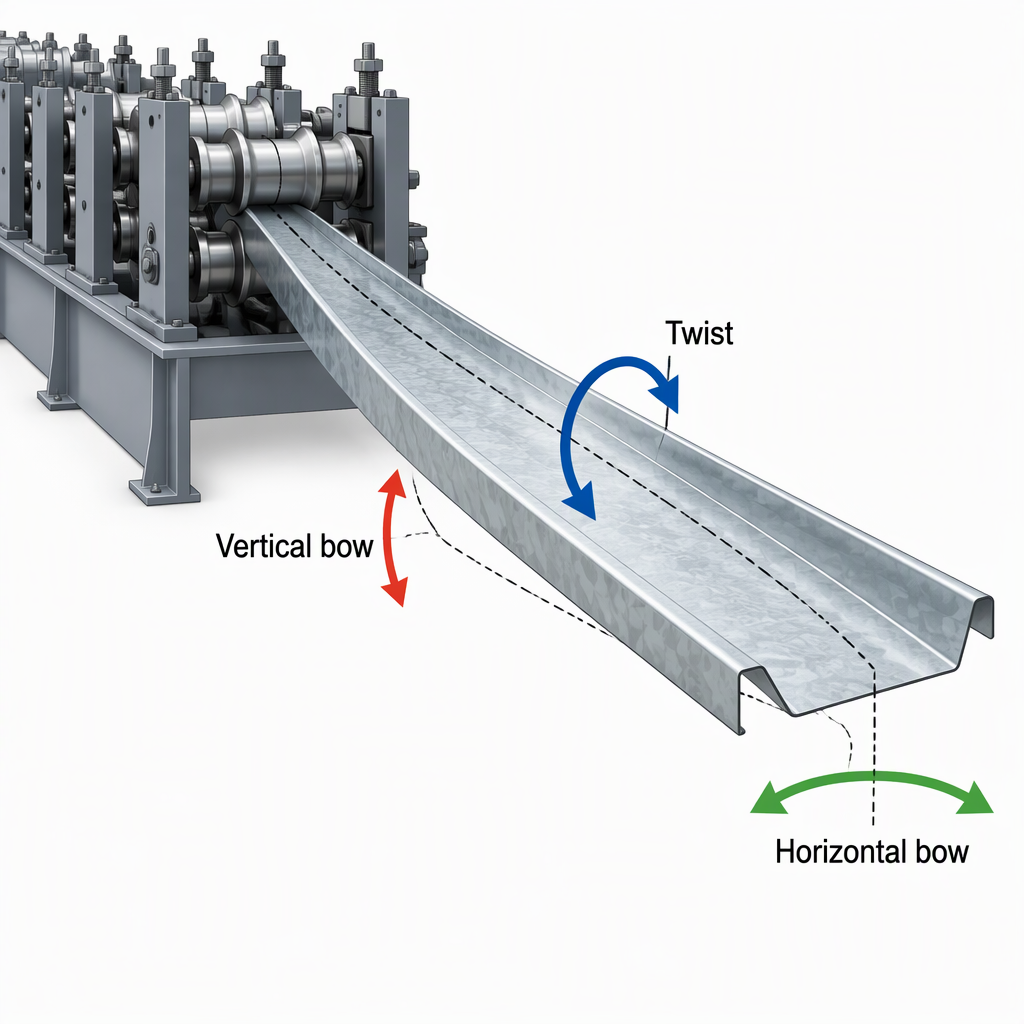
Twist and bow are different symptoms, not one defect
Twist is a rotation of the profile along its length, while bow is a lengthwise curvature; treating them as separate symptoms helps engineers choose the right measurements before adjusting a roll-forming line.
In roll forming, flat strip is progressively shaped into a profile, and the final part can show vertical bow, horizontal bow, twist, or a combination of these defect forms. For metal building profiles, that distinction matters because a roof, wall, purlin, rail, or frame component may look straight from one viewing direction while still rotating along its length.
| Symptom | What the buyer or engineer sees | Diagnostic implication |
|---|---|---|
| Vertical bow | The profile curves upward or downward along its length. | Check whether the measurement method captures height variation consistently along the part. |
| Horizontal bow | The profile curves sideways when viewed in plan. | Check side-to-side deviation separately from vertical curvature. |
| Twist | The profile rotates around its length, so flanges or webs do not keep the same angular orientation. | Record angular change along the profile instead of assuming the problem is only lateral or vertical bow. |
Why twist and bow point to longitudinal strain imbalance
Twist and bow are not just cosmetic observations: a roll-forming study ties vertical bow, horizontal bow, and twist to inhomogeneous longitudinal strain distribution across the profile cross-section.
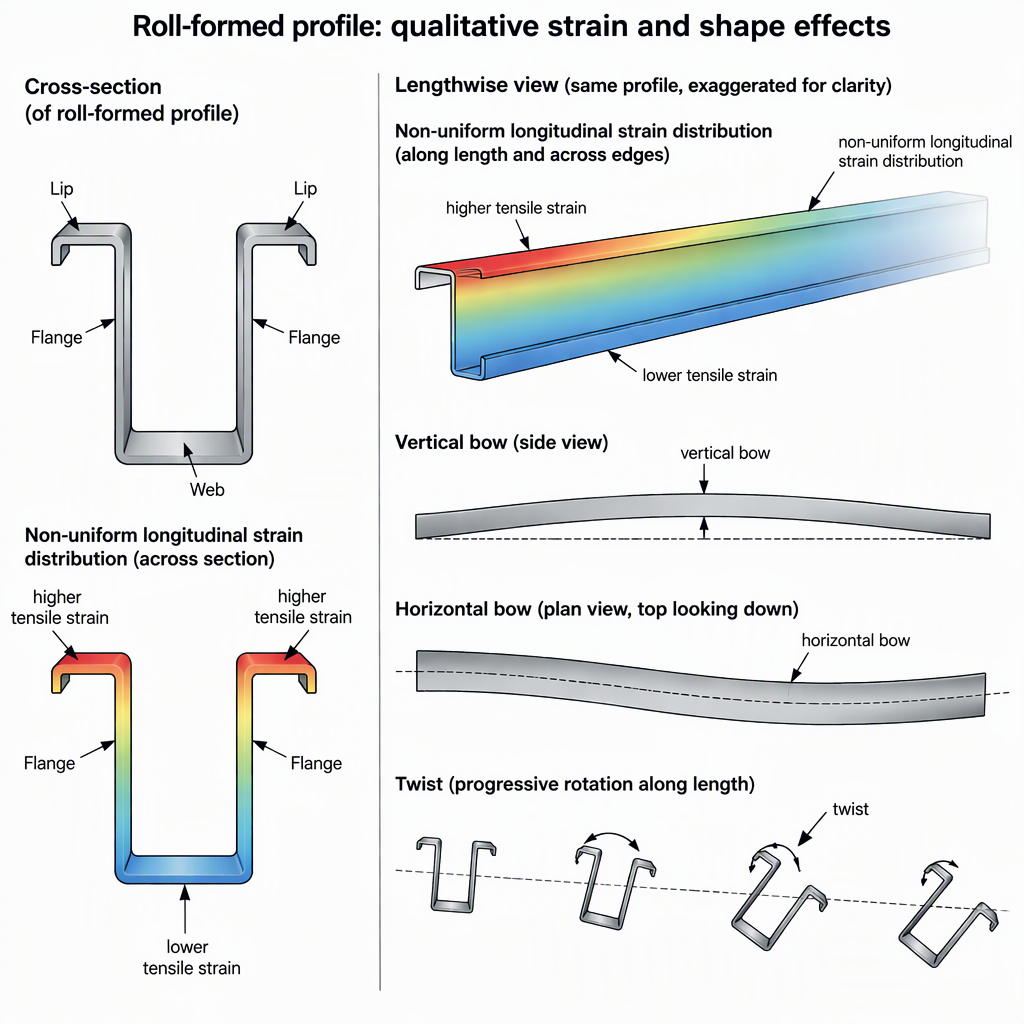
A study in the International Journal of Material Forming investigates the relationship between profile defects and inhomogeneous longitudinal strain distribution in roll forming.
The same work presents an analytical model that uses cross-section geometry together with horizontal bow, vertical bow, and twist curves to calculate longitudinal strain distribution.
For a process engineer, the practical lesson is to avoid changing one stand, shim, guide, or straightener setting based only on the most visible distortion. The measured shape along the length of the part is part of the diagnosis, because the strain pattern can vary across the cross-section.
A practical diagnosis workflow before changing the mill
Before changing tooling or straightening settings, measure the profile shape consistently along its length and separate vertical bow, horizontal bow, and twist observations.
- Define the profile orientation and datum surfaces before measurement, so every sample is checked the same way.
- Record vertical bow, horizontal bow, and twist separately along the length of the profile.
- Compare the measured curves with the cross-section geometry rather than relying on a single end-of-part observation.
- Review the forming sequence, because roll forming uses successive paired roller dies and incremental bends through the line.
- Check material grade, finished-part complexity, mill design, forming force requirements, number of stands, springback behavior, tooling condition, and material strength as process-control inputs.
- Confirm acceptance limits against the customer drawing or internal quality plan before judging twist or bow.
- Separate first-piece setup checks from ongoing production checks so drift is not confused with an initial setup error.
- Before any manual access to a powered mill, straightener, guard area, roll stand, or drive-side component, switch off and disconnect the relevant electrical, hydraulic, pneumatic, or battery power source, apply the site lockout procedure, and follow the model manual for permitted access only.
- Document which adjustment was changed and which symptom changed afterward; otherwise a later equipment or tooling decision may be based on coincidence rather than diagnosis.
Decision table: likely source, check, and corrective direction
Start with the factor that best matches the defect pattern: material behavior, profile geometry, forming sequence, tooling condition, and mill design all affect roll-forming dimensional control.
AHSS Guidelines describes roll forming as a sequence of incremental bends through successive paired roller dies and identifies grade, part complexity, mill design, force requirements, stand count, springback, worn tooling, and material strength as relevant process factors.
| Observed pattern | Check first | Corrective direction |
|---|---|---|
| Vertical bow or horizontal bow dominates while twist is minor. | Confirm whether curvature is measured in the correct plane and whether it changes along the length. | Review forming sequence, straightening strategy, and profile support before changing multiple stands. |
| Twist appears with bow rather than alone. | Check for cross-section strain imbalance indicators by comparing shape measurements across the profile. | Prioritize symmetric setup checks, roll alignment review, and controlled test adjustments rather than treating the part as simple side bow. |
| Defects change after material grade or strength changes. | Review material strength, grade, springback, and forming force requirements. | Reassess pass design assumptions, stand loading, and available forming margin for the selected material. |
| Defects grow on complex or high-forming profiles. | Review finished-part complexity, mill design, and number of stands. | For equipment selection, ask whether the proposed line configuration supports the profile complexity and material range, rather than comparing machines only by nominal profile size. |
| A line that previously ran acceptably begins producing more distortion. | Check worn tooling and setup repeatability. | Inspect permitted tooling surfaces and alignment under the site safety procedure before assuming a new equipment purchase is required. |
Applicability boundaries for engineers and equipment buyers
This troubleshooting logic applies best when the buyer can measure the profile shape along its length and compare the symptoms with cross-section geometry and roll-forming process conditions.
The strain-imbalance explanation directly supports diagnosing vertical bow, horizontal bow, and twist as related roll-forming profile defects.
The process-control explanation directly supports checking material grade, springback, tooling wear, part complexity, mill design, force requirements, and stand count when selecting or adjusting a roll-forming process.
The same logic becomes weaker when the profile geometry, sampling method, or production condition does not match the assumptions behind the measurement approach. In that case, buyers should request the applicable drawing, tolerance method, material information, and supplier procedure before approving tooling changes or equipment selection.
Conclusion: diagnose first, then select the correction path
The safest purchasing and process decision is to diagnose twist and bow as measured shape symptoms before choosing tooling, setup, straightening, maintenance, or equipment changes.
For metal building manufacturers and cold-roll-forming engineers, the next step is a disciplined comparison between the observed defect pattern and the process inputs that control forming: material, springback, profile complexity, tooling condition, mill design, stand count, and forming force requirements.
- Separate vertical bow, horizontal bow, and twist before deciding on corrective action.
- Use longitudinal shape measurements to support diagnosis, while respecting the limits of model-based interpretation.
- For equipment selection, connect the defect pattern to material range, profile complexity, tooling strategy, stand count, and mill design.
FAQ: Diagnosing twist and bow in roll-formed profiles
These buyer questions help separate measurement, process diagnosis, and equipment-selection decisions.
What is twist in a roll-formed profile?
Twist is rotational distortion along the length of the profile, so the cross-section does not keep the same angular orientation from end to end.
What is bow in a roll-formed profile?
Bow is lengthwise curvature. It may be vertical bow or horizontal bow, so the measurement plane should be recorded.
Why should twist and bow not be treated as one defect?
They are different profile-defect forms, and separating them helps the engineer connect the visible symptom with the likely strain and process condition.
What should be measured before adjusting tooling?
Measure vertical bow, horizontal bow, and twist along the profile length and relate those measurements to the cross-section geometry before changing the mill setup.
Can material changes increase twist or bow risk?
Yes. Material grade, strength, and springback affect roll-forming process control and dimensional behavior, so a material change should trigger a process review.
How does twist and bow diagnosis help equipment procurement?
It turns a visible defect into supplier questions about mill design, number of stands, forming force requirements, tooling strategy, material range, and part complexity.
Is there one universal acceptable twist or bow limit?
Use the drawing, contract, customer quality plan, or applicable project specification for acceptance limits. General roll-forming guidance helps diagnosis, but it does not replace a profile-specific tolerance requirement.