


Quote trap: headline price only
A low initial price can look attractive when the evaluation ignores lifecycle cost, missing scope, and criteria that are not measurable.
Views: 0 Author: Site Editor Publish Time: 2026-11-30 Origin: Site

Compare roll forming machine quotations by first making every supplier quote the same line scope: coil feeding, forming stands, tooling, cutoff, and any inline punching, notching, embossing, slotting, or curving. Then evaluate the offers with clear, measurable criteria and lifecycle-cost thinking, rather than awarding the project on the lowest machine price alone. For capital equipment, include supplier-risk and total-cost factors such as freight, tariffs, longer lead times, inventory, overhead, and business risk.
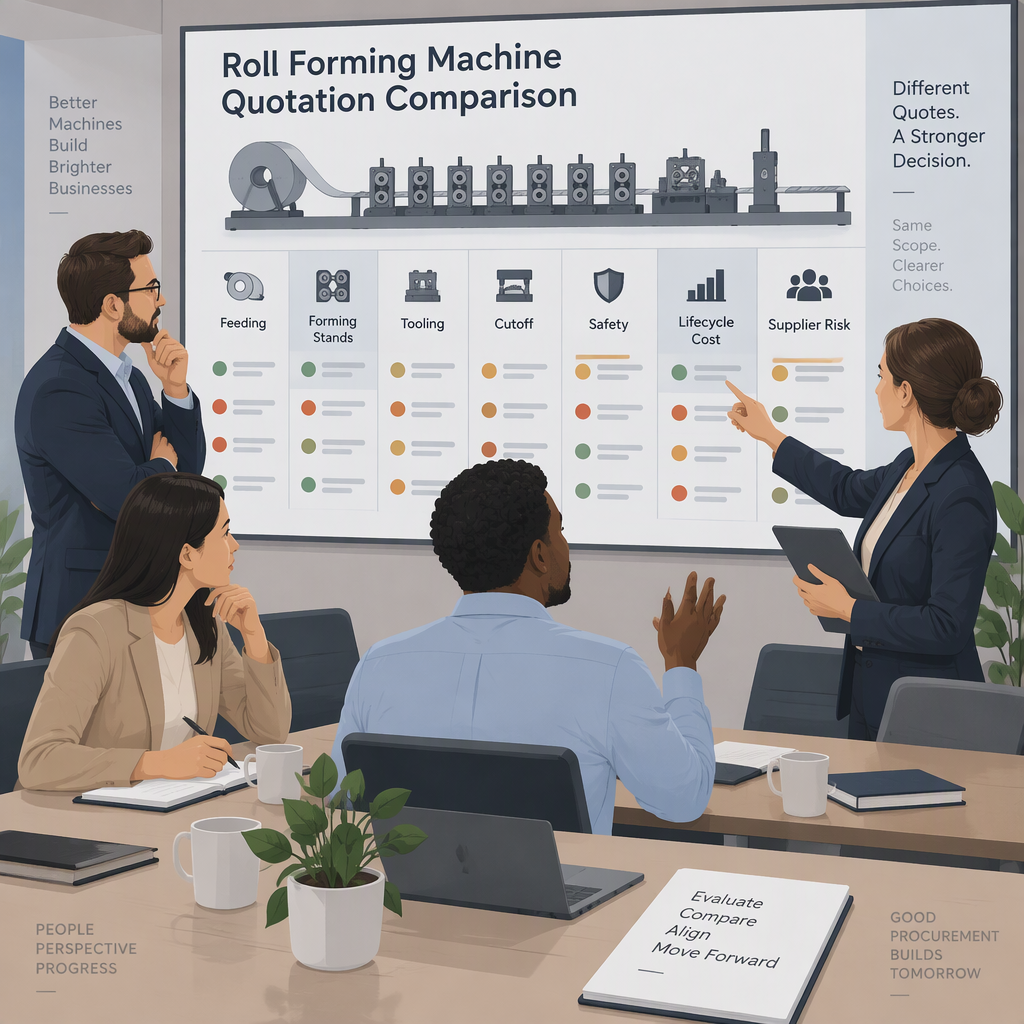
The fastest fair comparison is to convert every offer into the same RFQ scope, then compare measurable technical, commercial, safety, and supplier-risk criteria.
A low initial price can look attractive when the evaluation ignores lifecycle cost, missing scope, and criteria that are not measurable.
A normalized scope asks each supplier to state the same line functions, including coil feeding, forming, cutting to length, and any inline processes required by the profile.
A roll forming quotation should be compared as a complete line configuration, because the process feeds flat strip through successive paired rollers and may include upstream, forming, cutoff, and inline operations.
| Quotation line item | What to compare | Why it changes the quote |
|---|---|---|
| Coil feeding and entry equipment | Coil handling, feeding, guiding, and strip preparation responsibilities | A continuous roll forming line can include coil feeding before the forming section. |
| roll forming stands | Number of stands, station spacing, shaft size basis, and adjustment method | The number of roll pairs or stands depends on material grade, profile complexity, and mill design. |
| Tooling and profile set | Included roll tools, profile limits, changeover assumptions, and spare tooling options | Tooling wear, springback allowance, forming load, and maintenance assumptions can affect the design. |
| Cutoff and inline processes | Cutting to length plus punching, notching, embossing, slotting, or curving if required | roll forming lines can incorporate optional inline operations, so missing functions can shift cost outside the machine quote. |
Use the AHSS Guidelines explanation of roll forming as a process reference when deciding whether two quotations are describing the same manufacturing line, but do not treat a general process guide as proof of any individual supplier's performance.
Two suppliers can quote different stand counts or tooling designs for the same profile because material grade, finished-part complexity, forming load, springback, lubrication, maintenance, shaft diameter, and tooling wear all affect the forming plan.
The AHSS Guidelines roll forming guidance explains that the number of roll pairs or stands depends on the sheet metal grade, finished part complexity, and mill design, and that higher-strength steels can require greater forming loads and attention to maintenance and tooling wear.
| Assumption to request | Good quotation answer | Comparison risk if unclear |
|---|---|---|
| Material grade and thickness basis | Supplier states the assumed grade range and thickness range used for the forming design. | Higher strength steel can change forming loads and pass requirements. |
| Profile complexity and tolerancing basis | Supplier explains why the stand count and roll sequence fit the profile geometry. | Part complexity can affect the number of roll pairs or stands. |
| Springback and wear allowances | Supplier describes how tooling design and adjustment address springback and maintenance. | Springback allowance, tooling wear, lubrication, and maintenance influence long-term production assumptions. |
The cheapest quotation should not automatically win, because total cost of ownership can include costs beyond purchase price, including freight, tariffs, longer lead times, inventory, overhead, and business risks.
| Evaluation category | What to ask | How to score it |
|---|---|---|
| Measurable award criteria | Are the criteria clear, specific, proportionate, and related to the machine purchase? | Score only documented answers, not sales impressions. |
| Lifecycle cost | Which operating, tooling, maintenance, training, acceptance, and support items are included or excluded? | Compare the cost of owning and using the line, not only buying it. |
| Supplier risk | What supplier evaluation, selection, metrics, and risk checks will your team apply? | Score evidence of responsiveness, documentation, supply continuity, and support boundaries. |
| Total cost of ownership | What freight, tariffs, long lead-time effects, inventory, overhead, and business risks could apply? | Add known buyer-side cost categories before ranking final offers. |
Public procurement guidance on assessing competitive tenders supports using clear, measurable criteria and considering lifecycle cost for non-basic purchases; private buyers can use the same discipline while following their own purchasing rules.
Before accepting a roll forming machine quote, clarify the guarding, control measures, risk assessment responsibilities, installation scope, commissioning checks, and local compliance responsibilities.
The Health and Safety Executive's equipment and machinery guidance emphasizes machinery safety, suitable machines, risk assessment, and control measures; buyers should confirm the legal duties and adopted requirements for the country or site where the machine will operate.
A weighted model helps your team compare quotations consistently by scoring measurable technical fit, lifecycle cost, safety scope, and supplier risk before negotiating final terms.
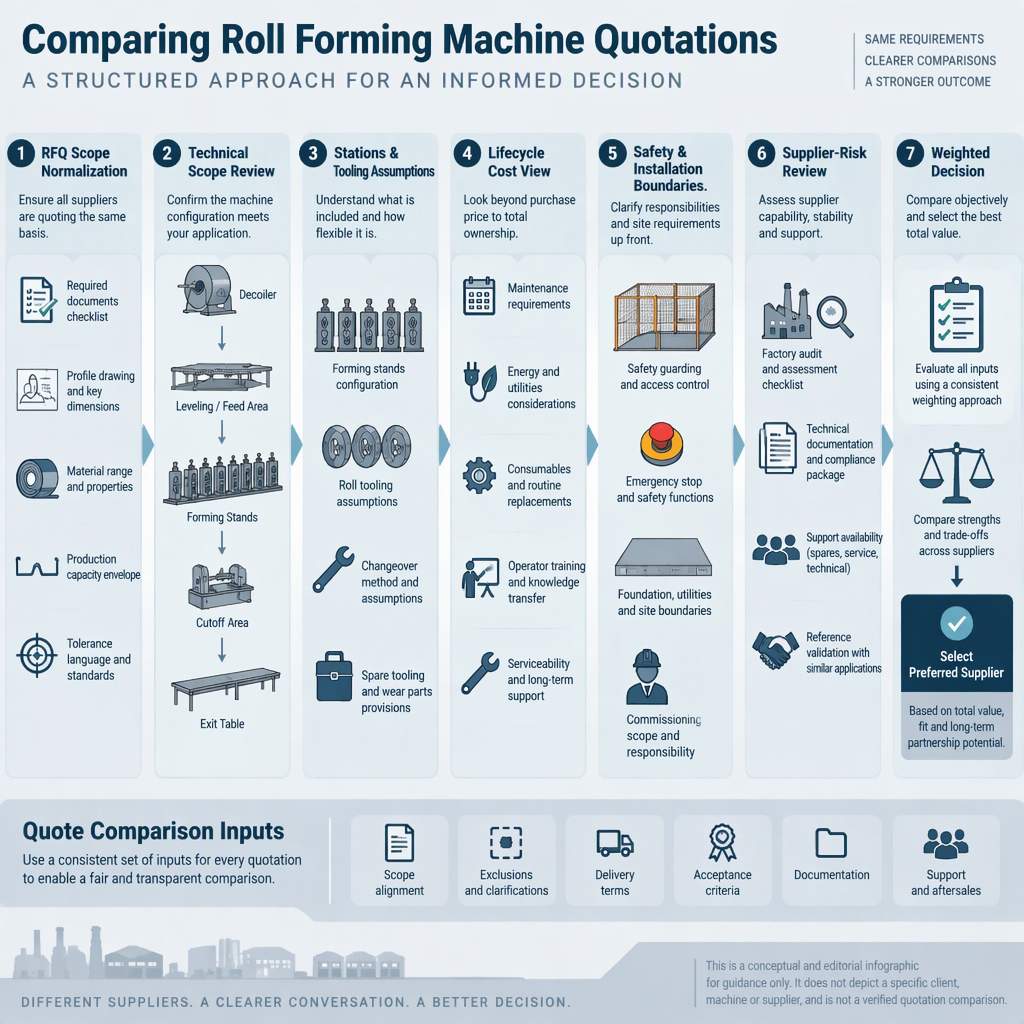
| Criterion | Suggested evidence to request | Reason to weight it |
|---|---|---|
| Line scope match | Scope matrix covering feed, forming, tooling, cutoff, and inline operations | Prevents comparing a complete line against a partial machine scope. |
| Material and tooling fit | Material assumptions, stand count explanation, tooling plan, and maintenance assumptions | Connects the quote to the actual profile and steel grade challenge. |
| Safety and installation | Guarding, controls, risk-assessment responsibilities, and commissioning scope | Reduces ambiguity before the machine reaches the installation site. |
| Supplier and TCO risk | Supplier evaluation answers, logistics assumptions, support boundaries, and TCO categories | Accounts for cost and continuity risks beyond the purchase price. |
For a complex profile or tight project constraint, assign higher weight to the criteria most related to the subject matter of the purchase.
Supplier scorecards, supplier evaluation, and supplier selection work best when the buyer asks for comparable documents and metrics.
Before placing a purchase order, confirm that the winning quotation is technically complete, commercially comparable, safety-reviewed, and supported by a supplier-risk and lifecycle-cost assessment.
Choose the roll forming machine quotation that gives the clearest fit to your profile, material, line scope, safety responsibilities, lifecycle cost, and supplier-risk requirements.
For a metal building product factory or cold roll forming engineering team, the practical decision is not simply which supplier writes the smallest number on the first page.
The stronger decision is the quote that makes technical scope, ownership cost, and supply risk visible before the purchase order is signed.
These quick answers help buyers challenge unclear quotation items before ranking suppliers.
Start by normalizing the technical scope so every quotation covers the same coil feeding, forming, cutoff, and required inline operations.
Stand count can vary because sheet metal grade, profile complexity, forming load, springback, tooling wear, maintenance, and mill design all influence the forming plan.
Not automatically. Compare total cost of ownership and supplier risk as well as purchase price, especially when freight, tariffs, lead times, inventory, overhead, or business risk may be material.
Check whether punching, notching, embossing, slotting, curving, and cutting to length are included, excluded, or priced as optional scope.
Ask about guarding, control measures, risk assessment responsibilities, installation checks, commissioning boundaries, and the local machinery-safety rules that apply at the installation site.
Use clear, measurable, specific, and proportionate criteria tied to the purchase, then score documented answers for technical fit, lifecycle cost, safety scope, and supplier risk.
Confirm the assumed steel grade, thickness range, forming loads, lubrication needs, shaft or tooling considerations, springback allowance, and maintenance expectations.


