What Does Coil Weight Mean for Decoiler Selection?
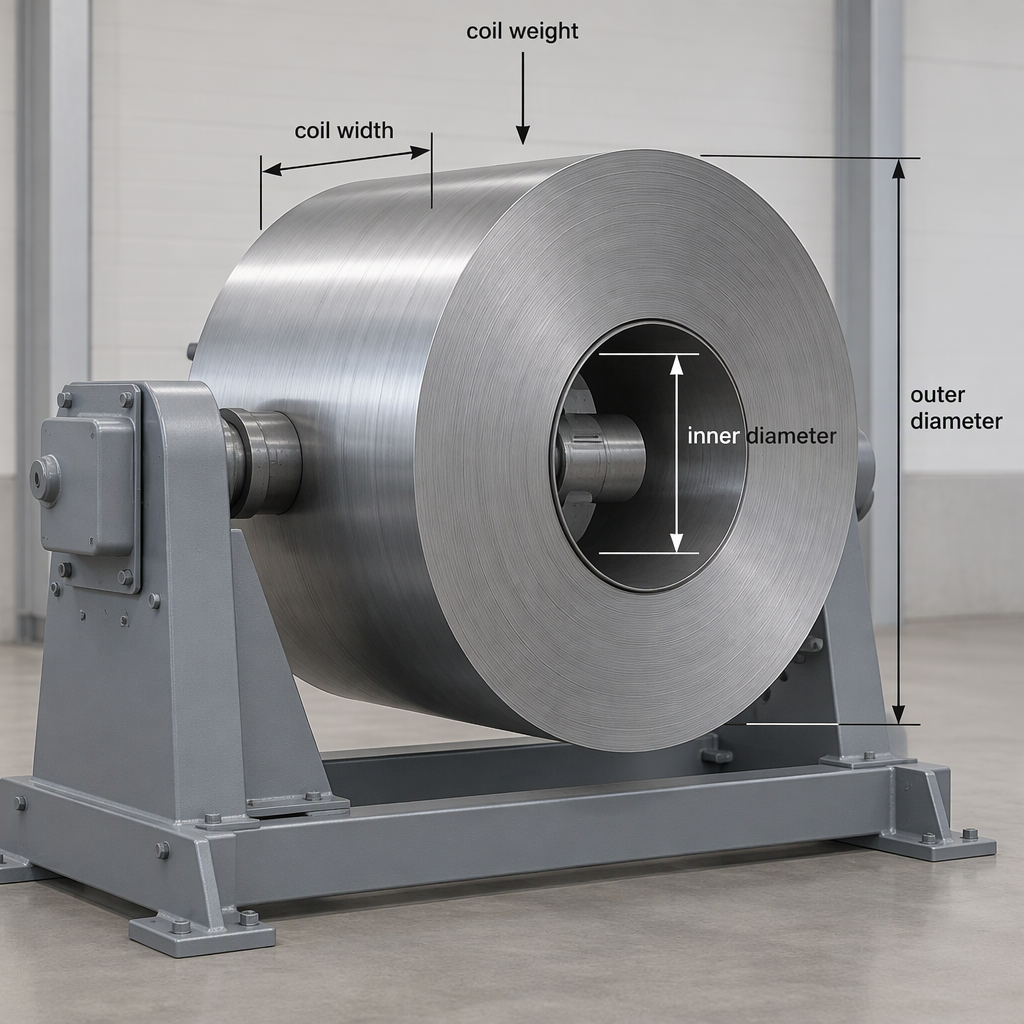
Coil weight is the mass of one coil at the line. It sets the duty on the mandrel and its expansion segments, the shaft and bearings, the base frame, the hold-back brake and every device that loads the coil. Specify the heaviest coil you will run and the lightest too, so the machine can still control a nearly empty coil.
Which Coil Data Should Be Fixed Before You Compare Decoilers?
Five dimensional ranges from your own plant make a comparison meaningful: coil weight, coil width, bore, outside diameter, and thickness with its steel grades. Record each as a minimum and a maximum with units, because a decoiler must cover the ends of every range. The loading method and the free floor space around the coil position are handling conditions rather than range values, so describe them separately.
Weigh the heaviest coil. Use coil tickets or a weighbridge, and include the heaviest coil your mill may buy over the next few years.
Note the lightest coil. Mandrel grip and hold-back control are hardest to keep stable on a short, light coil.
Record the width span. Note the narrowest and widest coil, including slit coils.
Record the bore range. Give the smallest and largest inner diameter the mandrel must expand through.
Record the outside diameter range. A full coil and a run-out coil sit at different heights and need different loading travel.
Add thickness, grade and loading method. Thickness and yield strength drive torque and brake duty; the loading method and clear floor space drive mounting height.
How Do Coil Width, Inner Diameter and Outer Diameter Change the Machine You Need?
Coil width sets the mandrel's working length and the distance to the first guide roll. The bore sets how far the mandrel expands and how the coil seats. The outside diameter sets mounting height, loading travel and the clearance the coil needs as it unwinds.
Coil dimension
What it constrains on the decoiler
What to state in the enquiry
Coil weight
Mandrel, shaft, bearings, base frame, hold-back brake and lifting duty
Heaviest and lightest coil, with units
Coil width
Mandrel working length, guide-roll spacing and guard span
Narrowest and widest coil, including slit coils
Inner diameter
Mandrel expansion range and how the coil seats
Minimum and maximum bore
Outer diameter
Mounting height, loading travel and clearance as the coil unwinds
Largest full coil, smallest run-out diameter
Strip thickness and grade
Pulling torque, hold-back brake duty and any hold-down or peeler
Thickness range and yield strength
Coil handling is usually bought as an auxiliary package with the forming line: 厦门贝姆斯集团有限公司 lists a hydraulic decoiler among its auxiliary machines and in its roll forming machine range. Ask for the model drawing showing mandrel, loading arrangement and foundation detail, and check it against your envelope, not a summary table.
What Handling Requirements Must Be Settled Alongside the Decoiler?
Settle three things before the base is fixed: how the coil is loaded onto the mandrel, how much clear floor the loader and coil stack need, and how the rotating coil and strip entry are guarded. These decisions are far cheaper in the enquiry than after the foundation is cast.
Crane and sling loading
What it needs: a crane or gantry rated for the coil plus its lifting attachment, and slings rated, edge-protected and inspected before each use.
The sling rules in 29 CFR 1910.184 require use within rated capacity, edge protection, pre-use inspection by a competent person and legible identification.
Confirm in the enquiry: crane coverage, headroom, and mandrel height against hook height.
Coil car or coil lift loading
What it needs: a floor- or pit-mounted car or lift sized for your heaviest coil and its outside diameter, travelling in line with the mandrel.
Confirm in the enquiry: rated load against your heaviest coil, travel length, and the height at which it presents the bore.
Main constraint: it needs civil work and alignment, so lay it out with the decoiler rather than adding it later.
How Do You Screen a Decoiler Specification Against Your Coil Range?
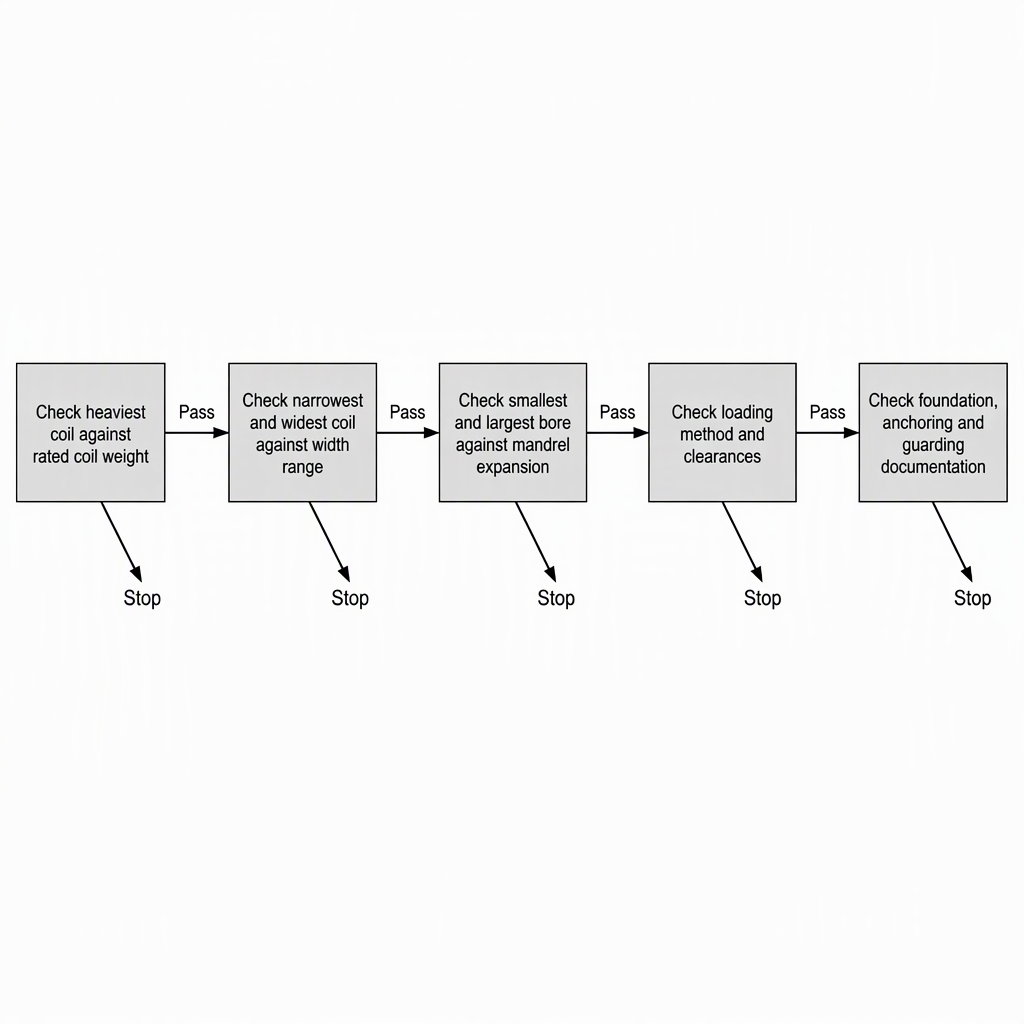
Test every written rating against your extremes: heaviest coil against the load rating, narrowest and widest coil against the width range, smallest and largest bore against the mandrel expansion, then the loading arrangement, foundation and guard documentation. The first figure that fails an extreme disqualifies the machine.
Requirement from your plant
An answer that disqualifies the machine
Documentation to request
Heaviest coil
A rating below your heaviest coil
Rated coil weight on the drawing and in the quotation
Coil width span
A range covering your usual width but not your narrowest or widest coil
Minimum and maximum coil width
Bore range
Mandrel expansion that misses your smallest or largest bore
Expansion range with coil seat dimensions
Outside diameter
A loader that cannot hold your largest or smallest coil
Coil diameter range and loader drawing
Strip thickness and grade
Drive or brake data sized only for light gauge
Torque and brake data at your heaviest, thickest coil
Loading method
No rated load for the crane interface, car or lift
Rated load of the loader and its presentation height
Site documentation
No foundation drawing, anchor detail or guard layout
Foundation and anchor-bolt drawing and guard layout
What Should a Decoiler RFQ Ask the Supplier to Confirm in Writing?
Ask for written confirmation of the rated coil weight including the lifting attachment, the minimum and maximum coil width, the bore range the mandrel expands across, the loading method with its rated capacity, and the foundation, anchoring and guarding documentation for the model. A figure that stays verbal is a risk when the machine arrives.
Rated coil weight as the maximum coil mass the mandrel and base carry, matched to your heaviest coil.
Width range as minimum and maximum, covering slit coils at both ends.
Bore range the mandrel expands across, at both ends.
Coil outside diameter range and the loading arrangement, including the rated load of the crane interface, car or lift.
Mandrel and pass-line height checked against the first roll of your forming line.
Drive and hold-back brake data for your heaviest and thickest coil.
Foundation and anchor-bolt drawing for the model being quoted.
Guard arrangement for the mandrel, rotating coil and strip entry, plus the inspection, maintenance and operator training information the team needs — HSE guidance on the Provision and Use of Work Equipment Regulations covers inspection, maintenance and training and competence of users.
The aisle, doorway and coil storage clearances the installation layout assumes.
What Is the Practical Takeaway for Decoiler Selection?
Select the decoiler from an envelope, not a headline tonnage: heaviest and lightest coil, full width span, both ends of the bore and outside diameter range, then the loading method, clearances, guarding and anchoring that envelope demands.
Write those dimensional ranges into the enquiry as minimum and maximum values and ask for each one back in writing; a machine that covers your extremes covers everything in between.
Where the decoiler belongs to a new cold roll forming line, give the same envelope to the line supplier's engineers so the decoiler, the first roll and the coil handling are designed together.
Frequently Asked Questions on Decoiler Selection
Once the coil envelope is on paper, these questions decide the remaining details: which diameter ranges to quote, whether a rating can be stretched, and what has to be fixed down.
What coil inner and outer diameter range should I state in an enquiry?
State both ends of each range: the smallest and largest bore you will run, and the largest full coil and smallest run-out coil.
Can a decoiler or its crane handle a coil heavier than the rating if the line runs more slowly?
No. A rated load is a structural limit; the crane rules prohibit loading beyond it except for test purposes, and a slower line does not reduce the weight on the mandrel or hook.
What is the difference between a decoiler and an uncoiler?
Both terms describe equipment that holds a coil and pays strip into the line. Suppliers use decoiler for a powered mandrel machine and uncoiler for simpler types, so read the description rather than the word.
Is coil width the same as the finished strip width?
The coil width you buy is the running strip width, and a slit coil is described by its slit width including the slit edges. The finished profile width is set by the roll tools.
Does a decoiler need to be anchored to the floor?
If the machine is designed for a fixed location, yes — general machine guarding rules include secure anchoring. Request the foundation and anchor-bolt drawing for the exact model.
How much space should I keep around a decoiler?
Enough for the loading path, the coil stack and the travel of the hook or coil car, with aisles clear and coils stored stable. If a jammed coil must be removed, switch the decoiler off and isolate its power supply first.
Founded in 1992, BMS Machinery joined XIAMEN BMS GROUP in 2017. Our manufacturing network in China includes 8 factories, 6 machining centers and 1 steel structure company, covering over 30,000 m². Supporting credentials include ISO9001:2015 quality management certification and SGS-issued CE/UKCA machinery compliance verifications. XIAMEN BMS GROUP’s Dun & Bradstreet D‑U‑N‑S Number is 55-379-8879.