


Roll forming material yield should be calculated as accepted output against a clearly defined input basis, not as a generic machine promise. Treat unusable excess material as scrap, separate coil lead and tail losses from usable strip length, and use the result to compare process assumptions, tooling condition, material condition, and equipment requirements before committing production expectations.
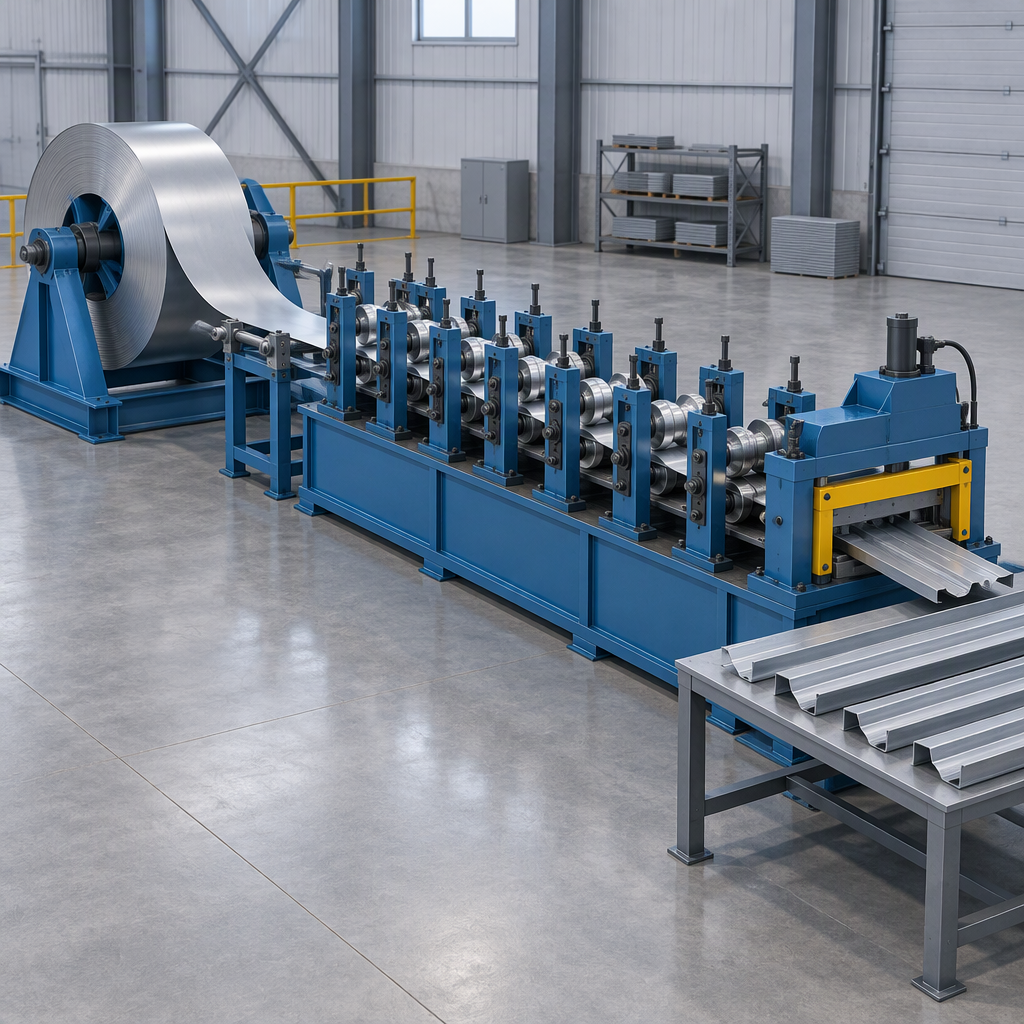
Define the calculation scope before using a yield percentage
For roll forming material yield, define whether you are measuring accepted output, first-pass accepted output, or material utilization before you calculate a percentage. Roll forming is a continuous process that feeds flat sheet or strip through successive paired roller dies, so the calculation boundary should match the actual coil-to-part flow.
A practical scope starts at coil input and ends at accepted formed parts after cutting and any inline operations that apply to the job, such as notching, slotting, punching, embossing, or curving.
Quality yield is not the same as material purchase utilization: yield focuses on outputs that meet specified requirements without rework or being scrapped, while material utilization focuses on how much of the coil becomes accepted product.
| Calculation view | Use it for | Keep out of the number |
|---|---|---|
| Quality yield | Accepted units or output that meet specified requirements without rework or scrap | Coil allocation losses that are not quality failures |
| Usable strip length | Converting net coil input into length available after unusable lead and tail are removed | Finished-part acceptance decisions |
| Scrap rate | Tracking unusable excess material generated during manufacturing | Material that can still be corrected through approved rework |
For a process overview, AHSS Guidelines describes roll forming as longitudinal feeding through roll dies and identifies process factors that can affect formed-part quality.
Review the roll forming process description from AHSS Guidelines.
Collect the inputs that make the calculation auditable
Before calculating yield and scrap, collect net coil weight, strip weight per foot, unusable lead and tail, required job length, and accepted output on the same measurement basis.
- Record net strip weight for the coil, excluding packaging or items that are not part of the strip input.
- Establish weight per foot from a measured strip sample or from width, thickness, and alloy density using consistent units.
- Record unusable lead and tail length so total coil length and usable coil length are not confused.
- Measure required job length on the same length basis used for the coil allocation calculation.
- Count accepted output only when it meets the specified quality requirements without rework or scrap.
- Classify unusable excess material as scrap rather than blending it into accepted production.
- Capture process notes on material strength, sheet thickness, springback, bend radius, tooling condition, and coil shape imperfections when they are relevant to part quality.
For metal building product production, this input list helps process engineers compare jobs with different profiles, strip widths, cut lengths, and inline operations without turning every loss into one undiagnosed percentage.
Calculate total and usable coil length
Total strip length can be calculated by dividing net strip weight by weight per foot, and usable length is the total length minus unusable lead and tail.
- Confirm the weight basis. Use net strip weight for the coil so the length calculation represents material entering the roll forming process.
- Calculate weight per foot. Use a measured strip sample when available, or calculate it from strip width, thickness, and alloy density with consistent units.
- Calculate total length. Divide net strip weight by weight per foot to estimate total lineal feet or meters in the coil.
- Subtract unusable lead and tail. Deduct the lead and tail material that cannot be used for the job to obtain usable strip length.
- Compare usable length with required job length. The difference is the job margin before quality yield and scrap classification are applied.
The coil-length arithmetic is a planning method: total length equals net strip weight divided by weight per foot; usable length equals total length minus unusable lead and tail; and job margin equals usable length minus required job length.
Use one unit system throughout. Mixing kilograms with pounds, millimeters with inches, or theoretical density with measured strip weight can make the result look precise while the underlying basis is inconsistent.
Calculate material yield and scrap rate
Calculate material yield from accepted output that meets requirements, calculate scrap from unusable excess material, and keep the numerator and denominator on the same weight or length basis.
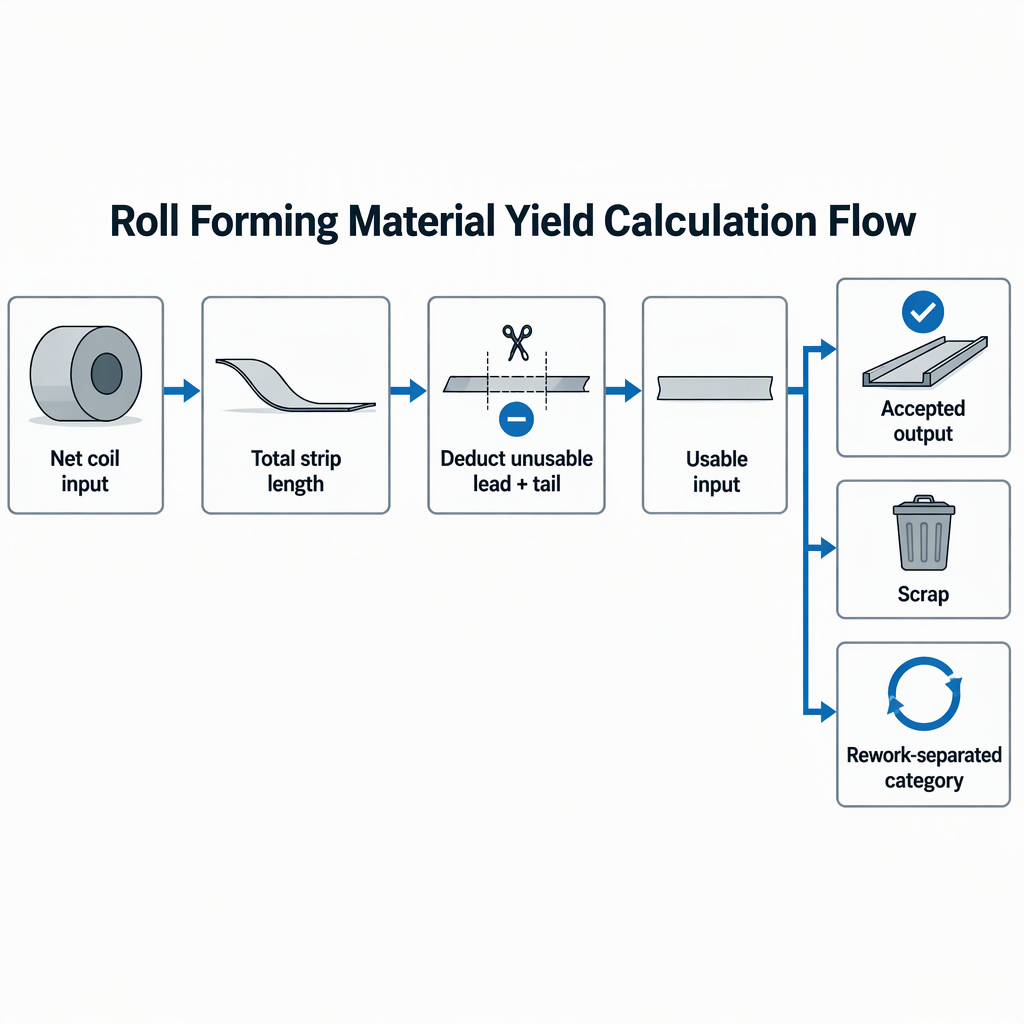
- Choose the basis. Use length when cut lengths are the clearest production record, or weight when scrap bins and coil balances are measured by weight.
- Set usable input. Start from usable strip length or usable strip weight after removing defined lead and tail allowances.
- Measure accepted output. Count only parts or output that meet the specified requirements without rework or being scrapped.
- Measure scrap. Count unusable excess material generated during manufacturing as scrap.
- Calculate the rates. Material yield equals accepted output divided by usable input, multiplied by 100. Scrap rate equals unusable scrap divided by the same usable input basis, multiplied by 100.
ASQ describes yield as the percentage of process outputs that meet specified quality requirements without rework or scrap. Read the ASQ yield glossary definition.
NIST defines manufacturer scrap as unusable excess material generated during manufacturing. Review the NIST manufacturer scrap definition.
If accepted output is recorded by length but scrap is weighed, convert one side before calculating. The formula is only meaningful when the same basis is used on both sides of the fraction.
Separate normal allowances from true scrap signals
Separate planned lead and tail deductions from scrap, then track unusable manufacturing excess as its own category so the percentage points to the right corrective action.
| Loss category | How to treat it | Why it matters |
|---|---|---|
| Lead and tail | Deduct from total coil length to calculate usable length | Prevents unavoidable unusable ends from being confused with job margin |
| Unusable manufacturing excess | Classify as scrap | Keeps true waste visible for production review |
| Output needing rework | Keep outside first-pass accepted yield until it meets requirements without rework | Avoids overstating first-pass quality performance |
| Quality issues linked to material or forming factors | Record the observed condition with the affected coil, profile, or setup | Sheet thickness, material strength, springback, bend radius, tooling condition, and coil shape imperfections can affect formed-part quality |
Do not assign one universal cause to every yield loss. Roll forming quality can be influenced by material properties, tooling condition, and coil shape, so a useful scrap log should connect the loss category to the job conditions that were present.
Use the result for process and equipment selection, not unsupported promises
Use the calculated yield to compare process fit, material condition, profile demands, and equipment requirements; do not treat it as a guaranteed scrap percentage for every roll forming line.
- Ask whether the profile requires inline operations such as notching, slotting, punching, embossing, curving, or cutting to length, because the calculation boundary should include the operations that affect accepted output.
- Review material strength, sheet thickness, bend radius, springback, tooling condition, and coil shape imperfections when repeated defects appear.
- Request that suppliers explain how they define usable coil length, lead and tail deductions, and job margin when discussing production estimates.
- Separate first-pass yield from output accepted after rework when comparing process stability.
- Keep unusable excess material in a scrap category so purchasing, engineering, and production teams can see the material loss clearly.
For equipment selection, the calculation helps frame questions about profile complexity, material range, roll tooling condition, and inline processing, but it does not replace a supplier’s project-specific proposal, trial plan, or written specification.
Conclusion
Start with a consistent coil-length basis, measure accepted output against stated quality requirements, and classify unusable manufacturing excess as scrap.
- Usable input should exclude defined lead and tail before yield and scrap rates are compared.
- Yield is a quality result, not a generic production promise.
- Material and process variables should be reviewed when yield changes between coils, profiles, or jobs.
FAQs about roll forming material yield and scrap
These answers address common calculation choices for metal building product manufacturers, cold-roll-forming engineers, and equipment buyers.
Is scrap the same as rework?
No. Scrap is unusable excess material generated during manufacturing. Rework is different because yield definitions distinguish accepted output from output that requires rework or is scrapped.
Should I calculate by weight or by length?
Either basis can work if you keep it consistent. Coil allocation can be calculated from net strip weight and weight per foot, while production teams may prefer length when cut lengths are the primary job record.
Can this article provide a standard scrap allowance for roll forming?
No single allowance should be assumed from the general process description, because roll forming quality can be affected by sheet thickness, material strength, springback, bend radius, tooling condition, and coil shape imperfections. Define scrap as unusable excess material and calculate it from your job data.
What is first-pass yield in this context?
First-pass yield focuses on output that meets specified requirements without rework or being scrapped. It is useful when you want to separate immediate process stability from later correction.
Why subtract lead and tail before calculating yield?
Lead and tail are deducted to move from total coil length to usable coil length. If they remain in the denominator, the calculation can understate the usable material actually available for the job.
How does profile complexity affect the calculation?
Profile complexity can change the calculation boundary when inline operations such as punching, notching, embossing, curving, or cut-to-length steps are part of the job. Include the operations that determine whether output is accepted.
How should equipment buyers use a yield calculation?
Use it to ask better selection questions about material range, tooling condition, coil quality, bend requirements, and inline processing. Do not convert a general calculation into a guaranteed yield for a specific machine without project-specific written data.


