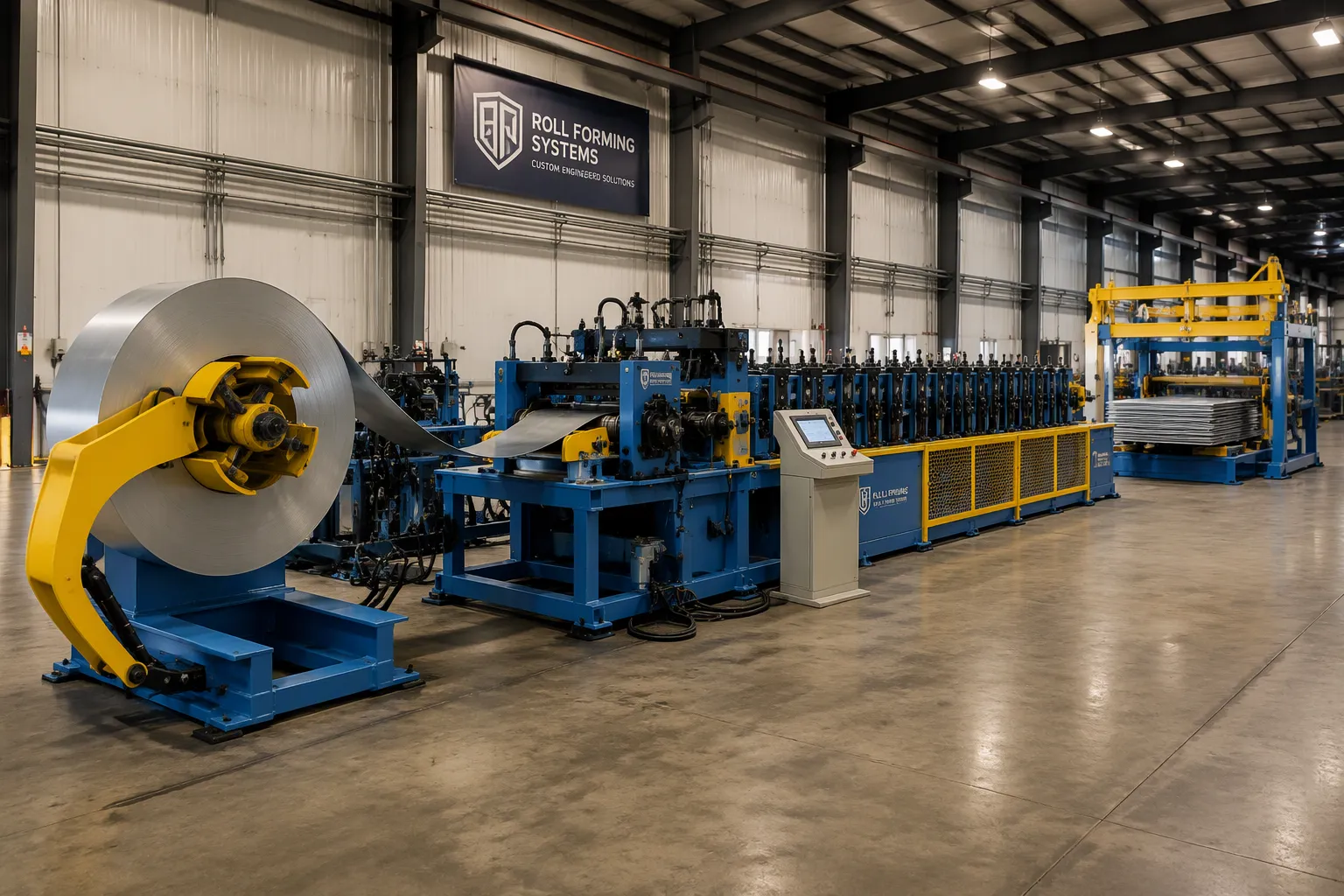
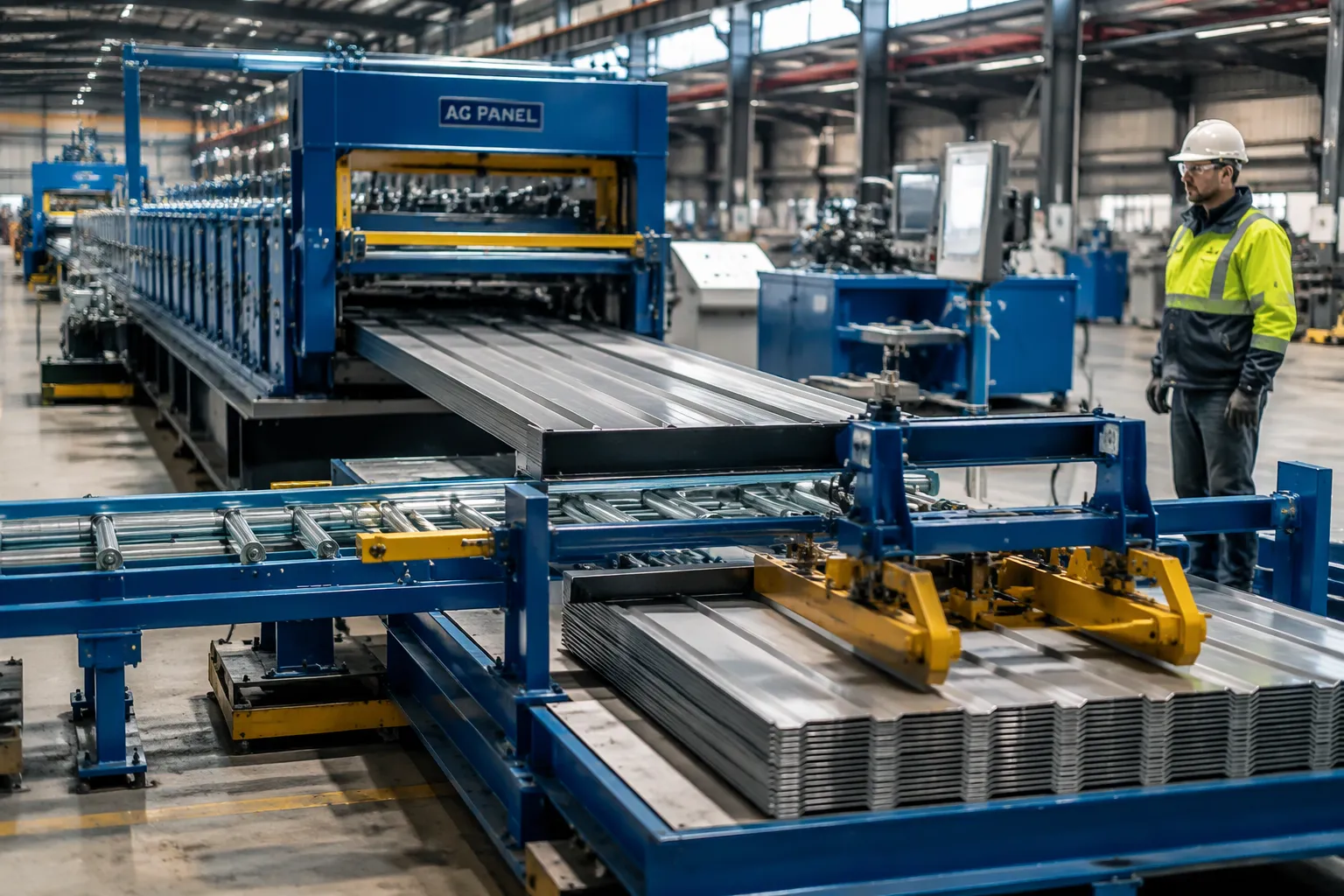
You must lock down three specification clusters together on an ag panel roll forming machine: coil range (width, inside and outside diameter, weight capacity), cutoff arrangement (pre-cut, post-cut stationary, post-cut flying), and stacker configuration (runout type, stack height, bundle handling). Specify them as one package. The ag profile and your coil schedule constrain all three, so a change to one cluster ripples through the others.
You may be drafting an RFQ or comparing quotations for an AG panel forming machine right now. Either way, you need to know which parameters to define and which options to request in writing.
This article separates published model facts from options that require written supplier confirmation on your metal roofing forming equipment. It assumes no throughput, capacity, or gauge-conversion figures. Treat every number here as a prompt for ag panel roll formers suppliers to confirm.
Key Takeaways
Specify coil range, cutoff, and stacker together as one package for your AG panel roll forming machine.
Match the cutoff method to your batch pattern: pre-cut for short lengths, stationary for mixed lengths, flying for high volume.
Choose a stacker that fits your cutoff and panel length to keep production smooth.
Use a specification matrix to compare supplier quotes on equal terms.
Get every option confirmed in writing before you sign the order.
AG Profile and Coil Schedule
What Defines an AG Panel
An AG panel is an agricultural siding and roofing profile. You see it on barns, shops, and outbuildings. Rib geometry, panel cover width, and panel length range set the forming stations and the strip you must buy for an ag panel roll forming machine.
Rib pitch separates the AG family from the R-panel family. Both are exposed-fastener agricultural profiles. Roof Technologies lists R Panel major ribs at about 1-1/4 in on 12 in centers with 36 in coverage. The Roofing Brief, citing Western States, gives the AG (U) Panel 3/4 in ribs on 9 in centers with 36 in coverage width. Rib height and spacing differ, so your drawing — not a generic category — drives the specification. Ask suppliers to quote against it, including any ribbed ag panel profile variant you plan to run.
Panel length range matters too. Long agricultural roofing panels demand more forming stations and a longer line. Send the shortest and longest metal roofing panel you plan to sell. That pair tells an ag panel roll former builder how to lay out the mill, and it fixes the ag profile your drawings describe.
Coil Range Basics
Coil range means strip width, inside diameter, outside diameter, and maximum weight. Confirm the strip width band against your drawing and your target panel coverage.
Strip coating, substrate, and coil thickness belong in the same conversation. Your drawing and strip data govern the material thickness range. Do not accept a gauge conversion you cannot verify. Give ag panel roll formers the coating type, the substrate, and the thickness band in writing.
One more check: outside diameter and weight limit set the mandrel envelope. A roll that fits the mandrel but exceeds the weight rating stops the line. Record all four dimensions on the RFQ for every ag panel roll-forming machines quote you collect, and note the rib height each supplier assumes for your agricultural panel.
Feeding and Forming on an AG Panel Roll Forming Machine
Hydraulic Uncoiler and Coil Loading
The hydraulic uncoiler is the component you match to your coil range. Its mandrel grips the bore of the coil, and the expansion mechanism may be manual or hydraulic, according to patechforming. Published decoiler data from patechforming lists coil inside diameters of 450–515 mm, and a machinematcher setup guide gives 450–520 mm. Confirm your coil ID falls inside the expansion range before you sign.
Specify these uncoiler points in writing:
Mandrel expansion range, which must cover your coil ID
Hydraulic versus manual expansion
Whether a coil car is included, which believeindustry calls essential for coils above 5 tons
Induction brake versus servo tension control
Does hydraulic expansion mean powered uncoiling? No. Expansion grips the inside of the coil; the drive rotates it. Specify both functions when comparing quotations.
A hydraulic uncoiler with a coil car speeds loading and protects the strip edge. Controlled tension then feeds the coil into the mill without slack or drag.
Feed arrangement comes next. Manual entry suits light coils and short runs. Driven feed rolls, entry guides, and edge alignment hold the coil width steady on the ag panel roll forming machine. Ask which arrangement the supplier quotes.
Forming Stations and Published Facts
Station count and roll design follow from your AG profile drawing. The drawing fixes rib geometry and coverage, and the ag panel roll former builder lays out stations to suit. BMS publishes verified facts for its YX19.05-914.4 model, shown below.
Parameter
Published Value
Model
YX19.05-914.4
Material Thickness
0.3–0.8 mm
Application Material
GI, GL, color-coated sheet, galvanized sheet
Forming Stations
20 steps
Effective Width
914.4 mm
Control System
PLC Control System
Treat this table as published model facts, not a guaranteed package. The specific production package must follow the selected drawing and quotation. PLC-based control typically synchronizes feed speed, forming, and cutoff length on the main roll forming machine. Confirm that feature in writing rather than assume it. Mark each line item as verified standard equipment or a requested option, and record which forming details are quoted versus published. That record keeps your ag panel roll formers comparison honest, and it protects your uncoiler capacity and production line assumptions when quotations arrive from several ag panel roll-forming machines suppliers and every ag panel roll-making machine vendor.
Cutoff Arrangements for AG Panel Roll Forming Machines
Pre-Cut, Stationary, and Flying
The cutting method decides where the shear sits in the line and how the panel leaves the mill. Three arrangements cover most AG lines.
Pre-cut means you cut the coil to length before forming. The shear sits at the entry side, and each blank feeds through the mill as a fixed piece. Post-cut stationary means the panel runs through the mill, stops, and a fixed shear cuts it in place. Post-cut flying means the shear travels with the moving panel and cuts on the run.
Each cutting method suits a different production pattern. The table below shows where each one fits best.
Factor
Pre-Cut
Post-Cut Stationary
Post-Cut Flying
Cut quality and end squareness
Good on short blanks; forming can disturb the cut end
Clean, square ends; the panel is at rest
Good, but blade travel must match panel speed
Line speed interaction
Mill runs in cycles, not continuously
Mill stops at every cut
Mill runs without stopping
Panel length range suitability
Best for short, fixed lengths
Wide range, including long panels
Wide range, favors long runs
Typical fit by batch size and length mix
Small batches, one length
Mixed lengths, moderate batches
High volume, few lengths
No arrangement wins outright. A shop running many short lengths may prefer pre-cut. A shop running long agricultural panels in mixed lengths often fits stationary cutoff. A high-volume line with a narrow length mix points toward flying cutoff.
What to Confirm in Writing
Ask every ag panel roll forming machine supplier to state the cutting method in the quotation. Then confirm four details. First, the blade or shear type. Second, the cut length tolerance. Third, the length control method, such as a PLC encoder or a measuring roll. Fourth, whether the arrangement is published standard equipment or a requested option.
A cutting method listed as standard on one ag panel roll former may be an option on another. Get the answer in writing for the exact model you buy.
The cutting method also shapes your stacker choice. Flying cutoff favors continuous output, so the panel flows straight into a runout. Stationary cutoff pairs naturally with stop-and-stack handling. Specify both together on ag panel roll forming machines, and check that ag panel roll formers quote the same pairing. Buyers comparing ag panel roll-forming machines often find the cutoff and stacker quoted as separate items, so tie them to one coil schedule before you sign.
Runout and Stacking for AG Panel Roll-Forming Machines
Runout and Stacker Configurations
The runout receives each finished panel, and the stacker turns panels into a bundle you can move. You have two runout paths. A simple runout table uses gravity rollers, and rollformingmagazine.com notes that rollers let long panels move smoothly without dragging. A powered conveyor moves panels with minimal manual intervention. That same source reports that power tables and conveyors become more attractive as production volume increases, and that long conveyor runs of 80 feet or more let a shop finish a full order before stopping the machine.
Stacker configurations range from manual stacking to an auto stacker with bundle or package handling. The table below compares them by labor input, panel length handling, and production volume fit.
Stacker Type
Labor Input
Panel Length Handling
Fit by Production Volume
Manual stacking
High; operators lift and align each panel
Suits short to moderate lengths
Low to moderate volume
Auto stacker
Low; panels accumulate and align automatically
Handles long panels on a matched runout
Moderate to high volume
Bundle or package handling
Low; bundles form for removal
Needs runout length matched to bundle size
High volume, frequent bundles
Treat stack height and stacker capacity as items to confirm with your supplier. Do not accept a figure you cannot verify in writing.
Matching Stacking to Output
Your cutting method shapes the stacking choice. A flying cutoff feeds panels continuously, so auto stacking keeps pace. A stationary cutoff stops the panel at each cut, and stop-and-stack handling fits that rhythm. Your batch pattern matters too. Mixed lengths favor a flexible stacker, and a narrow length mix favors auto stacking with bundle handling.
Panel length range and bundle requirements set the runout length. Rollformingmagazine.com reports common table sizes for 10-, 13-, or 21-foot panels, with some conveyor-style tables exceeding 40 feet. When you place tables end to end, up to two-foot gaps can usually accommodate panels without warping or oil canning.
Site factors belong in the same specification. Record floor space, crane or forklift access, and your removal method. Give the ag panel roll former supplier your actual site electrical data for the production line. Ask each of the ag panel roll formers you shortlist to quote the runout and stacker as one item on the ag panel roll forming machine, and confirm every option in writing on ag panel roll forming machines and ag panel roll-forming machines alike.
The Complete Line in the Quotation
Specification Matrix and RFQ Inputs
A quotation becomes comparable only when every supplier answers the same rows. Build one matrix before you request pricing, and send it with the RFQ. The matrix below gives you the row structure. Add a column for each supplier you contact.
Matrix Row
What You Specify
Supplier Confirmation Required
Coil range
Strip width band, inside diameter, outside diameter, maximum coil weight
Mandrel expansion range and weight rating in writing
Feed arrangement
Manual entry or driven feed rolls, entry guides, edge alignment
Which arrangement the quote includes
Cutoff
Pre-cut, post-cut stationary, or post-cut flying; blade type; length tolerance; length control method
Published standard or requested option
Panel length
Shortest and longest panel you plan to sell
Station layout and line length for that range
Output handling
Runout table or powered conveyor; manual, auto stacker, or bundle handling
Stack height, capacity, and removal method
Supplier confirmation
Every unresolved or ambiguous item
Written response before you treat the item as covered
The patechforming quotation-comparison guide suggests a status field beside each row. Use four labels: included, optional, buyer-supplied, and unresolved. An included label records supply status only. Keep technical compliance in a separate field, so a checked box never reads as design acceptance.
Your RFQ inputs drive every row. Supply six items: the AG drawing, coil coating and thickness, length range, batch size, coil dimensions, and stack requirements. The drawing fixes rib geometry and coverage. Coil data fixes the hydraulic uncoiler envelope. Length range and batch size point to a cutting method. Stack requirements size the runout and the stacker.
The patechforming guide also asks you to trace the supply boundary in production order. Walk the ag panel roll forming line from coil handling through feeding, forming, cutting, and finished-part handling. At the entry end, separate the decoiler from any coil car or loading aid. At the output end, separate a simple support table from a transfer or stacking system. Record the part lengths, handling method, and staffing each supplier assumes.
Standard Equipment vs. Requested Options
Suppliers draw the standard-versus-option line in different places. The hzrollforming AG panel roll former page illustrates the pattern. It lists the decoiler with motor, hydraulic motor, or passive drive as optional, along with a filming covering device, front shear, safety cover, post-cutting drive type, and output system choice between a manual supporter and an automatic stacker. It also lists control brand as optional or as requested. Treat that list as an example of how options appear, not as a package you can assume.
Mark every line item on your matrix with one of two labels. Verified standard equipment means the supplier states the item is included for your configuration. Requested option means the item needs a written price and a written confirmation of dependencies. The patechforming guide adds a useful rule: normalize optional items before you compare totals. An auto stacker priced inside one quote and outside another distorts the comparison until you align the scope.
Keep replacement tooling separate from production tooling. A spare blade or wear-parts kit belongs in its own row. Do the same for services. Installation, commissioning, and operator training may sit inside or outside the base price, so ask each ag panel roll formers supplier to state the boundary. Request a document register too, covering manuals, drawings, setup records, and parts information.
An option you did not request in writing is an option you cannot expect on delivery. Put every requested item on the matrix and get a written response before you sign.
Close the body with a short buy checklist drawn from the matrix. Confirm the AG drawing against the quoted profile. Confirm coil data against the uncoiler envelope. Match the cutting method to the stacker and to your batch pattern. Document every option in writing. When all four items pass, you can compare ag panel roll forming machines on equal terms and place the order for your ag panel roll forming machine with confidence. A clean matrix also shortens the review of your production line layout, because every interface already has an owner. Buyers who run auto stacking alongside a flying cutoff should confirm that pairing explicitly on the ag panel roll forming machines they shortlist, since the two choices interact.
Your AG profile and coil schedule set the frame for the whole line. Cutoff and stacker choices follow from your batch and length patterns. The quotation should document every option in writing, so no item arrives as a surprise on delivery.
Assemble your RFQ inputs and the specification matrix before you request quotations. That step lets you compare ag panel roll forming machines on equal terms and place the order with confidence. Send BMS your AG drawing, coil coating and thickness, length range, batch size, coil dimensions, and stack requirements. Our team will match an ag panel roll former to your schedule. Buyers who shortlist ag panel roll formers this way get cleaner quotes, and every ag panel roll-forming machines comparison starts from the same coil data.
FAQ
What coil width should I specify for an ag panel roll forming machine?
Confirm the strip width band against your profile drawing and your target coverage width. Your drawing governs the final number, so put it in writing on the RFQ.
Can one machine run both AG and R-panel profiles?
Rib pitch and coverage differ between the two families, so the profile drawing drives the roll design. Ask the supplier whether the quoted ag panel roll forming machines can accept a second tooling set. Get that answer in writing before you compare prices.
How do I choose between stationary and flying cutoff?
Match the cutting method to your batch pattern. Mixed lengths and moderate batches suit a stationary shear. High volume with few lengths favors a flying shear. Confirm blade type, length tolerance, and length control method in the quotation.
What stacker setup fits a long-panel AG line?
Long panels need a runout matched to your bundle size. A powered conveyor helps at higher volume. Confirm stack height and capacity with the supplier, and record floor space, crane access, and your removal method on the RFQ.
Which details must appear in every quotation?
Ask each of the ag panel roll formers to state the coil range, feed arrangement, cutoff type, panel length range, and output handling. Label every item as standard equipment or a requested option. An unresolved item stays open until you hold a written response.
Founded in 1992, BMS Machinery joined XIAMEN BMS GROUP in 2017. Our manufacturing network in China includes 8 factories, 6 machining centers and 1 steel structure company, covering over 30,000 m². Supporting credentials include ISO9001:2015 quality management certification and SGS-issued CE/UKCA machinery compliance verifications. XIAMEN BMS GROUP’s Dun & Bradstreet D‑U‑N‑S Number is 55-379-8879.

 日本語
 한국어
 ไทย
 繁體中文
 العربية
 فارسی
 Français
 Русский
 Español
 Português
 English
 Deutsch
 italiano
 Nederlands
 Tiếng Việt
 Polski
 Türkçe
 አማርኛ
 ພາສາລາວ
 ភាសាខ្មែរ
 Bahasa Melayu
 ဗမာစာ
 தமிழ்
 Filipino
 Bahasa Indonesia
 magyar
 Română
 Čeština
 Монгол
 қазақ
 Српски
 हिन्दी
 Kiswahili
 Slovenčina
 Slovenščina
 Norsk
 Svenska
 українська
 Ελληνικά
 Suomi
 Հայերեն
 עברית
 Latine
 Dansk
 اردو
 Shqip
 বাংলা
 Hrvatski
 Afrikaans
 Gaeilge
 Eesti keel
 Māori
 සිංහල
 नेपाली
 Oʻzbekcha
 latviešu
 অসমীয়া
 Беларуская мова
 Esperanto
 मराठी
 پښتو