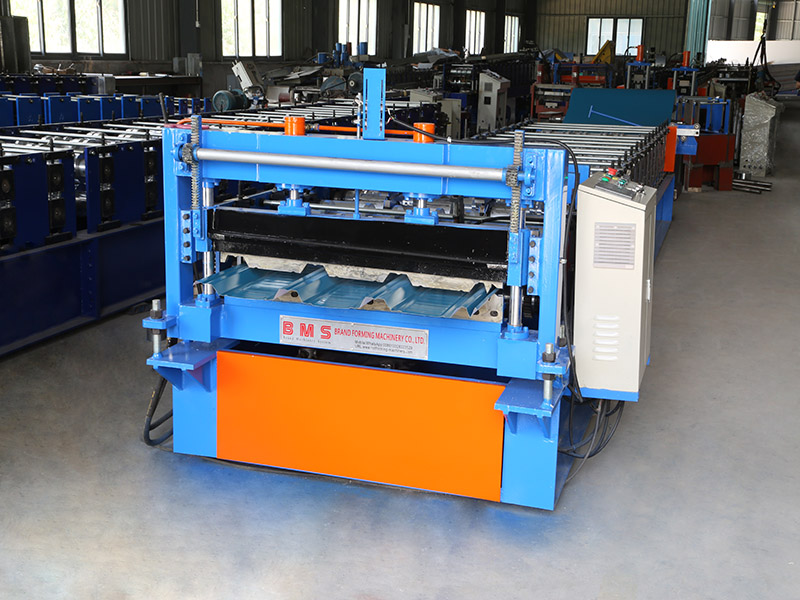
The Roll Former VS-150 is a standing-seam panel-forming machine sold with mechanical-lock and U-panel capability; other profiles depend on the installed dies. For a roofing contractor or panel shop, the buying question is whether the quoted configuration makes the exact panel the job requires.
A VS-150 quote should name the die set and material range for the panel you plan to make. Another supplier's “150” label may describe a different seam, so compare panel drawings and formed samples before treating the machines as alternatives.
What the VS-150 name identifies
A roll former is a category of machines that shapes sheet metal through successive rolls; Roll Former LLC is also the name of the company selling the VS-150 model. The company describes this standing-seam panformer as having hydraulic drive and a front hydraulic scissors shear. It forms panels; it is not the powered seamer that closes a mechanical roof seam after panels are placed. Those are separate functions in an equipment quote.
BMS also uses “SS150” in the description of its snap lock metal roof machine, marked “for SS100/SS150/SSQ200.” That label alone does not tell you whether the machine forms a VS-150 panel. Compare dimensioned panel cross-sections, clips and any field seamer before treating the two as interchangeable.
Keep the three names separate
VS-150: a Roll Former LLC machine model.
SS150: a label on a BMS snap-lock machine listing; confirm its panel cross-section before comparing it with VS-150 output.
Standing seam: a family of roof-panel joints, not one interchangeable machine or accessory package.
What comes standard—and what requires another die
Roll Former LLC lists 1-inch and 1½-inch standing-seam panels and identifies mechanical-lock and U-panel profiles as standard on the base VS-150. Other profiles require the relevant dies, which can be purchased separately. “Multi-profile” describes what the machine can make with those dies, not every panel included at delivery.
VS-150 standard profiles and available options |
Standard or optional | Profiles and equipment | What to confirm before ordering |
Base profiles | 1-inch and 1½-inch standing seam; mechanical-lock and U-panel profiles listed as standard | Confirm the supplied die set and obtain sample cross-sections for the required seam. |
Optional forming dies | Snap-lock, SOP-15, Bermuda and batten pan/cap | Specify the intended profile; price and availability need an itemized offer. |
Optional controls and handling | Digital controller, attachments and 3,000- or 5,000-lb decoiler options | Check the chosen feed and handling arrangement, rather than assuming a complete line. |
Optional seam-closing tools | SSX and SSX-HD seamers | These are separate from the panformer and should be listed when the panel system needs one. |
The base-machine hydraulic drive and scissors shear are listed as standard features. A controller, decoiler or seamer can change how the crew feeds, cuts or closes panels, yet none changes the panel geometry unless the matching forming dies are present. For an actual order, request one configuration sheet naming the installed dies, accessories and any material limit attached to that profile. The sheet tells you what will arrive; a formed sample shows the panel those dies make.
The published specifications that affect your job
The maker publishes a 9–24-inch adjustable panel width and 40 feet per minute (FPM) line speed for the VS-150. These figures help screen a job, but the speed is a machine rating, not a promised count of finished panels per hour. Panel length, coil handling, cuts and profile changes all affect the actual schedule.
VS-150 specifications and buying checks |
Specification | VS-150 figure | What to check |
Panel width | Adjustable finished panels from 9 to 24 inches | Compare the required finished panel width; do not treat it as the raw coil-feed width. |
Line speed | 40 FPM | Use as a stated line rating, then plan output with actual lengths, cuts and handling time. |
Listed materials | 24–26 ga painted steel; 0.032-inch aluminum; 12–20 oz copper | Match the coil specification and intended die set to the current configuration. |
Optional 22-ga capacity | 22 ga painted steel for an optional mechanical-lock profile only | The optional die's geometry and part number are not specified. Request written die details before using the 22-ga rating for your job. |
Electrical supply | 110 V single-phase in the description; 120 V AC in the Power field | Confirm the particular unit's nameplate/manual, including voltage, phase, frequency and current. |
Roll Former LLC lists mechanical lock among the standard profiles, but reserves the 22-ga rating for an optional mechanical-lock profile. Ask for that die's drawing or part number and its written capacity before choosing material. The maker's 110 V and 120 V labels may describe the same nominal supply; check the actual machine's nameplate for your site. Considering a used 2023 unit? The 2023 VS-150 listing guide covers its advertised dies, trailer package and inspection checks.
Which VS-150 configuration fits your panel?
Start with the required panel, not the model's total profile count. The VS-150 has standard mechanical-lock and U-panel profiles, a separate 22-ga rating for an optional mechanical-lock profile, and several specialty dies. The die and supporting documents you need depend on the panel and material. A matching nominal seam height does not establish that the panel will fit the project's clips or field seamer.
Match the panel to VS-150 tooling |
Panel requirement | Relevant tooling | What to request |
Base mechanical-lock or U-panel work | Mechanical-lock and U-panel profiles are standard; the model also lists general material limits | Die drawing and sample at your required width and material; for a mechanical-lock roof joint, compatible clip and seamer details |
22-ga painted-steel mechanical lock | The 22-ga painted-steel rating applies only to an optional mechanical-lock profile | Optional die part number and cross-section, written 22-ga capacity for that die, sample panel and matching roof components |
Snap-lock, SOP-15, Bermuda or batten work | These profiles require optional dies | Included die list and profile drawing; if structural test data is required, the report for the specified panel-and-anchor assembly and conditions |
The Metal Construction Association's clip guidance ties clip selection to the panel's dimensions and joint design. Roll Former LLC labels its optional SOP-15 profile “ASTM E1592 Tested,” but that wording does not cover every VS-150 output. ASTM E1592 addresses a panel-and-anchor assembly tested under stated conditions. Use the report for the exact proposed arrangement; a machine model or sample alone is not a blanket roof approval.
What a second supplier must match
Give each supplier the same panel drawing and material specification. BMS offers standing seam roll forming machines, including an SS150-labeled snap-lock product. The SS150 name alone cannot confirm a VS-150-equivalent joint, so ask BMS to match the drawing with a proposed die set and formed sample.
Give the supplier the dimensioned panel cross-section, seam method, finished width, coil material/thickness and the roof-system document that governs the job.
Request the installed die identifier, representative sample, exact electrical supply, coil-feed/decoiler arrangement, shear, controls and any required field seamer.
Ask for one delivered offer listing machine, dies, accessories, freight, applicable tax/duty, commissioning, training, warranty and service terms.
If a supplier cannot show that its machine forms the required joint in your material, a lower price or higher listed speed will not solve the mismatch. Once two configurations meet the drawing and roof-system requirements, compare the production layout and delivered terms. That makes the decision about the panel you can produce, not a shared “150” label.
Frequently Asked Questions
How long does a VS-150 profile change take?
Roll Former LLC advertises a range of 15 minutes to one hour. That is not a guaranteed time for your particular dies, crew or setup. Ask to see the changeover procedure or a demonstration for the two profiles you expect to switch between.
Can a VS-150 run in a shop as well as on site?
The maker describes the VS-150 as portable and lists a machine stand for shop use as an option. Either setup still needs the selected coil-handling arrangement, feed and runout space, and the actual unit's electrical requirements.
Choose by the panel you need to produce
Choose a machine that can form the specified panel with the right die, coil capacity and compatible roof-system components. For the VS-150, identify the supplied and optional dies before applying the maker's ratings to your job. Compare a BMS option using the same panel drawing, material and site requirements.
Email info@rollformingmill.com your panel drawing and coil specification. Ask for a recommended configuration, a formed sample and an itemized quote for equipment, delivery and support.
 日本語
日本語 한국어
한국어 ไทย
ไทย 繁體中文
繁體中文 العربية
 فارسی
فارسی Français
 Русский
 Español
 Português
 English
 Deutsch
 italiano
 Nederlands
 Tiếng Việt
 Polski
 Türkçe
 አማርኛ
አማርኛ ພາສາລາວ
 ភាសាខ្មែរ
 Bahasa Melayu
 ဗမာစာ
ဗမာစာ தமிழ்
தமிழ் Filipino
 Bahasa Indonesia
 magyar
 Română
 Čeština
 Монгол
 қазақ
қазақ Српски
 हिन्दी
 Kiswahili
 Slovenčina
 Slovenščina
 Norsk
Norsk Svenska
 українська
 Ελληνικά
 Suomi
Suomi Հայերեն
 עברית
עברית Latine
 Dansk
Dansk اردو
اردو Shqip
Shqip বাংলা
বাংলা Hrvatski
 Afrikaans
 Gaeilge
 Eesti keel
 Māori
Māori සිංහල
සිංහල नेपाली
 Oʻzbekcha
 latviešu
 অসমীয়া
 Беларуская мова
 Esperanto
 मराठी
मराठी پښتو
پښتو