


Profile and seaming compatibility should be defined from the roof system requirements, installation details, accessories, and inspection expectations before a standing seam roofing machine is quoted. The machine discussion then becomes a controlled match between coil input, roll-form tooling, panel geometry, seam closure method, cutting, and finished-panel handling.
What profile questions should come before a standing seam machine quote?
Define the roof panel profile as an installed system requirement first, then ask whether the standing seam roofing machine, tooling, and downstream process can make that profile consistently for the intended project use.
A useful profile discussion starts with the project specification, installation conditions, accessories, panel attributes, and final inspection expectations described in metal roofing installation guidance from the Metal Construction Association installation manual page.
- Target panel profile: seam height, pan width, rib layout, clip interface, accessory fit, and roof-slope or detailing assumptions should be reviewed against the project documents.
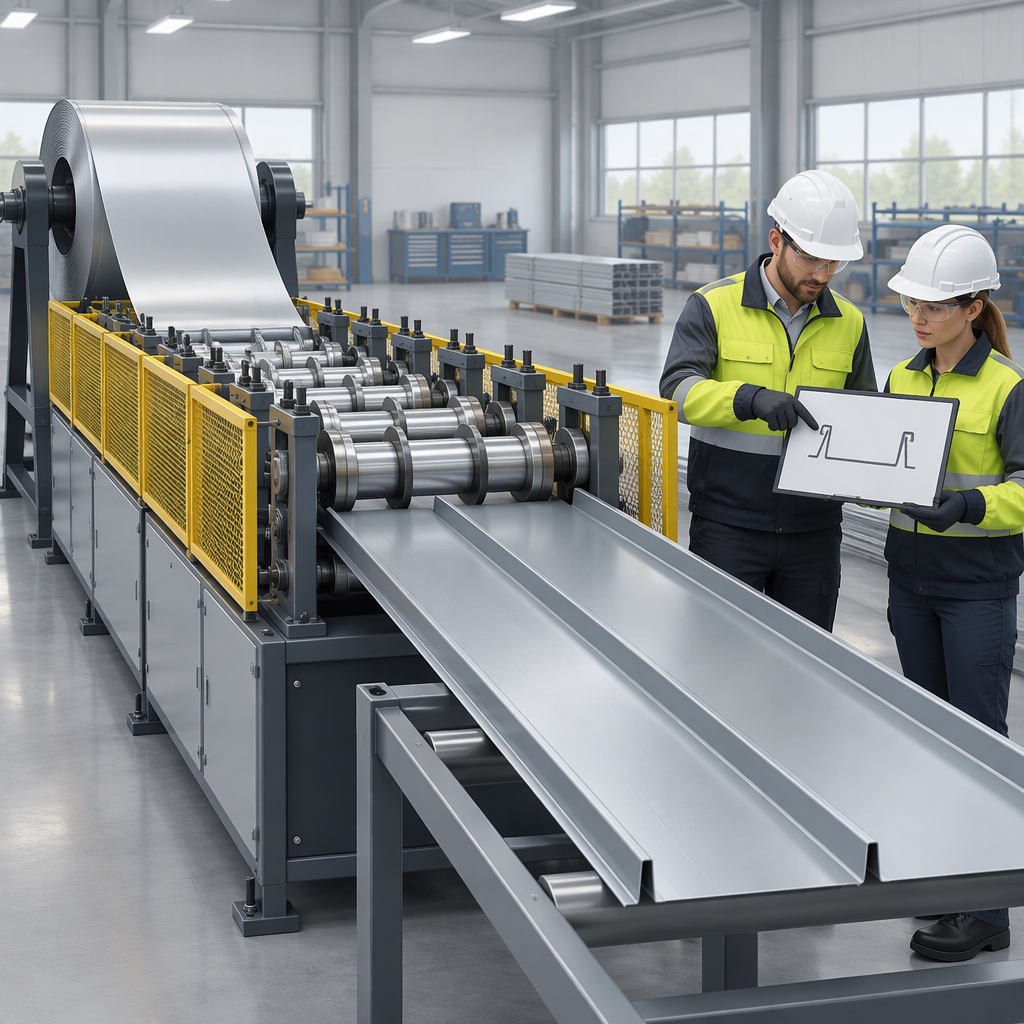
- Process route: confirm how the production sequence will handle feeding and positioning, roll forming through arranged rollers, automated cutting to length, and output of cut panels.
- Installation interface: check whether clips, closures, trim, fastener strategy, and final inspection requirements create constraints that the panel geometry must respect.
- Tooling boundary: treat roller design and cut-off setup as profile-specific questions rather than assuming one machine name covers every standing seam shape.
For buyers, the practical proof point is not a generic machine label; it is whether the proposed profile package aligns with the specification, installed products, accessories, and inspection responsibilities that govern the finished roof.
How is seaming compatibility different from profile forming?
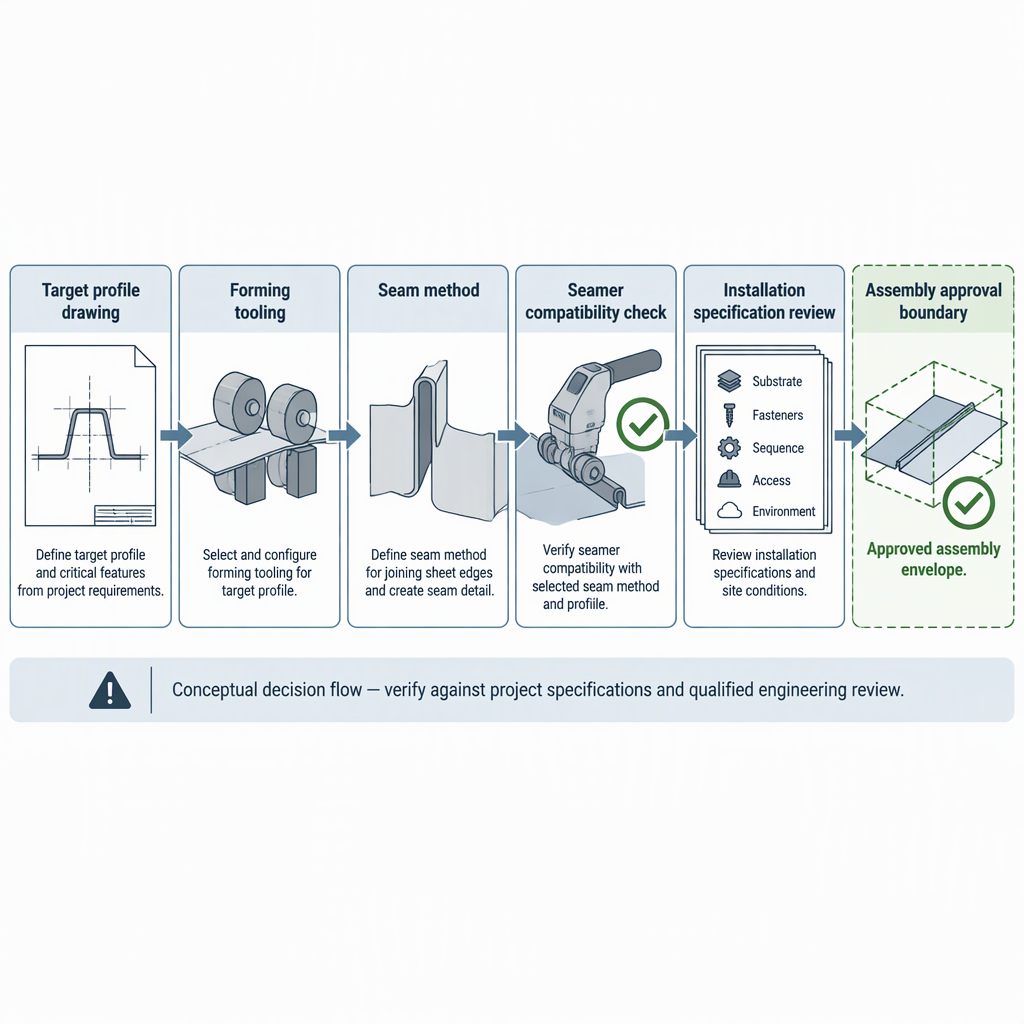
Profile forming creates the panel shape; seaming compatibility asks whether the formed edges, clips, accessories, and closure method can be joined correctly in the intended roof assembly.
| Compatibility question | Profile forming focus | Seaming focus |
|---|---|---|
| What must match? | Roller arrangement, material feed path, profile geometry, cutting length, and panel output. | Installed seam behavior, clips, accessories, specification requirements, and inspection expectations. |
| Where is it checked? | At the machine, tooling, and sample-panel stage. | At the roof-system detailing, installation, and assembly-review stage. |
| What can go wrong? | A panel may be formed to the wrong edge shape, width, or cut length. | A formed panel may still fail to fit the specified clips, accessories, or seam closure expectations. |
Do not approve tooling only from a sales name such as “standing seam.” Ask for profile drawings, sample checks, and the intended seaming method so engineering can compare the machine output with the roof-system specification.
How should buyers compare snap-lock and mechanically seamed requirements?
Compare snap-lock and mechanically seamed options by the questions they create for the profile edge, clip fit, field closure, accessory interface, and approval path; do not treat either name as a universal answer.
| Selection dimension | Snap-lock style question | Mechanically seamed style question |
|---|---|---|
| Panel edge geometry | Can the roll tooling form the lock geometry required by the target profile? | Can the roll tooling form edges that remain suitable for the intended mechanical closure? |
| Seam closure | Does the installed condition satisfy the project specification and inspection criteria? | Is the seaming operation, including seamer fit and seam shape, compatible with the roof-system details? |
| Accessories and clips | Do clips, closures, and trim suit the snapped profile? | Do clips, seam clearance, and accessory details remain compatible after mechanical closure? |
| Procurement evidence | Request drawings, sample panels, and installation-detail review. | Request drawings, sample panels, seaming checks, and installation-detail review. |
| If the project requirement says... | Ask the supplier to confirm... |
|---|---|
| A named roof profile must be matched. | The roller set, feed setup, and cut-to-length process can produce the required panel geometry. |
| A specific seam closure method is required. | The formed edge and seaming equipment are compatible with that closure method and installation detail. |
| An FM-approved assembly is required. | The complete roof assembly is checked in RoofNav or the applicable approval documentation, not inferred from the machine name. |
What information should procurement send with the RFQ?
Send an RFQ package that lets the supplier evaluate the complete forming route: material input, target profile, tooling assumptions, seam method, panel length control, and acceptance checks.
- Project or product specification, including roof type, panel profile drawing, accessory requirements, and inspection expectations.
- Coil information needed for machine setup discussions, such as material type, width, and thickness range required by the buyer’s own product design.
- Required production flow: decoiling or feeding approach, roll forming, cutting to length, panel collection, and any sample-panel approval step.
- Seaming method and related installation detail, including clip type, closure method, and whether field seaming equipment must be checked with the profile.
- Any assembly approval requirement, including whether FM Approved roofing information must be confirmed at the roof-assembly level.
- Start with the project specification and identify the profile, accessories, inspection requirements, and approval needs.
- Translate the profile into machine questions about feeding, roller tooling, cutting, and panel output.
- Request sample-panel or drawing review before tooling is finalized.
- Confirm the seaming method and installation interface before purchase approval.
Where do approval and test-method boundaries affect compatibility?
Approval and test-method questions belong to the roof assembly and the applicable standard or listing; a machine name or profile label does not prove that the finished roof system is approved.
When FM approval is part of the project requirement, use FM Approvals RoofNav to check FM Approved roofing assemblies, products, resources, current FM Approved roofing-related information, and related installation recommendations.
For structural-performance language, ask the project engineer or specification owner which official ASTM E1592 edition and test documentation apply; the observed ASTM E1592-25 description covers sheet metal roof and siding panels and anchor-to-panel attachments under uniform static air pressure difference, but the edition status should be confirmed from an official standards source before procurement relies on it.
This boundary matters because a machine can produce a panel shape while the project still requires assembly-level documentation for clips, deck, insulation, fasteners, installation recommendations, and approval listing details.
Which red flags should trigger engineering review?
Trigger engineering review whenever the profile drawing, seaming method, accessories, approval requirement, or inspection criteria are not clearly tied to the proposed machine setup.
| Red flag | Why it matters | Buyer action |
|---|---|---|
| Only a machine category name is provided. | A standing seam roofing machine category does not define the exact roller tooling, panel edge, or cut-length setup. | Request profile drawings and sample-panel confirmation. |
| The seaming method is not stated. | Installation and inspection expectations depend on how the seam is closed and how clips and accessories fit. | Confirm snap-lock or mechanical seaming requirements before tooling approval. |
| The project asks for FM approval. | FM Approved status should be checked at the roof-assembly level in RoofNav or current approval documentation. | Ask for the applicable approved assembly path and do not infer it from a profile name. |
| Accessories are selected after tooling. | Clips, closures, trim, and final inspection requirements can affect whether the formed profile is usable. | Review accessory fit before finalizing the tooling package. |
For a technical purchasing team, the safest commercial decision is to freeze the compatibility boundary in writing: profile drawing, material input, seam method, accessory interface, approval path, and sample-acceptance method.
Conclusion: specify the compatibility boundary before selecting the machine
Select a standing seam roofing machine only after the buyer’s team has defined what “compatible” means for the profile, seam, accessories, installation requirements, and approval boundary.
- Machine selection should be connected to the real production sequence: feed, form, cut, and output panels.
- Profile selection should be checked against installation specifications, accessories, and inspection expectations.
- Approval requirements should be verified as assembly-level requirements, not assumed from a machine or profile name.
For metal building product manufacturers, cold roll-forming engineers, and procurement teams, the RFQ should read like an engineering boundary document rather than a request for a generic machine category.
FAQs about standing seam roofing machine compatibility
These short answers help buyers separate profile, tooling, seaming, and approval questions before committing to a machine specification.
What does profile compatibility mean for a standing seam roofing machine?
It means the proposed machine setup, especially feeding, roller tooling, cutting, and panel output, can produce the target panel geometry that the buyer’s roof system requires.
Is seaming compatibility the same as forming the panel?
No. Forming creates the panel shape, while seaming compatibility also depends on closure method, clips, accessories, installation details, and inspection expectations.
Should buyers choose snap-lock or mechanically seamed profiles first?
Choose the seam method from the project requirements and installation strategy first, then check whether the machine tooling and any seaming equipment match that decision.
Can a standing seam roofing machine name prove compatibility?
No. A machine category name does not define the exact profile geometry, tooling set, material input, cutting setup, or seam closure boundary.
Can a machine supplier prove FM approval by naming a profile?
No. If FM approval is required, check the applicable roof assembly information in RoofNav or current approval documentation rather than inferring approval from a machine or profile name.
Where does ASTM E1592 fit into the decision?
ASTM E1592 is described as a structural-performance test method for sheet metal roof and siding panel systems under uniform static air pressure difference; buyers should confirm the official edition and project-required test documentation before relying on it.
What should be included in an RFQ?
Include the profile drawing, material assumptions, seam method, accessory and clip details, installation requirements, approval needs, and sample-acceptance expectations.


