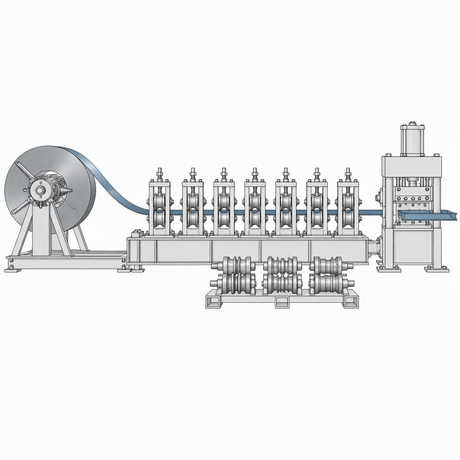
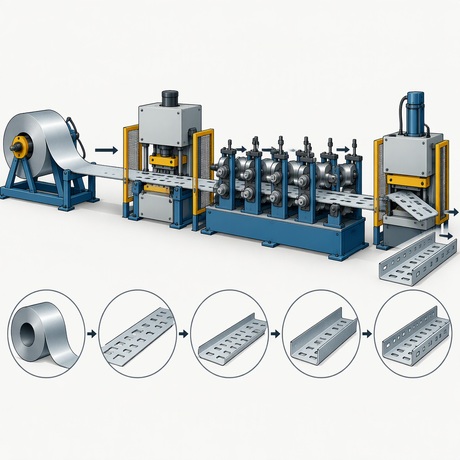
Evaluate purlin size changeover as the controlled path from the last good purlin in one size to the first good purlin in the next size, not as a feature name alone. The strongest purchase review combines observed adjustment steps, profile verification, defect checks, and scrap logging before accepting any changeover claim.

Define the purlin size-changeover boundary
For buying purposes, the purlin size-changeover boundary should cover every activity between the last conforming part from the old size and the first conforming part from the new size.
That boundary matches the setup-reduction framing described by NIST MEP lean and process improvement guidance: the useful measure is not simply motion at the machine, but the transition from one good output to the next good output.
In roll forming, flat sheet is shaped incrementally into a profile, and profile quality is sensitive to material, geometry, process parameters, and setup accuracy.
Because bow, twist, and other profile defects can relate to inhomogeneous longitudinal strain distribution, a changeover review should include profile verification after adjustment rather than stopping at whether a handwheel, spacer, cassette, or recipe has been moved.
For a metal building product factory, this scope keeps the conversation practical: ask what must be changed, how each setting is verified, what material is consumed before approval, and who signs off that the new purlin size is ready for production.
Evaluate the adjustment steps before comparing machines
Before comparing machine offers, observe the changeover sequence as a repeatable setup process with defined preparation, adjustment, threading or restart, measurement, correction, and approval steps.
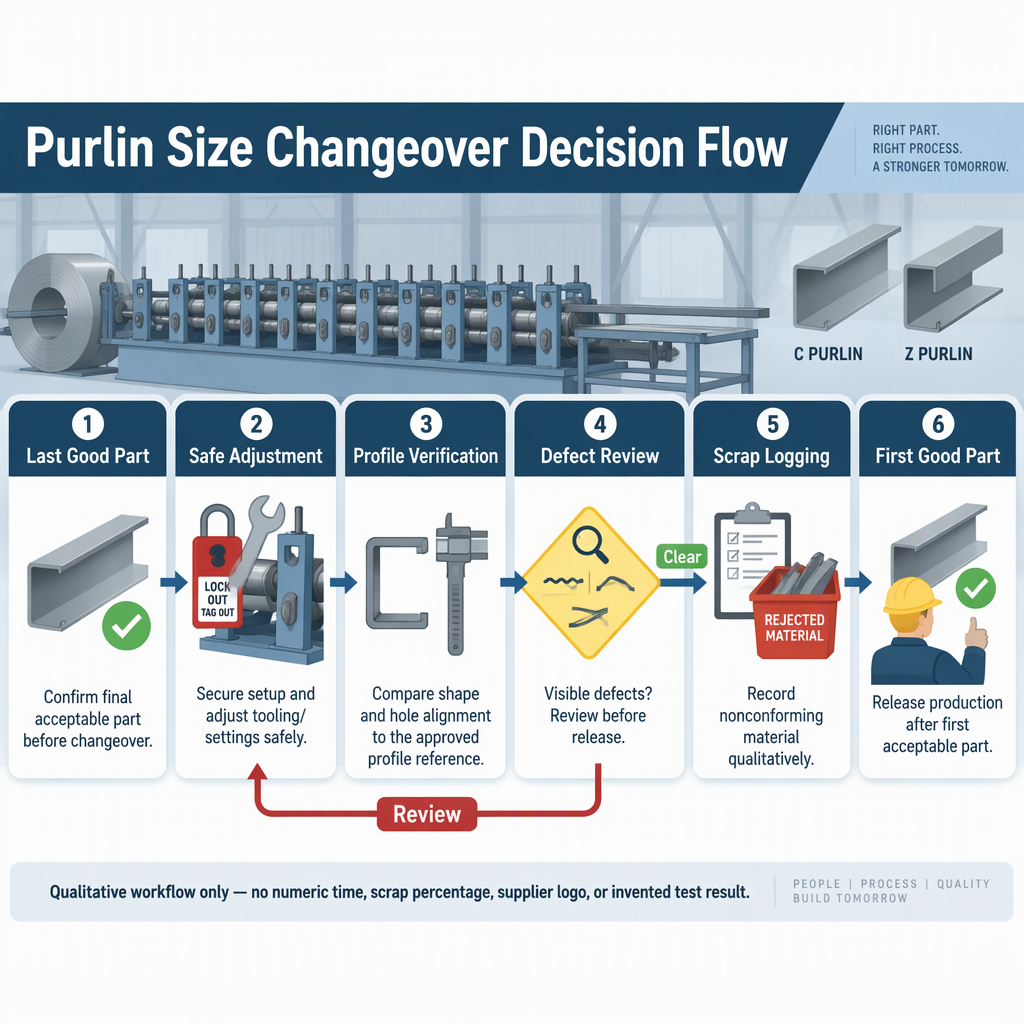
- Start with the last good part from the current run and record which setup conditions are being changed for the next purlin size.
- Before any manual access to powered equipment, require operators to switch off and disconnect the applicable electrical, hydraulic, pneumatic, or battery power source, then follow only the access and adjustment methods permitted by the machine manual.
- Observe whether tools, gauges, spacers, rolls, fixtures, and size documents are prepared before adjustment begins, because preparation affects whether changeover work is controlled or improvised.
- Check how the supplier verifies settings that can influence profile geometry, because setup inaccuracies can contribute to roll-formed profile defects.
- Run the first trial material only after guards and permitted operating conditions are restored, then inspect the profile for shape, bow, twist, hole or punch alignment where applicable, and dimensional fit.
- End the observation only when the first good part for the new size is accepted, not when the visible adjustment work appears complete.
- Ask whether each adjustment has a documented target, gauge, counter, recipe value, or physical stop.
- Ask which checks are done by the operator and which require quality or process engineering approval.
- Ask how corrections are recorded when the first trial piece does not meet the required profile.
- Ask whether the demonstration uses the same material thickness, yield range, lubrication condition, and purlin family that your factory expects to run.
Map scrap risk to verification, not just to the machine label
Scrap during purlin size changeover should be reviewed as non-value-added material created by setup trials, measurement, correction, and rejected profiles, not as a fixed percentage attached to a machine category.
The EPA’s lean manufacturing overview frames waste as non-value-added activity while still emphasizing quality products delivered efficiently; that makes scrap logging a useful selection check, not a marketing slogan.
| Changeover point | Scrap risk to review | Buyer verification question |
|---|---|---|
| Initial setup | Material may be consumed before the next size is accepted as a good part. | Where does the supplier define the start and end of changeover? |
| Profile forming | Bow, twist, and other shape defects can indicate setup-sensitive profile problems. | Which gauges or measurements confirm that the new profile is acceptable? |
| Correction loop | Repeated corrections can create additional nonconforming trial pieces if settings are not controlled. | How are corrective adjustments documented and repeated on the next changeover? |
| Release to production | The useful endpoint is the first good piece, not the first piece produced. | Who approves the first good purlin and what record is kept? |
Do not accept a scrap-reduction percentage without plant-specific conditions, trial records, material details, and a clear definition of scrap. A useful supplier demonstration should show what is counted, what is reworked, what is rejected, and what is accepted as the first good piece.
Use a selection table for supplier demonstrations and RFQs
Compare manual, semi-automatic, and recipe-driven changeover approaches by what the supplier can demonstrate and document under your production conditions.
| Evaluation item | What to ask for | Why it matters |
|---|---|---|
| Adjustment map | A list of all settings changed for each purlin family and size. | Setup reduction depends on understanding the whole setup process, not only one visible adjustment. |
| Verification method | Gauge points, profile drawings, inspection limits, and sign-off responsibility. | Profile defects can be influenced by setup accuracy and process conditions. |
| Operator workload | Which tasks are manual, assisted, or stored as recipes, and which still require judgment. | Automation language is meaningful only when the remaining human checks are clear. |
| Trial material accounting | How trial pieces, rejected pieces, and accepted first pieces are counted. | Scrap review is part of waste control and should be tied to quality acceptance. |
| Repeatability record | Demonstrations across more than one relevant size change, material condition, or operator team. | A repeatable process is more useful than a one-time setup display. |
- Include expected purlin families, size range, thickness range, hole or punching needs, and coil material assumptions in the RFQ.
- Ask the supplier to show the full path from last good part to first good part during acceptance testing.
- Request the operator instructions, setup sheets, inspection points, and permitted adjustment methods for the quoted configuration.
- Confirm that safety interlocks, guards, and energy-isolation instructions are part of the operating documents rather than informal operator knowledge.
Set applicability limits before accepting supplier claims
Treat any changeover-time, scrap, certification, capacity, or performance statement as conditional until it is supported by current supplier documents and a demonstration that matches the buyer’s material and profile requirements.
General roll-forming principles can help engineers ask better questions, but they do not prove that a specific purlin line has a particular adjustment range, automation level, output rate, scrap result, or service promise.
The roll-forming defect literature supports the need to check profile quality after setup because shape defects can be linked to strain distribution, geometry, process parameters, material, and setup accuracy.
The NIST MEP setup-reduction frame supports evaluating the complete changeover path from good part to good part.
Lean waste guidance supports tracking scrap as waste, but it does not provide a purlin-machine scrap benchmark.
For procurement, the practical boundary is simple: ask each supplier to prove the exact configuration being quoted. Specifications, performance claims, certifications, delivery commitments, and service scope should come from current supplier-controlled documents, contract terms, or acceptance-test records.
Conclusion
A purlin size-changeover decision is strongest when the buyer evaluates process control, verification, and scrap accounting together.
Because roll-formed profile quality can be affected by setup and process conditions, a good purchase review should look beyond the adjustment label and into how the line reaches a verified first good part.
- Define changeover from last good part to first good part.
- Observe the full adjustment sequence under safe, documented conditions.
- Connect scrap review to verification records, not to unsupported percentages.
- Request current documents for the exact purlin line configuration being purchased.
FAQs about purlin size changeover
These questions help buyers turn a changeover discussion into observable acceptance checks.
Which post-changeover defects should trigger additional setup review?
Bow, twist, and profile-shape deviations should trigger setup review because roll-forming defects can be linked to strain distribution, process parameters, material, geometry, and setup accuracy.
What counts as purlin size changeover for procurement?
Count the full path from the last accepted purlin in the current size to the first accepted purlin in the next size, including preparation, adjustment, trial running, inspection, correction, and release.
Can a supplier’s scrap number be used as a guaranteed result?
Use a supplier’s scrap number only when the definition, material, profile, operator method, inspection limits, and acceptance records match your intended production conditions.
Is automatic changeover always better than manual adjustment?
Not automatically. A recipe or assisted adjustment can be valuable, but buyers should still verify which settings are controlled, which checks remain manual, and how the first good purlin is approved.
What should be included in a supplier demonstration?
The demonstration should show preparation, safe adjustment, restart, inspection, correction if needed, scrap accounting, and the accepted first good part for the next size.
What safety condition is essential before manual adjustment?
Before manual access, operators should switch off and disconnect the relevant power source and follow the model manual’s permitted access steps; buyers should not accept demonstrations that bypass guards or rely on informal servicing shortcuts.
Which documents should be requested with the RFQ?
Ask for the quoted configuration, adjustment map, operating manual, setup sheets, inspection points, acceptance-test method, safety instructions, and any current documents supporting specifications or certifications.