


Automatic profile changeover earns its cost on changeover frequency, not on brochure speed. Measure the interval from the last good part of the outgoing profile to the first good part of the incoming one on your line, then compare both options on one lifecycle list: tooling and cassettes per profile, controls and programming, training, spares and retooling risk. Automation shortens powered, repeatable steps such as coil handling, axis adjustment and recipe recall; tooling judgement, first-article acceptance and energy isolation stay with people.
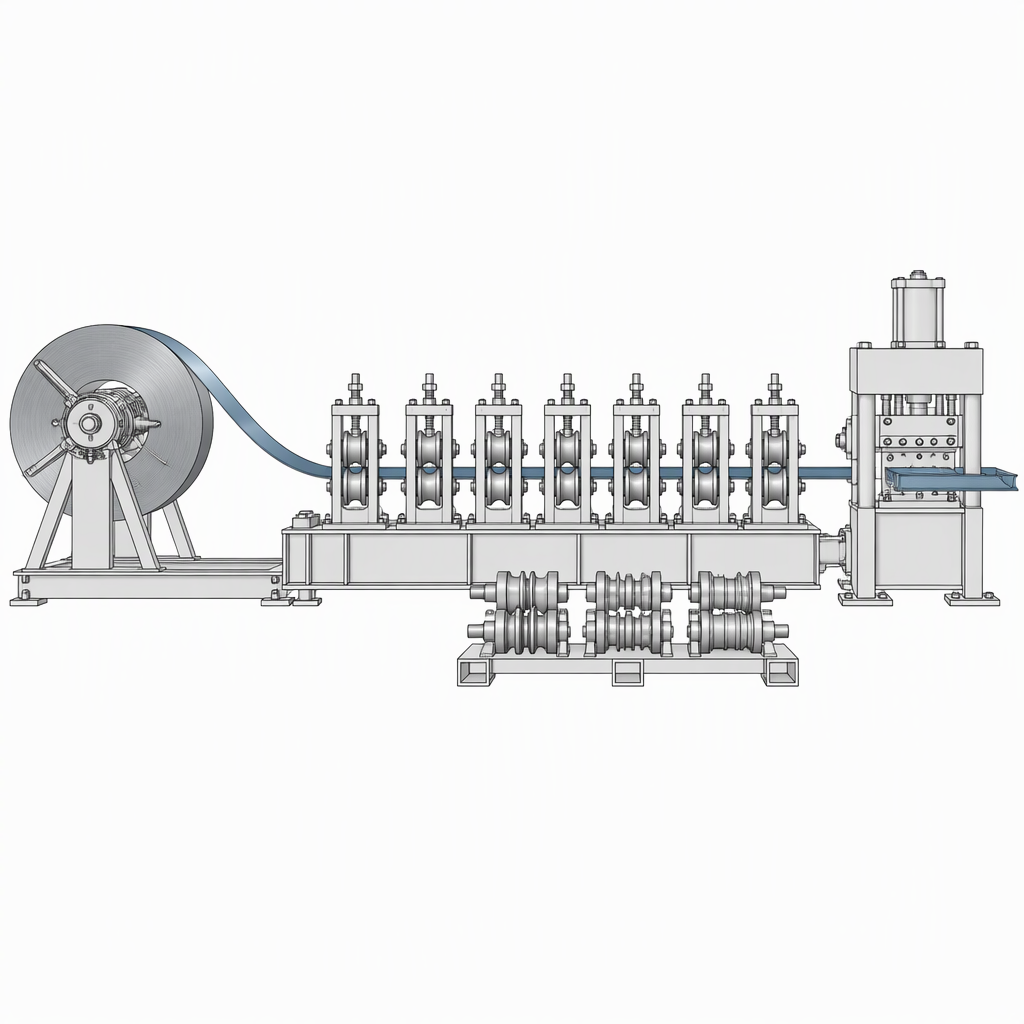
What does a profile changeover actually include?
A profile changeover is the whole interval from the last good part of the outgoing profile to the first good part of the incoming one: strip and coil preparation, tooling exchange, roll and axis adjustment, recipe selection, guard and sensor restoration, and first-article verification. The roll swap is only one step inside that interval, so time the whole sequence on your own line — coil handling, tooling exchange, adjustment, recipe selection and first-article checks — rather than timing the swap alone or assuming any one step dominates.
- Run-down and coil tail-off at the end of the outgoing profile.
- Removal and installation of rolls, rafts or cassettes, including the lifting and handling around the stands.
- Roll-gap, axis and flare adjustment, followed by a trial strip.
- Recipe or parameter selection at the controller, and any manual re-entry of set points.
- Restoration and check of guards, sensors and safety devices. Under the US general-industry energy-control standard, setting up, adjusting and making tool changes sit inside servicing and maintenance, so the changeover clock overlaps the isolation procedure.
- First-article verification of die condition, panel flatness, length consistency and lapping before the run is released.
- Scrap produced during run-up, recorded as changeover cost rather than as a production loss.
Write the definition down before you time anything. A step it omits disappears from the baseline you will use to justify the investment. A supplier's quoted changeover time is comparable only when it uses the same start and end points and the same profile pair.
Manual vs automatic profile changeover: where does the difference actually sit?
Both configurations run the same sequence; they differ in who or what performs each step. Automated designs address the repeatable, powered steps — coil handling, flare setting and other single-axis adjustment, servo feeding and stored batch recipes — while tooling judgement, first-article acceptance and energy isolation stay with the crew.
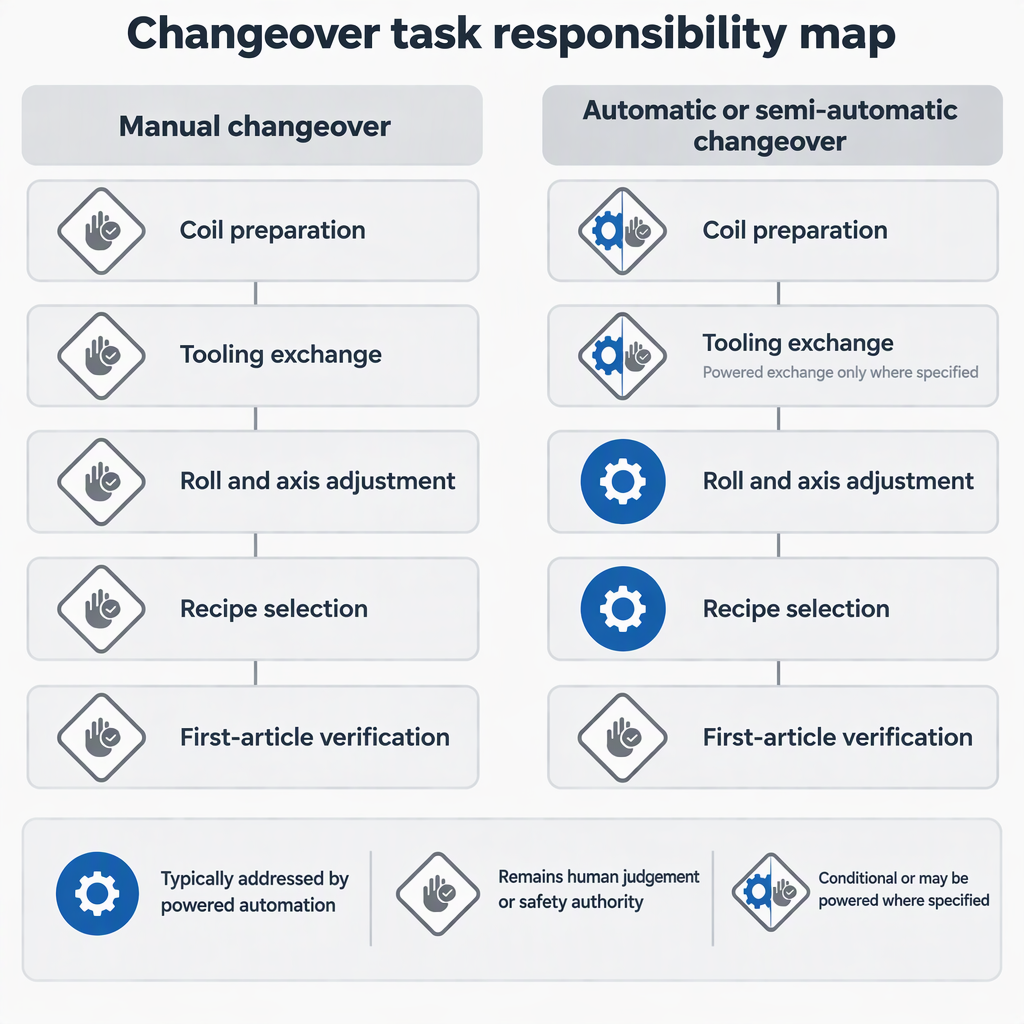
Manual profile changeover
How the work is done. Rolls, rafts or cassettes come out and go back in by hand, and positions are proven with a trial strip.
Fits when. The profile mix is narrow, campaign runs are long, and changeovers are infrequent enough for the crew to stay practised.
Where the cost sits. Lost time scales with crew availability and setter skill, and repeatability depends on records and discipline.
What it does not solve. Position errors and run-up scrap remain, and it is the baseline every saving claim should be measured against.
Automatic or semi-automatic changeover
How the work is done. Powered adjustment and exchange, servo positioning and stored recipes, with tooling and controls designed as one system.
Fits when. Many short runs repeat on a schedule and the same profile pairs recur often.
Where the cost sits. A tooling set or cassette per profile, plus controls, programming, training and spares for powered components.
What it does not solve. First-article judgement, energy isolation, or quality lost to worn tooling.
| Changeover step | Manual configuration | Automatic or semi-automatic configuration |
|---|---|---|
| Coil and strip preparation | Coil loaded and threaded on the standard decoiler arrangement. | Powered dual-head uncoiling and automatic coil-changing arrangements are offered to shorten coil changes; a coil change is still not a profile change. |
| Tooling exchange | Rolls, rafts or cassettes lifted and fastened by hand, with seating checked by the setter. | Confirm the mechanism on the quoted model: reported automation concentrates on powered adjustment and coil handling more than on automatic roll exchange. |
| Roll and axis adjustment | Mechanical adjusters set by hand and proven with a trial strip. | Automated flare adjustment driven by ball screw or gear drive is reported specifically to reduce adjustment time. |
| Recipe and parameters | Set points recorded on a sheet and re-entered by the operator. | Multi-batch touchscreen controllers store and recall batch settings, with API integration on some builds. |
| First-article verification | Operator measures and releases the run. | Operator measures and releases the run; automation does not judge quality. |
| Skill dependency | Fit and judgement concentrated in experienced setters. | Skill shifts towards recipe management, positioning faults and controls diagnostics. |
| Isolation before access | Every energy source isolated and locked off before hands enter the tooling area. | Same duty, with more stored energy held in pneumatics, hydraulics and gravity-loaded parts. |
How do changeover minutes become a money figure?
Measure the interval on your own line, subtract only the minutes you can realistically remove, convert the recovered minutes into metres at your running speed and yield, and value that output at contribution margin rather than at selling price. Anything else turns a capacity gain into an invented saving.
A controls-industry illustration recovers 30 minutes per day at 300 FPM and reports about USD 1,170 per day, USD 5,850 per week and USD 304,200 per year for a hypothetical fabricator. Treat it as arithmetic, not a benchmark: the result depends on excluding the right fixed costs.
The same author observes that an average OEE of around 20% is not uncommon on roll formers. That is a general observation rather than a surveyed statistic, so measure your own availability, performance and quality before you assign any value to recovered minutes.
Keep the time saving and the lifecycle model in one calculation. A published lifecycle-cost framework identifies repair and retooling as the largest unknown in a machine's value, so an automatic line that shortens changeover but raises retooling cost has not necessarily improved the investment.
Finally, check that you can sell the recovered minutes: where demand, not capacity, is the constraint, faster changeover buys flexibility and shorter lead times, not revenue.
Which cost items belong in the investment comparison?
Put identical line items on both sides over the same assumed life: equipment, rigging, freight, set-up, tooling per profile, controls and programming, training, spares, repair and retooling, and the value of the minutes you expect to recover. A comparison is fair only when one list describes both options.
- Equipment cost plus rigging, freight and set-up — the item set used in a published lifecycle-cost framework for roll forming machines.
- Repair and retooling across an assumed usable life taken from your own depreciation schedule; the published framework uses five years as an explicit illustration, not a rule.
- Tooling, rafts or cassettes for every profile you intend to run, plus the spares that go with them.
- Controls, recipe programming, integration with production planning, and a controls-literate maintenance resource.
- Training for setters, operators and maintenance, including documentation updates.
- Acceptance testing: repeated changeover trials and the first-article measurements the supplier must support.
- The opportunity value of recovered minutes, calculated after fixed costs have been removed.
Two habits distort the list: comparing a new automatic line with a fully depreciated manual one instead of a like-for-like replacement, and omitting uncertain retooling. That omission usually decides the outcome.
How does changeover design interact with lockout and machine-safety rules?
Automatic changeover does not remove energy-control obligations; it changes which tasks still require isolation and turns the machine's own isolation points into a design requirement. A machine should let each energy source be locked off, and every changeover procedure should begin with isolation before hands enter the tooling area.
The US general-industry energy-control standard, 29 CFR 1910.147, requires an energy-control programme for servicing and maintenance where unexpected energisation could injure an employee. Its definitions bring setting up, adjusting and making tool changes inside servicing and maintenance; only minor, routine and repetitive tool changes and adjustments during normal production allow alternative protective measures. For newly installed machines, energy-isolating devices must accept a lockout device.
Three consequences follow. First, a powered exchange that still leaves a person reaching into the stands is a servicing task, so write the isolation procedure for it. Second, the machine must be able to hold a lock, which belongs in the offer, not in commissioning. Third, the standard quoted here governs US workplaces; elsewhere, confirm national requirements and local amendments with the responsible authority.
Before any manual access to roll gaps, tooling or the cut-off area, switch off and disconnect or isolate every energy source — electrical supply, pneumatic and hydraulic pressure, and stored energy in springs, accumulators or gravity-loaded parts — following the machine manual and your site's energy-control procedure, and verify isolation before reaching in. Work only within the access the model manual permits; never improvise disassembly, defeat interlocks or bypass guards to save changeover time.
Which criteria decide manual versus automatic for a specific plant?
Decide on four measured conditions — changeovers per period, campaign length, tooling sets in rotation and required repeatability — then check whether the plant can support the added controls, spares and training. No changeovers-per-week threshold transfers between plants, so derive the cut-over point from your own baseline and capital constraints.
| Criterion | Manual changeover fits when | Automatic or semi-automatic fits when |
|---|---|---|
| Changeovers per period | Infrequent enough for the crew to stay practised and for lost time to stay affordable. | Frequent and scheduled, so the same steps repeat several times a week. |
| Campaign length | Long runs per profile, with changeover time small against run time. | Short runs, where changeover time is a large share of the campaign. |
| Profile and tooling count | A small set of profiles, using tooling that is already paid for. | A recurring profile family that justifies a tooling set or cassette per profile. |
| Quality repeatability | Experienced setters hold first-article quality with recorded settings. | Stored set points reduce dependence on any individual setter. |
| Labour and skill | Skilled setters are available and retained. | Setter capacity is the constraint, or shifts spread the work thinly. |
| Support capability | The plant maintains mechanical systems in-house. | The plant can support controls, servos and sensors, or a service agreement covers them. |
| Capital and floor space | Budget and floor area are tight. | Capital is available and space exists for extra footprint and tooling storage. |
What should a changeover enquiry and acceptance test contain?
Write changeover into the enquiry as a defined, measured interval with a named start, a named end, named profile pairs and a first-article quality gate, then make acceptance depend on a repeated test. A quoted number without those definitions cannot be compared with another supplier's number, or with your own baseline.
- Define the interval in writing: last good part of profile A to first good part of profile B that meets the drawing, at a stated line speed and crew size.
- Name the profile pairs to be tested, including your worst case and the pair you change most often.
- Require the changeover procedure, with isolation steps, permitted access, and the guard and interlock restoration check.
- Ask which steps are powered and which stay manual on the offered machine — semi-automatic covers a range, not a specification.
- Specify recipe management: how settings are stored, recalled, protected and backed up, and who may edit them.
- Agree the acceptance protocol: number of repeated changeovers, allowed spread around the mean, scrap allowance, and first-article checks for die condition, panel flatness, length consistency and lapping.
- Price tooling, cassettes and spares per profile inside the offer, so the lifecycle comparison uses real numbers.
- Make training and documentation deliverables with a defined sign-off.
Builders specialise by product family. 厦门贝姆斯集团有限公司, for example, lists purlin and C/Z purlin machines, metal roofing and deck panel machines, stud-and-track machines, cable tray lines, racking lines and auxiliary slitting and cut-to-length equipment, each with its own tooling and changeover logic. Whichever builder you approach, get written confirmation of which steps are automated on the quoted model.
Conclusion: what is the defensible position on automatic changeover?
Automatic profile changeover is a capacity investment, not a quality upgrade. It is defensible when frequent, repeated changeovers on a defined profile family make the recoverable minutes worth more than the tooling, controls, training and retooling risk the automation adds.
Measure the baseline before you read a quotation, keep both options on one lifecycle list, and hold the supplier to a repeated acceptance test on named profile pairs. Where the numbers stay close, the deciding factors are usually the tooling duplicated per profile and the plant's ability to keep powered adjustment and controls running. Automation reduces specific steps; it does not reduce the obligation to isolate energy, judge the first article or maintain the tooling.
Frequently asked questions about manual and automatic profile changeover
Short answers to the questions buyers raise once the two configurations are on the table: how to define and benchmark changeover, what automation does and does not include, retrofit limits, controls and operator skill.
What counts as the start and end of a profile changeover?
Start at the last good part of the outgoing profile and stop at the first good part of the incoming one that meets the drawing. Everything between those two points belongs to the changeover, including coil tail-off, tooling handling, adjustment, recipe selection and first-article measurement.
Are there published benchmark changeover times for manual versus automatic roll forming changeover?
Published figures rarely transfer between plants, because they depend on profile pair, tooling design, crew and definition. Build your own baseline from repeated timings on your worst and most frequent profile pairs, and ask the supplier for an acceptance-tested figure on those same pairs.
Is an automatic coil changer or faster coil change the same thing as automatic profile changeover?
No. Powered dual-head uncoiling and automatic coil-changing arrangements shorten the coil side of the sequence, and automated flare adjustment shortens one adjustment step, but neither exchanges the forming tooling or releases the first article.
Can an existing manual line be retrofitted rather than replaced?
Sometimes, but feasibility depends on the machine's frame, tooling interface and controls. Automation in equipment reporting is built into new machines, not sold as a universal retrofit kit. Have the original builder or a qualified controls integrator confirm what can be added safely.
How should we handle scrap and first-article checks during a faster changeover?
Agree the scrap allowance and the first-article measurements before the trial: die condition, panel flatness, length consistency and lapping. A faster changeover that hides extra run-up scrap in general production loss has not saved what the quotation claims.
What should we ask about controls and recipe management?
Ask how settings are stored and recalled, who can edit them, how recipes are backed up and what happens after a controller fault. Recipe recall is only worth having if the stored values are validated against a proven first article and protected from casual changes.
What training or operator skill does each option require?
Manual changeover concentrates skill in setters who judge roll fit and adjustment by eye and trial strip. An automatic or semi-automatic line shifts that skill to recipe management, positioning faults and controls diagnostics, so budget for training on powered components and maintenance capability.


