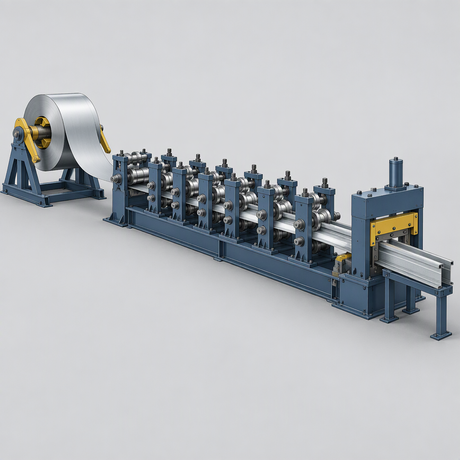
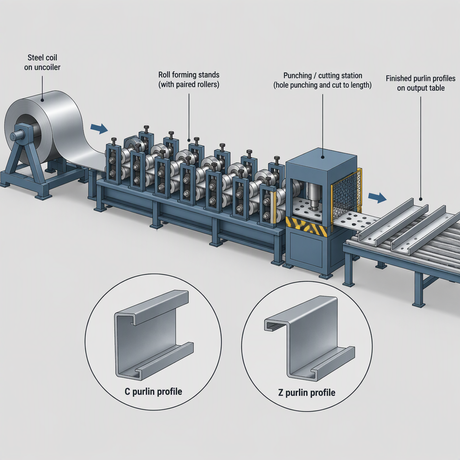
Coil width variation should not be blamed on the coil alone until the entry guide has been checked for lateral position, strip elevation, parallel guide rails, and repeatable settings. Roll forming depends on strip moving longitudinally through successive paired roller dies, so incoming coil shape and material variation can still affect the final profile even when the guide is set correctly.
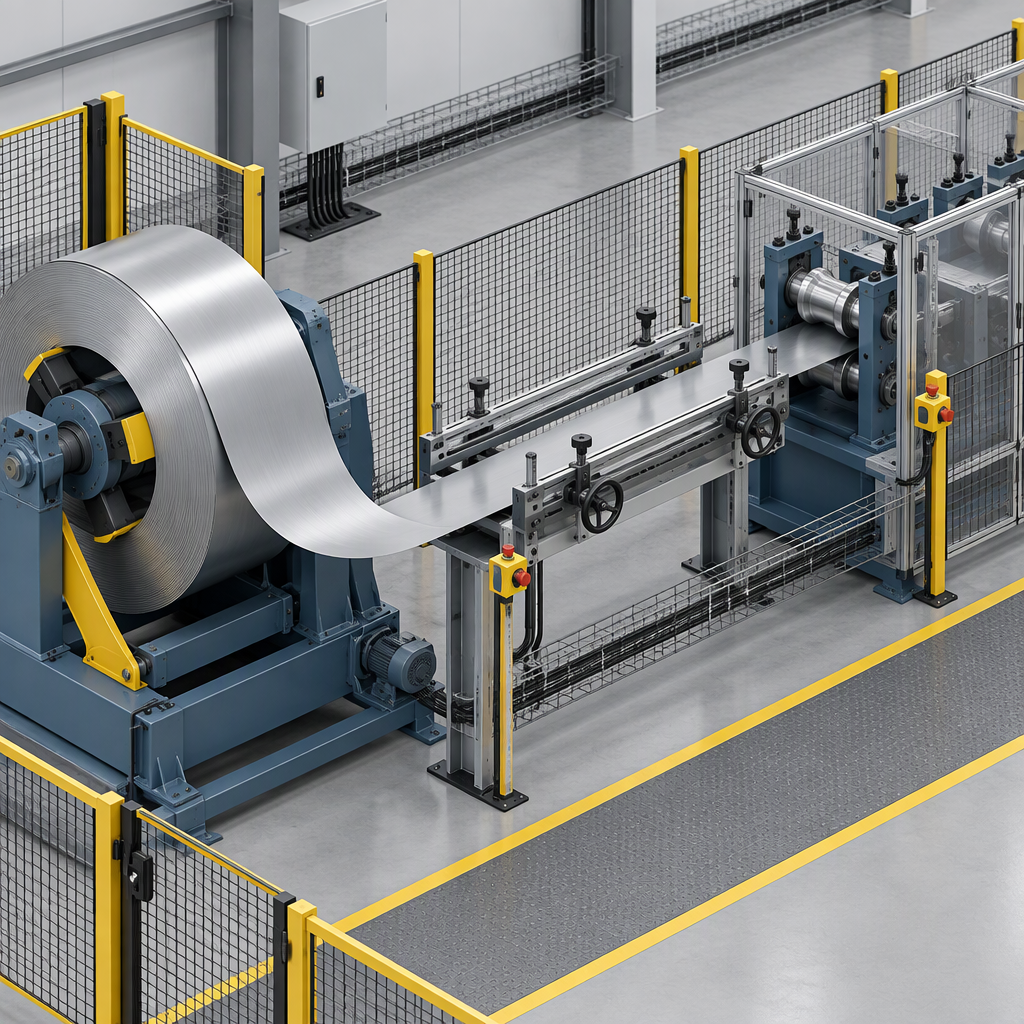
Why entry guidance matters when coil width changes
Roll forming entry guidance matters because it controls how the strip enters the first forming pass; it does not correct the strip width, but it can prevent a width issue from becoming a setup, twist, burr, or dimensional-control problem.
Entry guides and entry tables are used to guide incoming strip into the first forming pass by setting the strip's lateral location and elevation. If the guide rails are not parallel, the strip is not centered, or the elevation is inconsistent with the tooling, the line can add avoidable variation before forming begins.
In roll forming, flat sheet or strip is fed through successive paired roller dies that progressively bend the material into the final shape. That makes the first contact conditions important: the forming sequence assumes the strip is presented consistently before the downstream stands begin to shape it.
Separate coil-width variation from entry-guide error
Treat width variation as a material, slitting, or developed-width issue when the measured strip width, bend allowances, flat lengths, material behavior, or incoming coil shape cannot support the profile geometry, even with a correctly aligned guide.
| Question to answer | What it suggests | Practical buyer or engineer action |
|---|---|---|
| Does the strip width match the developed cross-section estimate based on flats, bend arc length, and the neutral-line assumption? | A mismatch points toward strip-width calculation, slitting, or profile-development review rather than guide adjustment alone. | Recheck the developed-width calculation and compare it with actual slit-coil measurements before moving guide settings. |
| Is the incoming coil showing camber, crossbow, coil set, center buckle, or other shape imperfections? | Incoming coil shape can influence dimensional control and part quality independently of the entry guide. | Measure and record the incoming condition, then decide whether leveling, coil acceptance criteria, or supplier review is needed. |
| Has the material grade, springback behavior, yield strength variability, or profile complexity changed? | Material and profile variables can change how the section forms through the stands. | Escalate to process engineering or tooling review when the same guide setting behaves differently with a changed material condition. |
An entry guide should not be used as a substitute for correct developed width. A profile made from bends and flats still depends on a strip width estimate that reflects the formed geometry and material behavior.
Use symptoms to decide what to inspect first
Start with entry-guide inspection when the symptoms follow strip presentation: snaking into the first pass, uneven side contact, twist, edge burr, or dimensional drift that changes after guide movement.
| Observed symptom | First entry-guide check | When to look beyond the guide |
|---|---|---|
| Strip appears to steer or snake before the first forming pass. | Check that the guide rails are parallel and that the strip is not forced laterally into one side. | If the strip enters straight but the profile still drifts, inspect coil shape and material behavior. |
| Twist or dimensional inconsistency appears after setup changes. | Verify guide elevation, side clearance, and the recorded setup position. | If the issue repeats across correct guide settings, review developed width and tooling assumptions. |
| Burr or edge marking is heavier on one side. | Inspect whether one guide rail is over-contacting the strip edge or holding the strip off its intended path. | Check slitting quality and edge condition if balanced guide contact does not remove the symptom. |
Check entry-guide alignment before changing the process
Before changing forming stands or blaming the coil, confirm that the entry guide is square to the line, parallel across the guide rails, set to the correct strip elevation, and recorded against a fixed reference.
- Stop the line according to the plant's lockout and operating procedures before manual access to the entry area; do not reach into powered equipment or moving strip.
- Use a fixed machine reference, such as the first pass or a verified centerline reference, to check whether the guide presents the strip straight into the tooling.
- Check the guide rails for parallelism so the strip is supported without being wedged, skewed, or pushed harder on one edge.
- Verify strip elevation at the entry table or guide area so the material enters the first forming pass at the intended height.
- Confirm side clearance using the actual measured strip width for the coil being run, then tighten or secure adjustments in the same sequence each time.
- Run a controlled sample under normal operating procedures and compare the result with the recorded setup before making further process changes.
Document guide settings so width changes do not reset the process
Repeatability improves when the plant records guide position, rail gap, elevation, coil width, and the reference points used, instead of relying on operator memory after every coil or job change.
- Record the measured strip width for the coil and the guide gap used for that run.
- Record left and right guide positions from a stable machine reference rather than from a movable or informal mark.
- Record entry elevation or shim conditions when the line uses shimming or adjustable support to set strip height.
- Record the profile, material, and coil identifier so future troubleshooting can separate guide settings from incoming material differences.
- Keep a setup-change log that notes which adjustment changed the symptom and which adjustment did not.
- Use documented settings as a starting point, then verify with measured strip and formed-part results before releasing production.
Buyer checklist for roll forming entry guidance
Equipment buyers should ask how the line supports accurate strip presentation, alignment verification, elevation control, and documented setup changes before treating the entry guide as a minor accessory.
- Ask how the entry guide is referenced to the first forming pass and how rail parallelism is checked during setup.
- Ask whether guide position and elevation can be measured and recorded in a repeatable way for different strip widths.
- Ask how the supplier expects the line to handle incoming coil conditions such as camber, crossbow, coil set, or center buckle.
- Ask what information is needed to confirm developed strip width for profiles with multiple flats and bends.
- Ask what setup documentation, reference dimensions, or operator checks are recommended for recurring jobs.
- Ask where the supplier's responsibility ends and where material specification, slitting quality, leveling, or tooling review should begin.
Know when to escalate beyond the entry guide
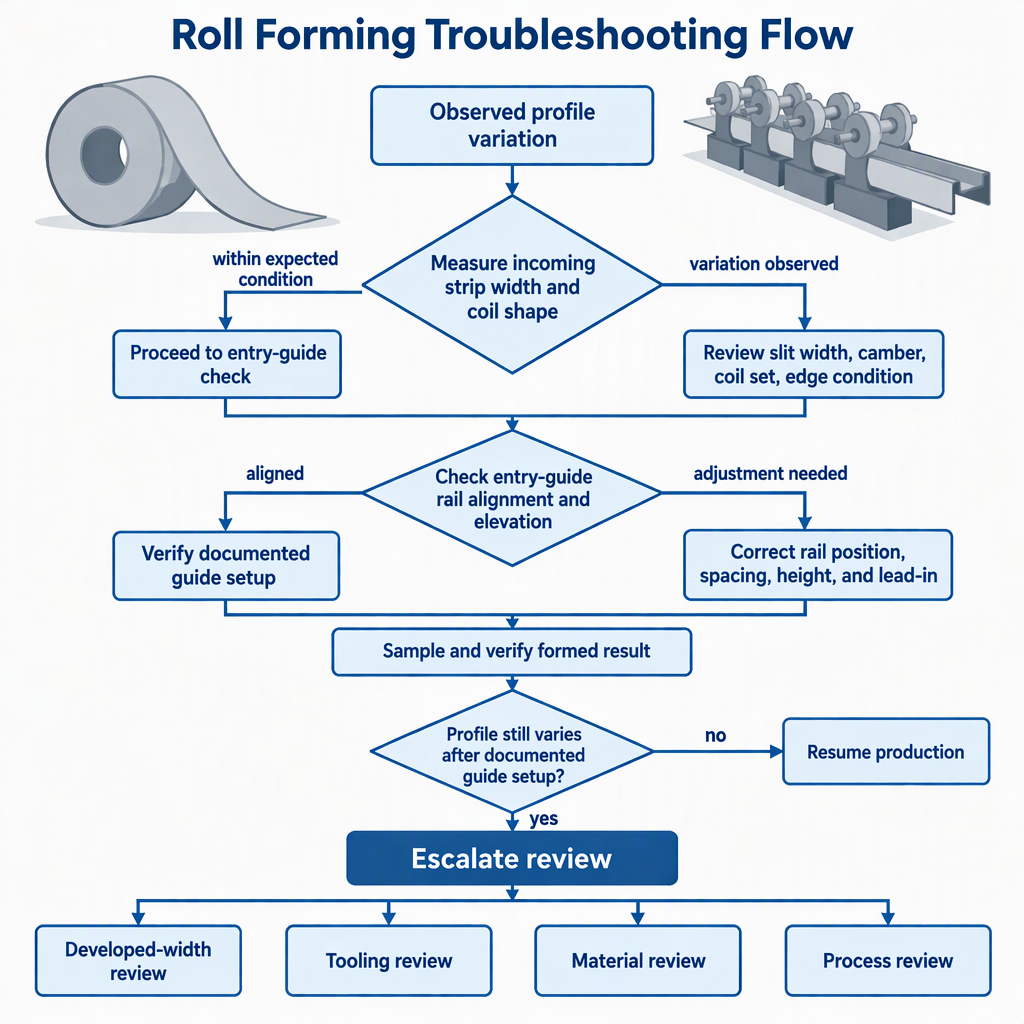
Stop adjusting the entry guide when measured strip presentation is repeatable but the formed profile still changes with material grade, coil condition, developed width, springback, or profile complexity.
Entry guidance controls strip presentation into the first pass. It does not replace correct strip-width estimation for a cross-section made from flats and bends. It also does not remove the influence of material properties, yield-strength variability, springback, or incoming coil shape imperfections described in AHSS Guidelines roll forming guidance.
- If the symptom changes immediately when the guide rails, gap, or elevation change, entry guidance remains a likely control point.
- If the measured slit width does not support the developed profile, review the strip-width calculation and slitting process.
- If different coils behave differently under the same documented setup, investigate material properties and incoming coil shape.
- If no documented setup exists, create one before making conclusions from one coil or one operator's adjustment.
Conclusion
A practical troubleshooting path is to measure the coil, verify entry-guide alignment and elevation, document the repeatable setup, and escalate only when the evidence points beyond strip presentation.
For metal building-product plants, roll forming entry guidance is a controllable boundary condition at the start of the line. Correct developed width and slitting remain essential for the profile geometry. Material behavior and incoming coil shape must be part of the same investigation when the guide is already repeatable.
FAQs about roll forming entry guidance and coil width variation
These questions help engineers, production teams, and equipment buyers decide what to check before changing tooling or blaming one coil.
Can entry guidance fix coil width variation?
No. Entry guidance can present the strip consistently to the first forming pass, but it does not change the measured slit width of the coil.
Why can a small width change affect a roll formed profile?
A roll formed cross-section depends on flat lengths, bend arc length, and the neutral-line estimate, so strip width changes can affect how the final geometry is achieved.
What symptoms point to entry-guide error?
Snaking into the first pass, one-sided guide contact, twist after setup, burr on one edge, or dimension drift that changes after guide movement are reasons to inspect the entry guide early.
What coil conditions should be checked before blaming the guide?
Camber, crossbow, coil set, center buckle, material grade, springback behavior, and yield-strength variability can all influence dimensional control and part quality.
How should entry-guide settings be recorded?
Record strip width, guide gap, left and right positions, elevation or shim condition, reference points, coil identifier, and the formed-part result.
What should equipment buyers ask about entry guidance?
Ask how the guide is aligned to the first forming pass, how rail parallelism and elevation are checked, and how settings are documented for repeat jobs.
When should the team escalate beyond the entry guide?
Escalate when the guide is aligned and repeatable but the profile still varies with material grade, coil shape, springback behavior, or profile complexity.