


Line speed
Line speed is tied to strip travel through the roll stands and does not, by itself, state how many finished pieces are accepted at the end of the line.

Views: 0 Author: Site Editor Publish Time: 2026-11-17 Origin: Site

Roll forming line speed describes strip travel through the forming process, while finished output is the accepted part count after forming, in-line operations, cutoff, handling, and quality losses; equipment buyers should compare quotations using operational metrics, not one headline speed number.
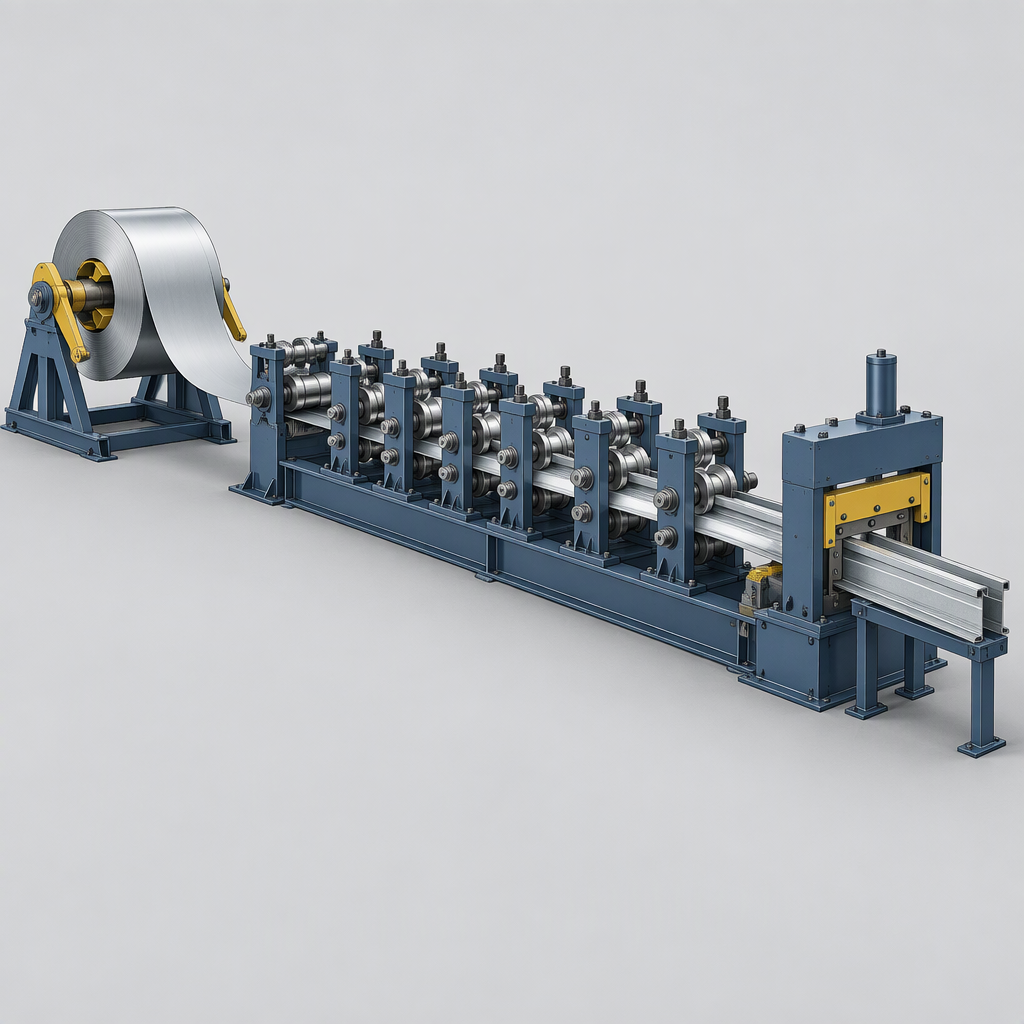
In roll forming, line speed is best understood as the linear movement of flat sheet or strip as it passes through successive paired roller dies that bend it toward the final profile; the AHSS Guidelines roll forming guidance describes the process as longitudinal feeding through roller dies, commonly with coil feeding, forming, and cutting to length.
Line speed is tied to strip travel through the roll stands and does not, by itself, state how many finished pieces are accepted at the end of the line.
Finished output depends on the same forming path plus the in-line operations needed for the ordered part, such as cutting to length, punching, notching, slotting, embossing, or curving.
A manufacturing reference entry from Springer Nature describes roll forming as a process used for uniform profiles and frames it as a process-design problem, which is why a quoted speed should be read in the context of the profile and material being formed.
Finished output differs from line speed because production performance should be measured with operational data and formal metrics, not by assuming that strip travel automatically becomes accepted parts.
| Comparison point | Line speed | Finished output |
|---|---|---|
| What it describes | Linear strip movement through the roll forming process. | Accepted parts after forming and required downstream or in-line operations. |
| Typical buyer risk | A single speed metric can be misread if it is not tied to operating conditions and measurement boundaries. | A useful output claim should define the metric, data source, acceptance rule, and operating assumptions. |
| Where bottlenecks appear | The forming section may run continuously. | Cutoff, hole patterns, embossing, curving, handling, and inspection can govern the actual count. |
The most important bottlenecks are the operations that must happen in sequence with forming, because roll forming can include notching, slotting, punching, embossing, curving, contour forming, and cutting to length.
| Operation or condition | Why it changes output | Buyer check |
|---|---|---|
| Cutting to length | Each finished part must be separated from the continuous strip path. | Ask whether the quoted speed assumes flying cutoff, stop-start cutting, or another cutoff method. |
| Punching, notching, and slotting | Feature patterns add position-dependent operations that may constrain the cycle. | Provide the hole pattern, pitch, part length, and tolerance requirements with the RFQ. |
| Embossing or curving | Additional forming or shaping steps can change the practical operating window. | Request output estimates for the exact part family, not for a plain profile only. |
| Inspection, scrap, and rework | Manufacturing performance metrics should reflect operating data, not only equipment motion. | Ask how rejected parts, trial pieces, and changeover losses are counted. |
A responsible first-pass estimate starts with the stated speed, then applies the actual part length, required in-line operations, availability assumptions, and accepted-part criteria as separate measurement steps.
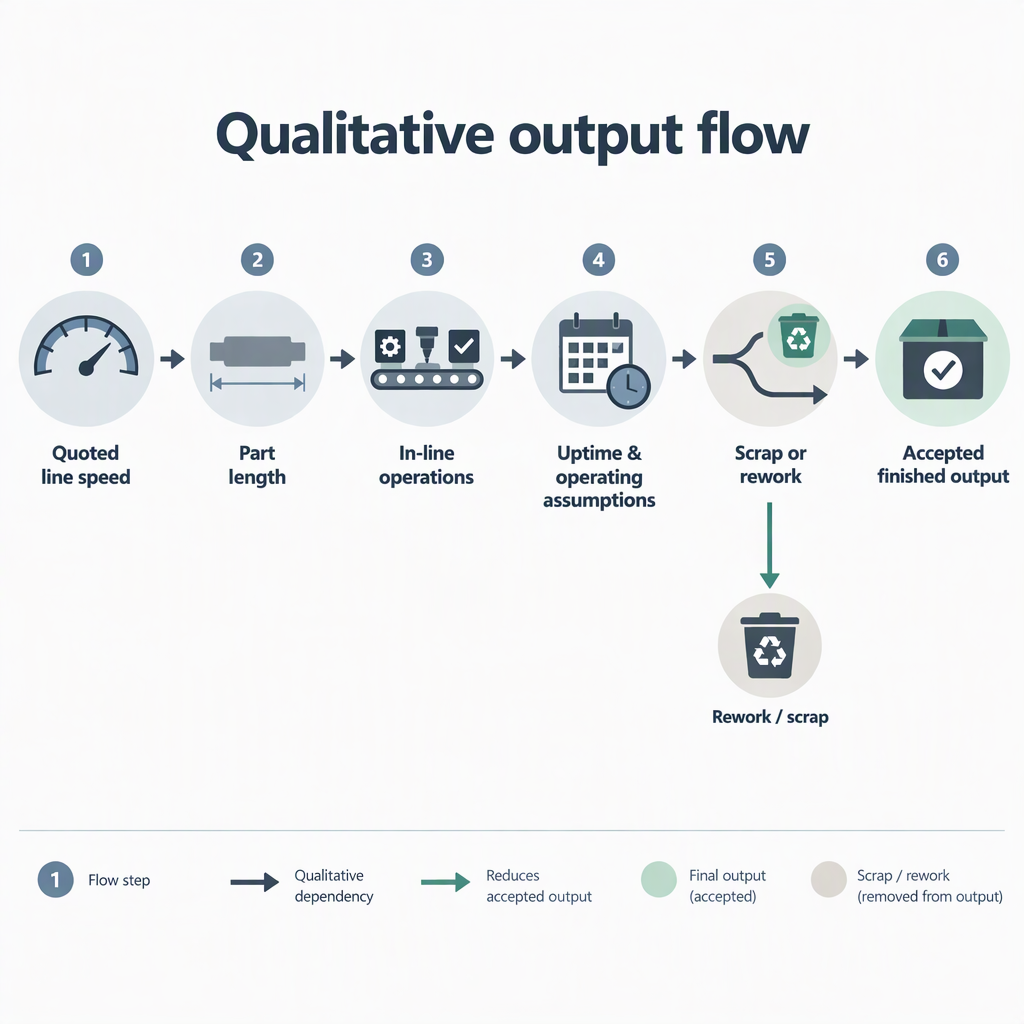
Before accepting a speed claim, request the metric definition, operating assumptions, data basis, and acceptance boundary used to turn machine motion into finished output.
A speed comparison is useful only when the compared lines are being evaluated for similar profile design, material requirements, process assumptions, and output definitions.
The Springer Nature reference frames roll forming around process design and simulation considerations for profiles and materials, so buyers should treat speed as application-dependent rather than a universal machine ranking.
The AHSS Guidelines page also ties roll forming to design factors and optional in-line operations, which supports asking suppliers for part-specific output assumptions.
A strong RFQ asks each supplier to translate line speed into finished output with the same part drawing, material, operations, quality boundary, and metric definition.
| RFQ item | Ask the supplier to define | Why it matters |
|---|---|---|
| Speed basis | Whether the number is peak speed, operating speed, or measured output. | Performance metrics need clear boundaries to be comparable. |
| Part family | Profile geometry, part length, hole pattern, and in-line operations. | Roll forming output changes when forming and auxiliary operations change. |
| Acceptance count | Whether rejected pieces, setup pieces, rework, and inspection holds are excluded. | Finished output should reflect accepted production, not only motion. |
Line speed and finished output are related, but they are not the same purchasing metric; the safer comparison is to start with the forming process, then account for in-line operations and measured acceptance criteria.
The most useful buyer questions focus on definitions, assumptions, and comparable output metrics.
No. Line speed describes strip travel through the roll forming process, while finished output counts parts after forming and required operations are completed.
Only as a first-pass estimate after the part length and cutoff method are known; feature operations and acceptance criteria can change the final count.
The limiting operation depends on the part, but cutting, punching, notching, slotting, embossing, and curving are common points to check because they can be integrated with roll forming.
They may be using different metric definitions, operating assumptions, or acceptance boundaries, so request the basis of calculation before comparing the numbers.
Yes. Roll forming is a process-design problem for profiles and materials, so a speed claim should be checked against the exact material, geometry, tolerance, and forming route.
Ask the supplier to state whether the number is maximum line speed, stable production speed, theoretical output, or measured accepted output under defined conditions.


