When the concern is coil memory
Coil set and crossbow relate to shape condition carried from the coil, so the line discussion should focus on how leveling or flattening will prepare material before cutting.

Views: 0 Author: Site Editor Publish Time: 2026-12-06 Origin: Site

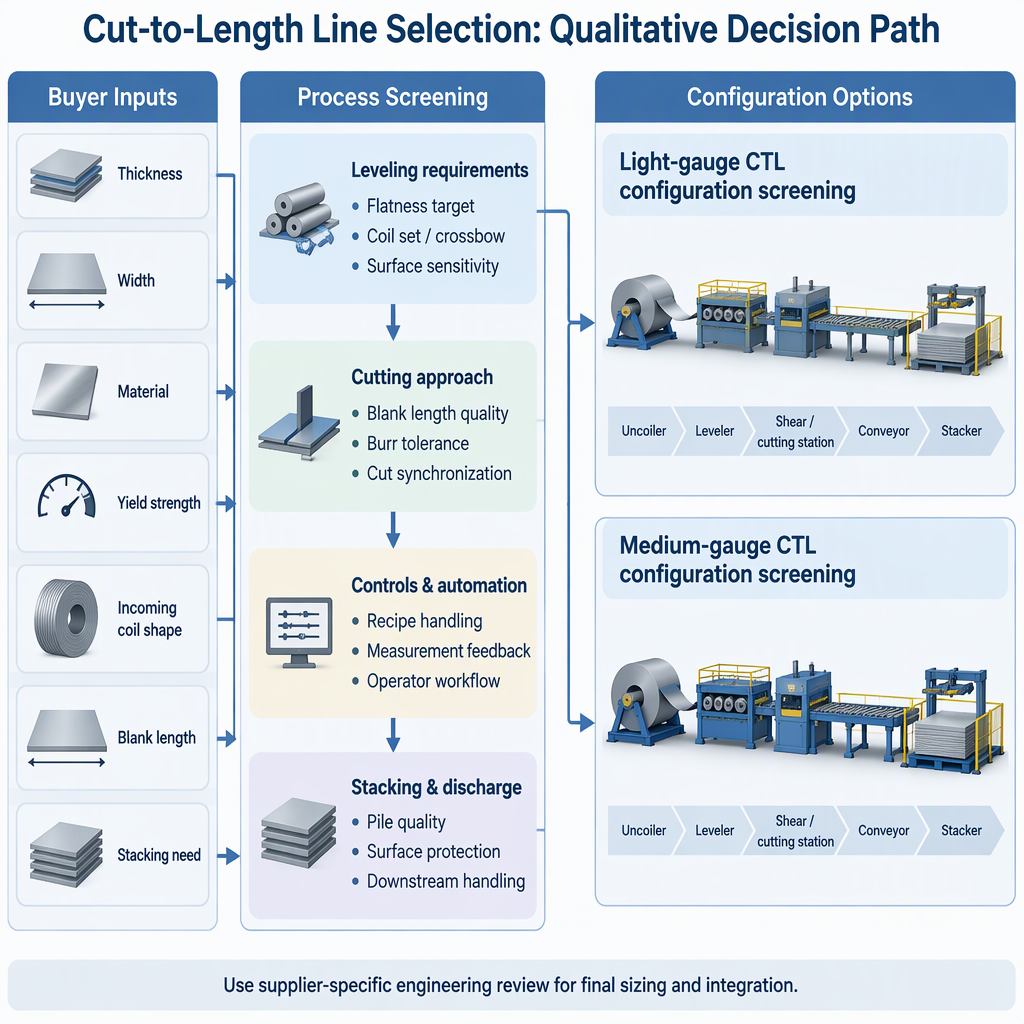
Cut-to-length line selection should start with the coil you actually process and the blanks you need to produce: confirm thickness, width, material, yield strength, incoming shape, cutting method, stacking needs, and downstream roll-forming interface before comparing machine options.
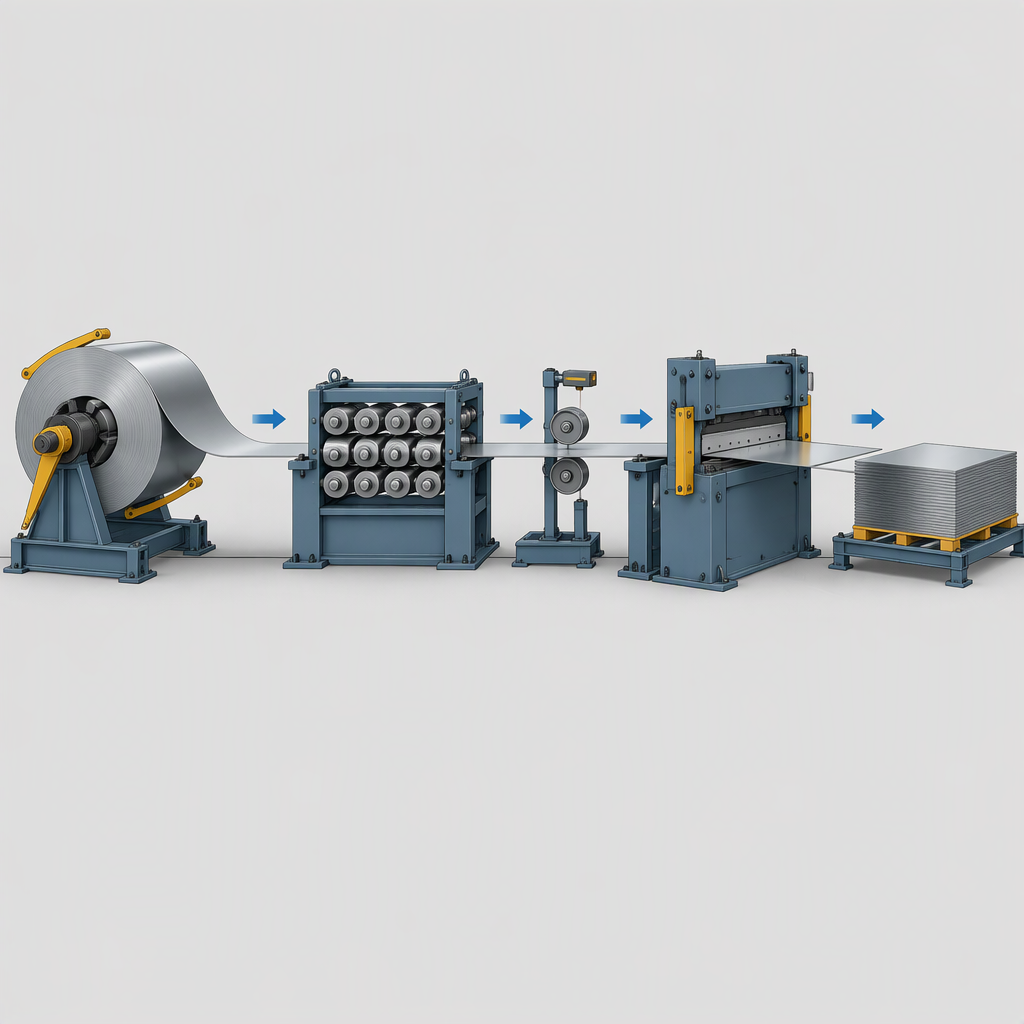
A cut-to-length line converts coiled metal into flat sheets through uncoiling, leveling or flattening, measuring and cutting, then stacking or handling, so each selection choice should be tied to a step in that workflow.
For procurement teams, this workflow turns a vague request for a CTL line into a set of machine boundaries: entry handling, leveling need, cutting arrangement, control requirements, and finished-sheet discharge.
The first shortlist filter is not brand preference; it is whether the candidate line is stated for the buyer’s coil thickness, feeding width, material type, strength range, and required handling process.
| Selection input | Why it matters | Buyer action |
|---|---|---|
| Material thickness range | A listed medium-gauge example states 0.3–2.8 mm, while a listed light-gauge example states 0.135–0.426 mm. | Screen options against your thinnest and thickest routine coils, not only a nominal gauge. |
| Feeding width | One listed medium-gauge example states 1250 mm feeding width. | Give suppliers maximum coil width and any future width range you expect to run. |
| Width options | One listed light-gauge example states 900 mm, 1200 mm, and 1250 mm feeding width options. | Match width options to the building-panel, trim, or sheet sizes you plan to blank. |
| Material and strength | A listed medium-gauge page names galvanized steel sheet and color-coated sheet applications with Q235–550 MPa yield strength. | Provide material grade, coating, and strength range so the supplier can check the applicable configuration. |
| Light-gauge material range | A listed light-gauge page names galvanized sheet and PPGI with 350–420 MPa yield strength. | Do not assume a light-gauge line fits heavier or higher-strength material unless the supplier confirms it for your coils. |
Use light-gauge and medium-gauge examples as applicability screens, not as proof that one configuration is universally better for every coil or output target.
| Procurement comparison point | Light-gauge listed example | Medium-gauge listed example |
|---|---|---|
| Thickness stated on product page | 0.135–0.426 mm | 0.3–2.8 mm |
| Feeding width stated on product page | 900 mm, 1200 mm, and 1250 mm options | 1250 mm |
| Application material stated on product page | Galvanized sheet and PPGI | Galvanized steel sheet and color-coated sheet |
| Control arrangement stated on product page | PLC control | PLC control |
| Cutting arrangement stated on product page | Stop-to-cut post cutter arrangement | Hydraulic post cutting within a workflow that also lists decoiler, rubber roller feeding, straightening, slitting, PLC control, and run-out table |
Treat these listed values as product-page screening information. For an actual purchase, confirm the exact coil specification, finished blank requirement, controls, stacking arrangement, and installation interfaces for your production plan.
Incoming coil shape can affect blank usability because coil set, crossbow, edge wave, center buckle, camber, and twist are different defect types that may require different leveling or processing attention.
Do not reduce leveling selection to thickness alone. Misaligned or deflecting processing rolls can create additional shape problems, so buyers should discuss incoming strip condition, expected flatness, and acceptable finished-sheet condition with the supplier before freezing the configuration.
Coil set and crossbow relate to shape condition carried from the coil, so the line discussion should focus on how leveling or flattening will prepare material before cutting.
Edge wave and center buckle are different flat-rolled shape defects, so procurement should describe the observed defect instead of asking only for a generic leveling function.
Camber and twist can affect how material behaves through processing, so the buyer should share sample coil condition and finished blank expectations during technical review.
Processing-roll misalignment or deflection can introduce shape problems, so acceptance checks should include finished-sheet condition, not only whether the line starts and cuts.
After coil limits are clear, translate output needs into blank length, cutting method, stacking or run-out handling, control workflow, and connection to downstream roll forming or storage.
A good RFQ should force both buyer and supplier to confirm coil boundaries, finished blank requirements, leveling expectations, cutting arrangement, control needs, stacking method, and documentation before shortlisting.
If your purchasing specification depends on a particular dimensional tolerance standard, name the standard and edition you require in the RFQ and ask the supplier to confirm how compliance will be checked for your material and blank size.
The most reliable CTL shortlist is built from verified coil data and required finished-sheet output, then checked against stated line configuration boundaries.
For equipment procurement, the practical goal is not to buy the most broadly described CTL line; it is to buy the line whose confirmed limits match your real coil inventory, finished blank plan, and plant workflow.
Most CTL selection questions come down to coil limits, leveling need, cutting and stacking workflow, and how the finished blanks will be used.
It changes coiled metal into flat sheets through uncoiling, leveling or flattening, measuring and cutting, and stacking or handling.
Prepare thickness, feeding width, material type, coating, and yield-strength information because these are typical product-page screening fields for CTL applicability.
Compare the stated thickness range, feeding width, material application, cutting arrangement, and control arrangement; do not assume a light-gauge configuration fits a heavier coil without supplier confirmation.
Leveling matters because coil set, crossbow, edge wave, center buckle, camber, and twist are different shape problems that can affect finished-sheet usability.
Discuss stacking when repeated sheet output, run-out handling, packaging flow, or downstream movement affects labor, layout, or sheet handling in your plant.
Include coil specifications, finished blank sizes, batch pattern, leveling expectations, cutting method, stacking needs, controls, downstream use, and the tolerance or inspection standard you require.
Do not assume that; screen each candidate line against stated material thickness, feeding width, material type, and strength range, then ask the supplier to confirm future coil cases before purchase.