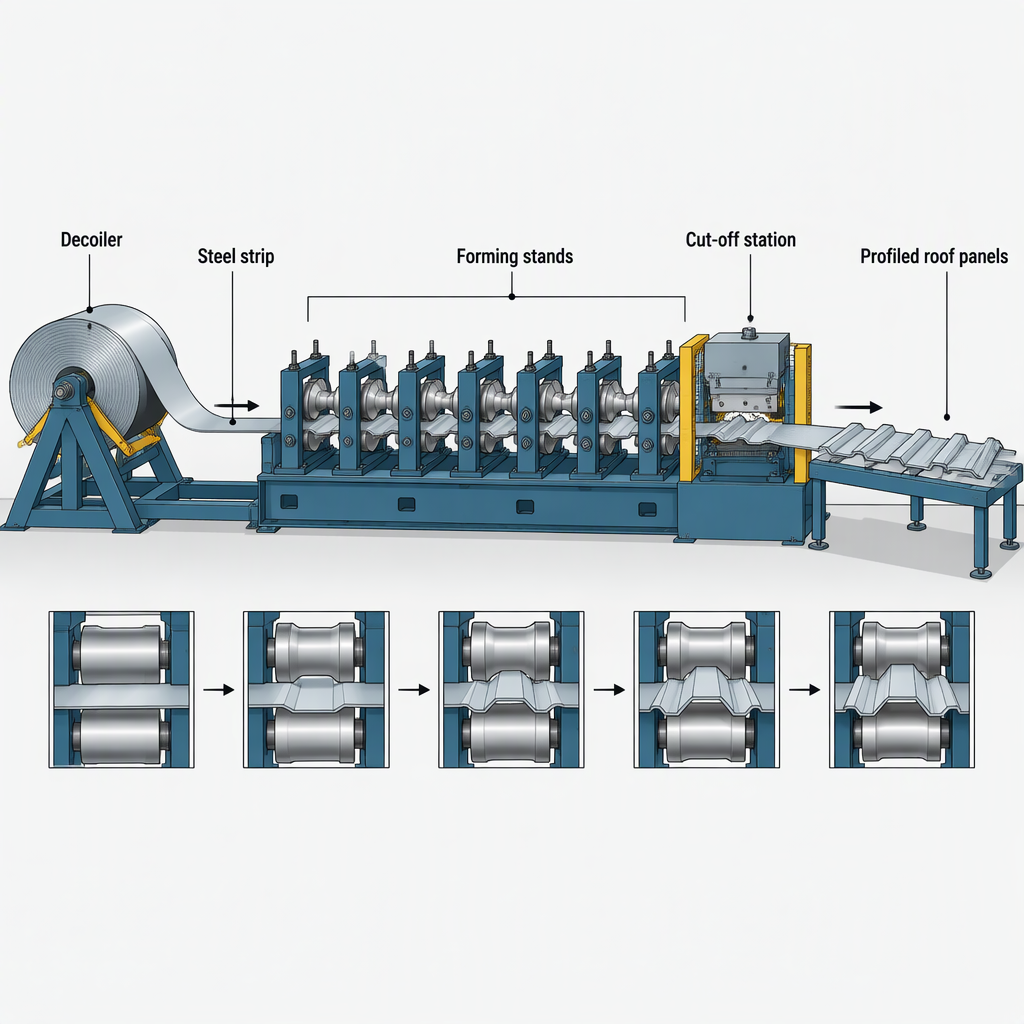
A metal roofing roll forming machine turns flat steel coil into finished roof panels: the coil is fed through a series of rollers that progressively shape it into an interlocking profile, and the line then cuts and runs out each panel. That forming task drives every later choice, so start with your panel and coil requirements, map them to a configuration, clear guarding and conformity, then compare quotes on one scope.
- Coil handling — steel strip is loaded onto a decoiler; the machine range that Xiamen BMS Group publishes for metal roofing includes hydraulic decoilers, electric cutting machines and electric seamers.
- Forming — the strip is driven through a series of rollers that shape it into an interlocking panel profile.
- Control and profile change — Xiamen BMS Group states that its standing seam machines run from a PLC controller with a quick-change design and offer multi-profile capability as an option.
What should you fix about the panel and coil before you compare machines?
Fix four inputs first: the roof profile and seam detail, the steel substrate and its thickness range, the coil width and maximum coil weight the line must accept, and the panel lengths you will sell. A line shapes one profile from one strip, so a vague brief produces two different machines.
- Profile drawings for every panel you intend to sell, including the seam detail and the dimensions that must be reproduced.
- Steel substrate and the full thickness range you expect to run.
- Coil width range and maximum coil weight, so the decoiler and the entry guides can be sized.
- Panel length range, shortest to longest, and how each panel is cut.
- Surface finish — painted, galvanised, coated or bare — and the handling it needs.
- Site constraints: floor length, headroom, foundation or container pad, and the power supply you can provide.
- Target output expressed as the panels and metres you need per shift, not as a machine speed.
Panel and seam decisions come from the roof, so start from how metal roof panels are installed and inspected. The Metal Construction Association publishes a metal roof installation manual, a roofing certification programme and industry-average environmental product declarations, a useful independent reference when you settle seam detail with your customers.
How do those requirements turn into machine specifications?
Convert each written requirement into a machine field, then ask every supplier to state a guaranteed value in the quotation. The profile drawing constrains the roller set, the thickness range the forming stands, the coil weight the decoiler — so offers that answer field by field can be compared.
From requirement to machine field, and what to confirm in writing | Your written requirement | What it constrains on the line | What to confirm in writing |
| Panel profile and seam detail | The roller set and the profile the line can form | That the supplier can form your profile drawing, and the dimensions the line will hold |
| Steel substrate and thickness range | Forming stands, shafts and drive sizing | The guaranteed thickness range, with the material grades it covers |
| Coil width and maximum coil weight | Entry guides, decoiler capacity and strip alignment | The coil width range and the maximum coil weight the decoiler accepts |
| Panel length range and cut method | Cut-off unit, run-out support and stacking | The panel length range, the cut method and the length accuracy stated as a figure |
| Output per shift | Drive, control and line speed | Guaranteed production figures as a range, with the conditions they were measured under |
| Surface finish and control package | Roller and guide finish, plus a PLC controller with a quick-change design, which Xiamen BMS Group states on its standing seam machines, with multi-profile capability offered as an option | The roller finish recommended for your coating, and which profiles any multi-profile option covers |
Fixed factory line or container-mounted mobile line: which configuration fits your project?
Decide from panel logistics. A fixed line suits repeatable production where coil arrives in bulk and finished panels travel to site by road; a container-mounted line suits projects where moving long panels is the constraint — Xiamen BMS Group states that its standing seam machines can be mounted in a 20 ft or 40 ft container for on-site production.
Fixed factory line
Best fit: steady, repeatable production against a stable panel catalogue.
Strengths: coil is handled in one place and the line stays inside your own maintenance routine.
Watch-outs: panel length is limited by how far finished panels can be transported.
Confirm: floor length, headroom, foundation and the power supply the line needs.
Container-mounted mobile line
Best fit: projects where long panels are difficult to transport, or where forming at the building reduces panel handling.
Strengths: panel length is set by the roof rather than by the truck, because the line travels to the site.
Watch-outs: you must arrange a level pad, site power, coil delivery, offloading and secure storage of the container.
Confirm: whether the line is built for a 20 ft or 40 ft container, and which site services the supplier expects.
Multi-profile line
Best fit: a catalogue with more than one roof profile, or a mix of project types.
Strengths: one line covers more of the catalogue, because Xiamen BMS Group offers multi-profile capability as an option on its standing seam machines.
Watch-outs: a profile changeover takes time and may need additional roller sets or tooling.
Confirm: which profiles the option covers, what changes at each changeover, and what the option includes.
Settle the supporting equipment with the line: the metal roofing range Xiamen BMS Group publishes includes hydraulic decoilers, electric cutting machines and electric seamers, plus purlin, metal deck, stud and track, gutter and ridge cap lines; those items decide how coil is loaded and seams are closed.
Which safety and guarding questions belong in the selection process?
Ask to see the guarding arrangement before you accept the design, not after installation. The UK Health and Safety Executive identifies drawing-in or trapping between rollers, and between belts and pulley drives, as machinery hazards, and sets a preferred order of safeguarding: fixed guards where practical, then interlocks, then trip devices such as light guards, then jigs and holders, with any remaining risk controlled by information, training and supervision.
Put the guarding questions to each supplier in writing: which zones are covered by fixed guards, which by interlocks, what happens to the drive when a guard is opened, where the emergency stops sit, and which measures rely on operator training or supervision rather than on a guard.
Clearing a jammed strip, cleaning rollers or adjusting a guide brings hands into the forming zone. Switch the line off and disconnect or lock off its power supply before any manual access, then use only the access the machine manual permits. The HSE advises isolating or locking off power before clearing blockages, cleaning or adjusting machinery, and the forming zone and drives stay guarded whenever the line is running.
The safeguard order and the isolation expectation come from the regulator's own guidance: the Health and Safety Executive's introduction to machinery safety sets out the fixed guard, interlock and trip device sequence, and the requirement to isolate power before clearing a blockage or adjusting the machine.
Which conformity documents should you expect, and how do you check them?
Expect a declaration of conformity, a technical file the manufacturer keeps and can produce, instructions your operators can read, and the marking that applies where the machine is first placed. In the EU, Machinery Directive 2006/42/EC currently harmonises the essential health and safety requirements for machinery; Machinery Regulation (EU) 2023/1230, adopted on 14 June 2023, applies on a mandatory basis from 20 January 2027, so a machine placed on the EU market before that date must comply with the Directive.
A certificate from a testing company does not, by itself, prove compliance. The European Commission states that unregulated or voluntary certificates are not a recognised means of proving compliance, that CE marking may only be affixed after the prescribed conformity assessment, and that a notified body's certificate counts only within the area that body is notified for. Ask which legislation the declaration cites and which assessment route was used, rather than treating any certificate as the answer.
For a machine placed on the market in Great Britain, the HSE states that new machinery must be UKCA or CE marked, supplied with a declaration of conformity and accompanied by instructions in English. Other markets set their own placement duties, so confirm the requirements where the machine will be used.
Documents to request, what they should tell you, and how to screen them | Document | What it should tell you | How to screen it |
| Declaration of conformity | The legislation the machine is declared against, and the manufacturer or authorised representative | Check that it names your model and configuration, cites the applicable legislation, and is signed and dated |
| Technical file | The drawings, guarding layout, electrical and hydraulic schematics and component list | Agree which drawings are handed over with the machine and which stay with the manufacturer |
| Instructions and manual | Installation, operation, adjustment, maintenance and the permitted way to clear a blockage | Confirm the language, and that the manual covers the configuration you ordered |
| Guarding drawing | The guarding arrangement, and how the safeguard order was applied to the forming zone and drives | Compare the drawing against the machine before acceptance, not after installation |
| Notified body certificate, where the assessment route uses one | Which conformity assessment route was used, and for which machine | Check the body's identification number and that the machine falls within that body's notified scope |
| Marking | The CE or UKCA mark and where it is applied on the machine | Confirm the mark is on the machine and consistent with the declaration |
The compliance position is published directly: the European Commission's machinery legislation page sets out the Directive to Regulation transition dates, the basis for affixing CE marking and its position on voluntary certificates.
How should you plan acceptance, commissioning and maintenance before the machine ships?
Agree in the contract what will be tested, who attends, what training operators receive and how the line will be maintained from the first week. Under the Provision and Use of Work Equipment Regulations 1998 (PUWER), which apply in Great Britain, work equipment must be maintained in an efficient state, in efficient order and in good repair, a maintenance log where one is kept must be up to date, and maintenance must be carried out safely — so the maintenance plan belongs in the purchase documents rather than in the commissioning week.
The HSE groups this guidance around inspection, maintenance, training and competence, and mobile work equipment, the areas a handover must cover.
- Factory acceptance: run the ordered profiles and thickness range, and record the guaranteed figures the supplier stated.
- Pre-shipment screen: confirm the marking, the declaration of conformity and the manual travel with the machine, and that the guarding matches the agreed drawing.
- Site preparation: verify the foundation or container pad, power supply and level conditions against the supplier's drawing before the line arrives.
- Power-up and function test: check each guarded zone, the emergency stops and the control interlocks with the supplier's engineer present.
- Training and maintenance handover: train operators on the ordered configuration, including the permitted way to clear a blockage, and agree the inspection and lubrication schedule taken from the manual, who records it and where the log is kept.
Plan maintenance work from the manufacturer's instructions, schedule it into downtime, isolate and lock off the power, and release stored energy such as compressed air or hydraulic pressure before work begins — the HSE advises these precautions on top of the duty to keep equipment in good repair.
- A maintenance plan built from the manufacturer's instructions, not a generic interval.
- A named owner for the maintenance log, and a fixed place to keep it.
- Isolation points identified and labelled, with locks or tags available.
- A spare-parts and wear-parts list with the supplier's replacement recommendation.
- Service contact arrangements recorded in the contract.
The maintenance duty and the isolation precautions come from the regulator: the Health and Safety Executive's maintenance of work equipment guidance covers the efficient-state requirement, the maintenance log and releasing stored energy before work begins.
How do you make competing machine quotes comparable?
Send every supplier the same written requirement list and ask each to answer it in the same order. When one offer states a coil weight and another leaves it out, close the gap before comparing totals.
- The profile drawings the offer covers, and the profiles any multi-profile option adds.
- The guaranteed thickness range, with the material grades it covers.
- Coil width range and maximum coil weight.
- Panel length range, cut method and length accuracy stated as a figure.
- Guaranteed production figures as a range, with the conditions they were measured under.
- The guarding arrangement, and which parts of the safeguard order were applied.
- Marking, declaration of conformity, manual language and the drawings handed over.
- Power supply, footprint, weight and foundation or container requirements.
- What is included in delivery, installation, commissioning and training, and what is excluded.
- Spare and wear parts, and the supplier's recommended maintenance items.
- The delivery, installation and training dates each supplier commits to in the contract.
Keep the answers in one sheet with a column per supplier. Where a field is answered by a general statement rather than a figure or a document, mark it unresolved and ask again before comparing totals.
Conclusion: choose the machine that matches a written requirement list
Write the panel and coil requirements first, convert them into machine fields, choose the configuration that fits your panel logistics, clear guarding and conformity, plan acceptance and maintenance, then compare quotes on one scope.
- Requirement list first: profile and seam detail, substrate and thickness range, coil width and weight, panel length, finish and site constraints.
- Guarding and isolation as selection criteria: safeguarding follows fixed guards, then interlocks, then trip devices, and clearing, cleaning or adjusting starts with switching off and locking off the power.
- Conformity as a document check: confirm the declaration of conformity and the assessment route, rather than accepting a voluntary certificate.
- Maintenance planned at handover: a plan taken from the manufacturer's instructions, with isolation and stored-energy release before work begins.
Compare quotes only once every supplier has answered the same requirement list, and keep the agreed figures, drawings and documents in the contract so acceptance has something to check against.
Frequently asked questions
These are the questions buyers most often leave until late.
Is a container-mounted mobile roll forming line better than a fixed factory line?
Neither is better in general; they solve different problems. A container-mounted line fits projects where moving long panels is the constraint, because the line travels to the building — Xiamen BMS Group states its standing seam machines can be mounted in a 20 ft or 40 ft container so panels are produced on site. A fixed line fits repeatable plant production supplied by bulk coil.
Can one machine produce more than one roof profile?
Yes, as an option rather than as standard. Xiamen BMS Group offers multi-profile capability as an option on its standing seam machines. Ask which profile drawings the option covers, what changes at each changeover and whether extra roller sets or tooling are needed, then confirm every profile in writing.
Does a CE certificate issued by a testing company prove the machine complies?
Not on its own. The European Commission states that voluntary or unregulated certificates are not a recognised means of proving compliance, and that CE marking may only be affixed after the prescribed conformity assessment. Ask instead for the declaration of conformity citing the applicable legislation, the assessment route used, and any notified body certificate within that body's notified scope.
Which documents should arrive with the machine?
A declaration of conformity, instructions your operators can read, the guarding, layout, electrical and hydraulic drawings agreed at order, and the maintenance information your plan is built from. For a machine placed on the market in Great Britain, the HSE states that new machinery must be UKCA or CE marked and supplied with a declaration of conformity and instructions in English.
How often must the line be maintained?
The interval comes from your machine rather than from a general rule. The Provision and Use of Work Equipment Regulations 1998 (PUWER), which apply in Great Britain, require work equipment to be maintained in an efficient state, in efficient order and in good repair, and the HSE advises planning maintenance from the manufacturer's instructions and scheduling it into downtime. Isolate and lock off the power before the work starts.
Can one line run several steel thicknesses?
Treat thickness as a range to be guaranteed rather than a single figure. Ask for the minimum and maximum thickness the line is guaranteed to form, the material grades those figures cover, and whether settings, tooling or speed change between the two extremes.
Does a roofing roll forming line come with a decoiler and seaming tools?
It depends on the scope you agree. The range Xiamen BMS Group publishes includes hydraulic decoilers, electric cutting machines and electric seamers for metal roofing alongside the roll forming line, so coil handling, cutting and seaming are often quoted together. Ask for one scope list so you can compare suppliers like for like.