


C-only or C/U scope
The buyer should start with the lipped C profile drawing: web width, flange height, lip length, material thickness, inside bend radius, hole drawing and acceptance limits.

Views: 0 Author: Site Editor Publish Time: 2026-11-16 Origin: Site

For a C vs Z purlin machine decision, the main change is not only the finished profile name: roll forming builds shape through successive passes, so profile geometry, material strength, bend count, hole patterns and tolerance expectations change the tooling, punching, cutting, controls and acceptance work you should specify. A C/CU-focused scope starts from the lipped C drawing and its dimensions, holes and acceptance limits, while a C/Z scope should also define how the line switches between C and Z profiles and which size range, punching options and workflow are included.
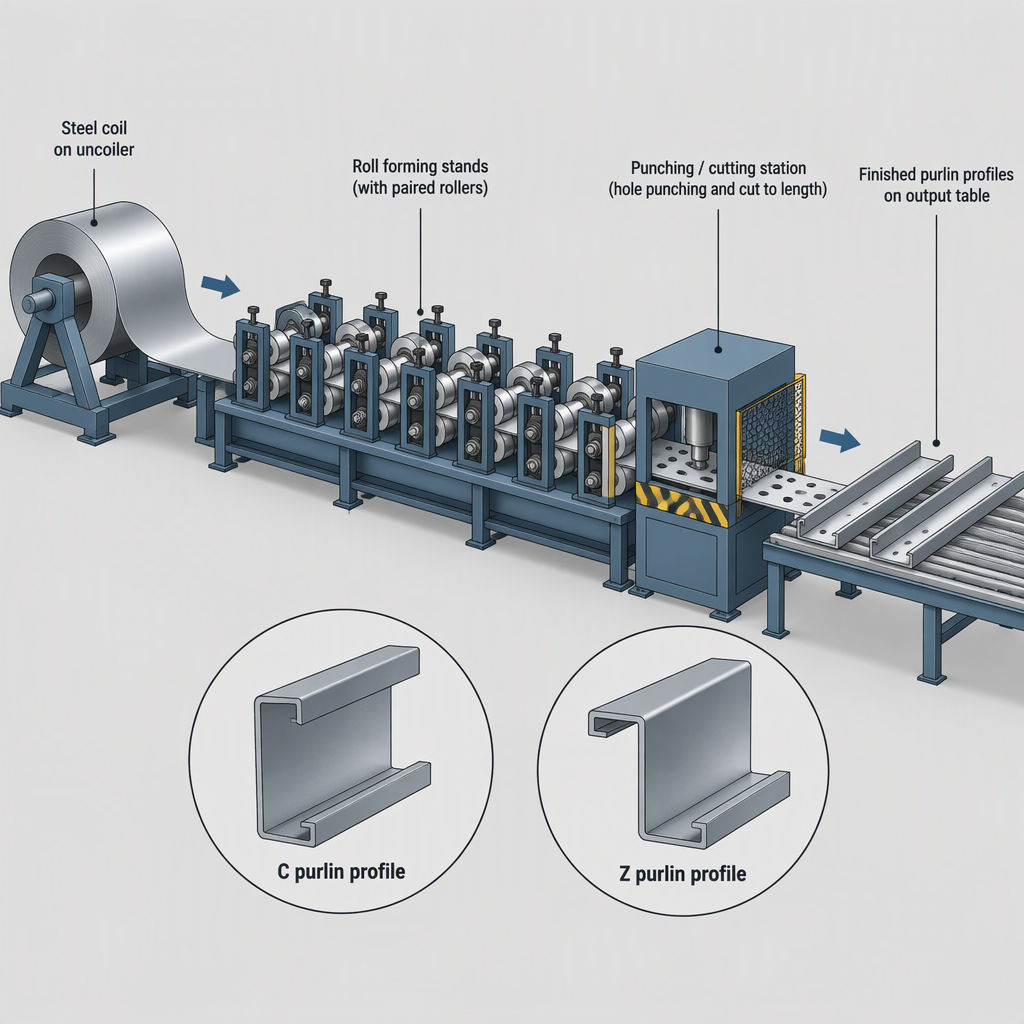
When production expands from C-only or C/U profiles to both C and Z purlins, the machine requirement changes from forming one profile family to managing two profile geometries, their size ranges, switching method, hole patterns and downstream cutting requirements.
The buyer should start with the lipped C profile drawing: web width, flange height, lip length, material thickness, inside bend radius, hole drawing and acceptance limits.
The buyer should define both C and Z ranges and confirm whether the proposed line covers the required sizes and switching approach; one listed CZ example presents C100-400/Z120-400 as its model range.
| Selection item | C-only or C/U production | C/Z production |
|---|---|---|
| Profile inputs | C drawing dimensions, thickness, bend radius, hole layout and acceptance limits. | C and Z profile ranges, material thickness, punching options and full line workflow. |
| Tooling question | Confirm tooling for the selected C or CU family and the required lipped section. | Confirm how the line changes between C and Z profiles; the listed CZ example states production of different C and Z purlin sizes without changing rollers or spacers. |
| Commercial comparison | Compare quotations against material, punching, cutting, controls, delivery and commissioning scope. | Compare the same items, plus the defined C/Z switching method and whether optional punching matches the drawings. |
Profile geometry changes the machine because roll forming feeds strip through successive paired roller dies, with each pass bending the strip incrementally toward the final shape.
The AHSS roll forming guidance explains that pass count and horsepower requirements are affected by steel properties, profile bends, section depth-to-thickness ratio, tolerance requirements and pre-punched holes or notches.
For procurement, this means a drawing with more demanding bends, tighter tolerances or more complex pre-punched features should not be treated as a simple catalog label. Ask the supplier to map your profile family, material and holes to the proposed forming passes, drive arrangement, punching station and cutting method.
A C/Z changeover claim is useful only when the quotation defines exactly what changes: profile direction, width, flange, lip, punching program, cut length, controls recipe and any manual adjustment outside the advertised switching feature.
Do not compare two machines by the word “automatic” alone. A listed CZ line may describe production of different C and Z sizes without changing rollers or spacers, but your purchase decision still depends on the actual drawings, material, controls and acceptance procedure in the quotation.
Tolerance discussions should separate the standard that frames cold rolled section tolerances from the specific acceptance limits that your supplier must demonstrate on your parts.
NEN-EN 10162:2003 is listed as current by NEN and covers dimensional and cross-sectional tolerances for cold rolled steel sections produced on roll-forming machines, including C and Z cross sections within its stated scope.
ANSI/SDI AISI S100-24 is the North American Specification for the Design of Cold-Formed Steel Structural Members and applies, within its stated scope, to load-carrying members cold-formed from carbon or low-alloy steel sheet, strip, plate or bar not more than 1 in. (25.4 mm) thick.
| Question | Buyer action | Why it matters |
|---|---|---|
| Are you specifying part tolerances? | Use the applicable cold rolled section tolerance reference as a framework, then state the acceptance limits required for your project. | The C/CU selection information points buyers to separate acceptance limits and measurement conditions. |
| Are the purlins structural members? | Confirm which structural design specification applies in the project market and with the project engineer. | AISI S100-24 addresses design of cold-formed steel structural members, not machine output guarantees. |
| Are you buying equipment? | Ask for a trial or acceptance check against your drawing rather than relying on a standards title alone. | A tolerance standard can frame what is measured, but it does not prove a specific machine configuration will meet your part drawing. |
A useful RFQ gives the supplier drawings, material data, hole requirements, cut lengths, tolerance expectations and the production mix before asking for a C vs Z purlin machine recommendation.
Shortlist a C-only or C/U line when your order book is concentrated in one profile family; shortlist a C/Z line when recurring demand for both C and Z profiles justifies defining a broader switching and acceptance scope.
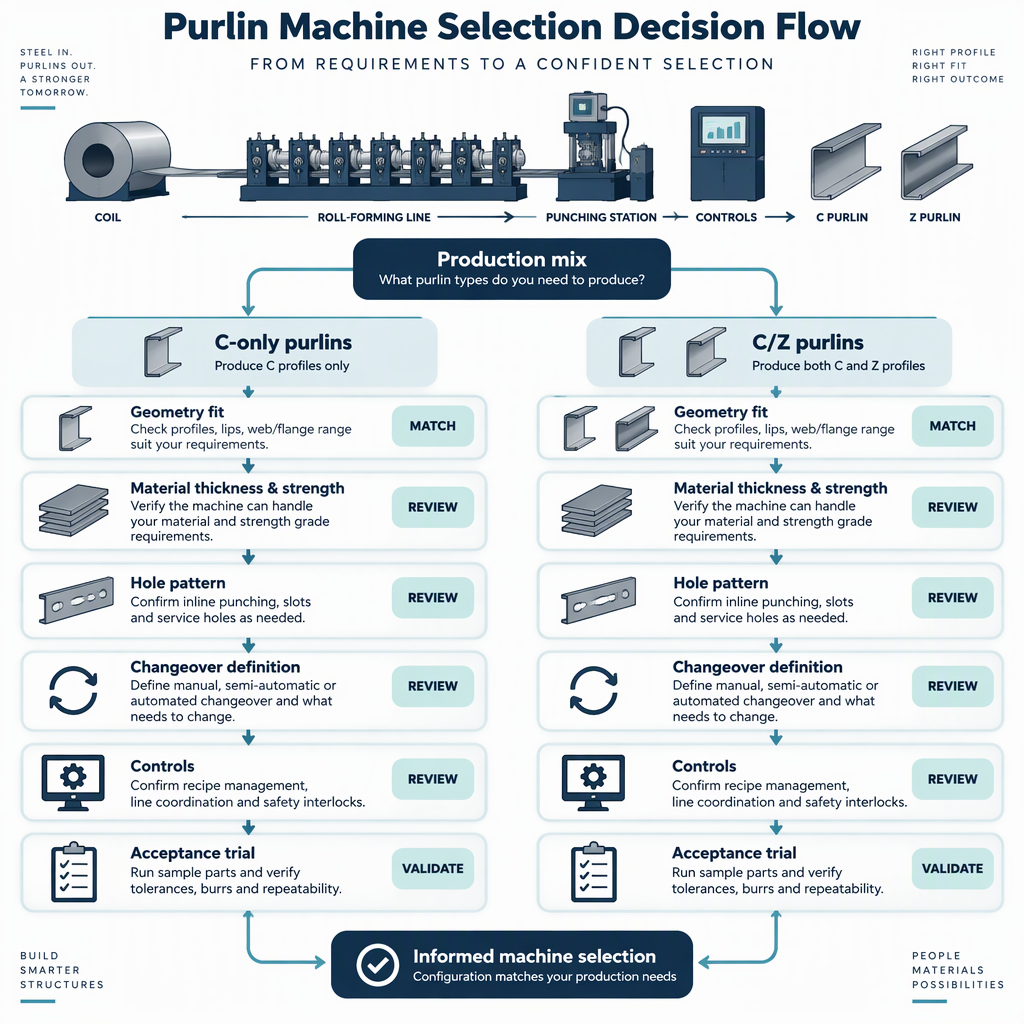
| Production situation | Likely shortlist | Procurement focus |
|---|---|---|
| Most projects use lipped C sections or C/U variants with stable dimensions. | C-only or C/U line | Confirm the profile drawing, thickness, holes, cutting, controls and acceptance checks. |
| Projects regularly require both C and Z purlin sizes. | C/Z line | Confirm C and Z size coverage, the switching method, optional punching and the workflow from decoiler through exit rack. |
| Your required holes, tolerances or material are project-specific. | Either scope, after trial definition | Do not select by model name alone; require a drawing-based acceptance method. |
Before ordering, the acceptance discussion should prove the proposed configuration against your actual profiles, holes, material and measurement limits.
The best C vs Z purlin machine choice is the one whose forming, punching, cutting, changeover and acceptance scope matches your actual drawings and material, not the one with the broadest label.
For C-only or C/U work, make the drawing, holes and tolerance checks precise. For C/Z work, add a clear switching definition and test both profile families in the acceptance plan. That approach keeps the comparison focused on machine requirements you can verify before purchase.
These short answers focus on machine-selection questions that affect drawings, tooling, punching, changeover and acceptance.
A C-focused scope starts with the lipped C or C/U profile drawing and its dimensions, holes and acceptance limits.
A C/Z scope must also define both C and Z profile ranges and how the proposed line switches between those profile families.
Not always; one listed CZ line example states that it can produce different C and Z purlin sizes without changing rollers or spacers, but that statement applies to that configuration and still needs to be checked against your drawings.
Pre-punched holes or notches can affect roll-forming pass and power requirements, and the buyer should also define punching scope and hole acceptance before comparing quotations.
NEN-EN 10162:2003 is a relevant tolerance-scope reference for cold rolled sections produced on roll-forming machines, including C and Z cross sections within its stated scope.
No. ANSI/SDI AISI S100-24 addresses design of cold-formed steel structural members within its stated scope; it does not prove a particular purlin machine's output or acceptance result.
Send profile drawings, material thickness, inside bend radius, hole drawings, cut lengths, tolerance expectations and acceptance checks; for C/Z production, include both profile families and the size range.
Ask what the claim includes: roller or spacer changes, width adjustment, profile family switch, punching program, cut length, controls recipe and the measured part that confirms the changeover is complete.


