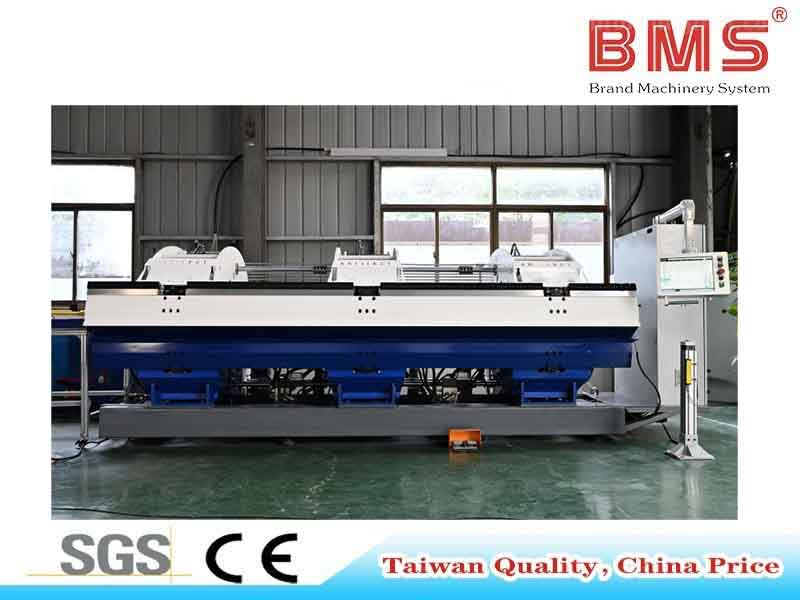
In sheet metal fabrication, choosing a single folder or a double folder means the difference in speed of bending, labor, precision, and capacity. However, just because it is double does not mean that it is better. It all depends on your material, product design, production volume, and process requirements.
This article breaks down howsingle folders anddouble folders compare on the factors that actually move the needle on a shop floor, so you can make the call with real information instead of a sales brochure.
What Is a Single Folder?
A single folder uses only one folding beam to fold sheet metal in only one direction in each clamping cycle. Here the sheet is clamped between the upper beam and the bed, and the folding beam is raised (or lowered, depending on the system).
It's a straightforward mechanism, and that simplicity is exactly the point. Single folders are:
Lower cost: initial cost is lower than double folders with quicker payback on simple jobs
Easy to train on: new employees will adapt more easily, as there is only one bending process to get used to learn
Well-suited to simple geometry: suitable for brackets, angles, plates, and flat panel products, folding in one direction
However, when the product requires folding in the opposite direction, the operator must first release the clamps, turn or rearrange the sheet, and clamp again prior to the second bending operation. This is where single folders start losing.
What Is a Double Folder?
A double folder has two folding beams placed in such a way that allows bending both up and down in one clamping cycle. In this case, it is not necessary to reposition the sheet itself—the machine does this.
That single difference changes a lot:
Fewer repositions per part: multi-directional folds can be achieved without releasing the clamps
Tighter reference consistency: because the sheet is not moved between the folding operations in opposite directions, all tolerance build-up from manual rearrangement is reduced
Better fit for complex parts: enclosures, boxes, cabinets, ductwork, parts requiring folds in different directions
Double folders cost more to buy and, with more moving parts, generally cost more to maintain. Whether that tradeoff is worth it depends entirely on the parts running through your shop.
Head-to-Head Comparison: The Core Efficiency Factors
Production Speed and Cycle Time
For products that can be bent in one direction only, the operation time of the single folder may be shorter than that of a double folder. Indeed, this type of machine is simpler and has fewer moving parts.
Take a basic four-sided box with folds alternating up and down. The operator in this case will need to clamp, bend, unclamp, reposition, reclamp, and then bend again the product. For a double folder, in most cases, it is possible to bend the product in one clamping cycle without repositioning.
Labor and Operator Involvement
Each time a single folder repositions a single sheet, this is an opportunity for the expertise of a skilled operator. Reorientation of the sheet back to the right point of reference, inspection for correct alignment, and minimizing scraps from the high-cost blanks are involved.
For operations that have two or more shifts or suffer frequent operator changes, it is not only speed but also consistency that will be improved through the use of double folders. Double folders will make it simpler to train operators for complex parts, because more of the required precision is being handled by the machine and less by hands-on skill.
Precision and Repeatability
This is where double folders earn their reputation. Each manual reposition of a single sheet introduces a small possibility for errors in alignment, whether it is the loss of fractions of a millimeter of shift or a small deviation in angle. It is not important for simple parts, but for complex multi-folds with tight tolerances—such as HVAC ducts, electrical enclosures, and appliance housing—it becomes critical.
A double folder, because it holds a sheet within one reference point for both folds, can maintain higher tolerance levels.
Part Complexity and Flexibility
The clearest way to think about this: match the machine to the geometry, not the other way around.
Simple, single-direction folds: a single folder does the job well and doesn't need the extra investment
Multi-directional folds on the same part: a double folder removes the repositioning bottleneck entirely
Mixed order books with unpredictable part types: a double folder offers more flexibility to take on complex jobs without retooling your process
Some job shops with highly varied order books lean toward double folders specifically because they don't know what next month's parts will look like.
Cost of Ownership
Single folders are less expensive to purchase and are simpler to maintain, and thus, the overall cost of maintaining the machine will be reduced. The double folders are more expensive to buy and to maintain because of the extra components in the machines, but they reduce the labor costs when dealing with intricate parts.
The question here is not how to get the cheaper machine, but rather how many labor hours per month am I paying on repositioning the parts, and at what point does the efficiency gained from a double folder offset its price? This point is reached much sooner than imagined by most shops manufacturing highly intricate parts. However, when you manufacture simple geometries, a single folder should last forever.
Matching the Machine to Your Shop
High-Volume, Simple, Single-Direction Bends
In case most of your jobs entail the making of simple profiles with repetitive bends, the single folder will be the best choice. After setup, the operators will be able to make the same kinds of jobs in no time, since they won’t have to pay for features they hardly ever use.
For shops that are into manufacturing a great number of parts, such a feature can also help to control the expenses related to equipment, maintenance, and training.
Complex, Multi-Directional Folds
The double folder is more suitable in case the job requires different bends at once. You will not need to frequently flip the sheet over; the machine will facilitate the process of making the bends.
That matters even more when you're working with long or awkward sheets. Less handling means shorter cycle times and fewer opportunities for operators to introduce positioning errors. Over hundreds of parts, those small time savings can add up to a meaningful productivity gain.
Unpredictable or Highly Varied Orders
If your order book is ever-changing, flexibility works in your favor as far as production goes. The double folder can accommodate a wider variety of bendings, making it easier for you to switch between different parts and different jobs.
This can come in handy, especially if you work in a job shop where you can never be sure what you're going to get next week. Instead of refusing certain jobs or adding manual labor into the process, you'll have more resources at your disposal.
Budget-Constrained Operations
For a shop that is just getting started with building its customer base or has a tight budget when it comes to investing, a single folder is the way to go. This allows you to invest in the features you currently need without having to pay extra right away.
Eventually, when the need arises, you can upgrade to a double folder without having to replace your current equipment.
Running Both Can Make Sense
You don't necessarily have to choose one machine for every job. Many established fabrication shops use single and double folders side by side, assigning each job according to its bending requirements.
Simple, repetitive work can stay in the single folder, while more complex or labor-intensive jobs go to the double folder. This prevents your more capable machine from becoming tied up with straightforward work and helps you get better utilization from both.
Ultimately, look beyond the machine's specifications and ask a more practical question: Which folder removes the biggest bottleneck from your current production process? That answer will usually tell you more than a feature comparison ever could.
Real-World Application Examples
HVAC Ductwork
Double folders are well suited to HVAC ductwork, especially when parts require multiple bends in different directions. Duct sections often involve several folds that need to line up accurately to ensure proper assembly and sealing.
By reducing the need to reposition and flip the sheet between bends, a double folder can shorten handling time and help maintain consistency across repeated parts.
Appliance Housings and Enclosures
For appliance housings, electrical enclosures, cabinets, and similar boxed components, a double folder can provide a significant productivity advantage.
These parts commonly require folds along several sides of the sheet. With a single folder, the operator may need to repeatedly reposition or turn the workpiece. A double folder can simplify this process, reducing manual handling and making production more efficient.
Roofing and Building Components
In many cases, the single folder is a wise solution to produce relatively simple roofing elements, flashing, gutters, edge trimmers, and other building materials that require simple repetitive bends.
If the most part of your work is based on one-direction bending, then the single folder will give you sufficient output without the necessity to pay for extra options that you seldom need.
Brackets and Simple Fabricated Parts
For bracket, channel, cover, panel, and basic fabricated parts, a single folder works well because the process requires fewer bends in most cases and therefore does not require the capability to bend in multiple directions.
This makes the single folder more appealing in situations where large quantities of standardized parts are manufactured.
Custom and Low-Volume Fabrication
In cases where custom manufacturing and varied job shop applications exist, a double folder can prove to be a versatile option. Whenever all work orders consist of various dimensions, materials, or bends, being able to create more intricate bends without needing to make changes in position will save time for the operator.
The flexibility of the double folder can make it worth the cost in situations where the volume of production is not large, especially if there are many complex pieces among the work to be done.
Architectural Metalwork
If single folders are best for architectural trim, simple fascia, decorative panel pieces, and other such products that have mostly straight and predictable bends, then the double folder is best for more complex architectural profiles.
The Bottom Line
Efficiency isn't about which machine has more capability on paper; it's about which machine matches what you're actually producing. A single folder that's perfectly matched to simple, high-volume work will outperform an underused double folder every time. And a double folder handling complex, multi-directional parts will save labor hours that a single folder simply can't recover.
If you're weighing this decision for your own production line, it's worth walking through your actual part mix, tolerance requirements, and order volume before deciding either way.BMS Group's team can help assess which folding machine setup fits your shop, whether that's a single folder, a double folder, or running both side by side.
FAQs
Can a single folder do double folds with manual repositioning?
Yes, a single-fold machine can perform double folds if you manually rearrange and rerun the material through the machine. But this totally depends on whether you use a sheet metal folding machine or an office paper folder.
How much more does a double folder cost compared to a single folder?
Since the terms "double folder" and "single folder" mean two different things in different industries, the cost difference also varies from one industry to another. In most cases, however, the cost of a double folder machine is slightly higher than that of a single folder machine, with less than a 15% increase in cost.
What industries benefit most from double folding machines?
A double folder machine for fabric, sheet metal, and papers is generally useful in industries where fast production, repeatability, and consistency of creasing, as well as savings on costs of storage and labor, are needed. Such industries include the textile and apparel industry, the sheet metal fabrication industry, and the HVAC industry.
Do double folders require more maintenance than single folders?
No, double folders do not need extra physical and system maintenance as compared to single folders; instead, they only add to organizational overhead.
BMS Machinery was initially established in 1992. In 2017, we became a member of XIAMEN BMS GROUP and invested 8 factories, 6 machining centers and 1 steel structure company in China, which totally covers an area of more than 30000 square meters.

 日本語
日本語 한국어
한국어 ไทย
ไทย 繁體中文
繁體中文 العربية
 فارسی
فارسی Français
 Русский
 Español
 Português
 English
 Deutsch
 italiano
 Nederlands
 Tiếng Việt
 Polski
 Türkçe
 አማርኛ
አማርኛ ພາສາລາວ
 ភាសាខ្មែរ
 Bahasa Melayu
 ဗမာစာ
ဗမာစာ தமிழ்
தமிழ் Filipino
 Bahasa Indonesia
 magyar
 Română
 Čeština
 Монгол
 қазақ
қазақ Српски
 हिन्दी
 Kiswahili
 Slovenčina
 Slovenščina
 Norsk
Norsk Svenska
 українська
 Ελληνικά
 Suomi
Suomi Հայերեն
 עברית
עברית Latine
 Dansk
Dansk اردو
اردو Shqip
Shqip বাংলা
বাংলা Hrvatski
 Afrikaans
 Gaeilge
 Eesti keel
 Māori
Māori සිංහල
සිංහල नेपाली
 Oʻzbekcha
 latviešu
 অসমীয়া
 Беларуская мова
 Esperanto
 मराठी
मराठी پښتو
پښتو