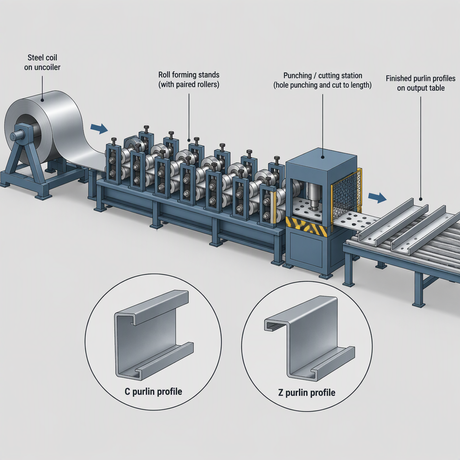
If your crew runs one C section for most of a shift, manual adjustment may meet every dispatch deadline. If short orders force several size changes before the lorry leaves, ask for a powered option and time the moves your crew actually makes.
Price forming, punching and cutting separately. A machine can punch holes and cut to length automatically while an operator still sets the web, flanges or lips by hand. Start the comparison with two things you already have: your part drawings and a recent shift’s order list.
Define the C-size schedule
Give each finished C section its own drawing ID. The web is the broad central face, the flanges turn away from it, and the lips are the short returns at their edges. Show both flange heights and both lip lengths, even when the left and right sides match.
Illustrative C-size schedule for a supplier trial
Drawing ID
Web (mm)
Each flange (mm)
Each lip (mm)
A
150
60
15
B
200
60
15
C
200
60
20
Read the table one change at a time. A to B changes only the web. B to C keeps the 200 mm web and changes each lip from 15 to 20 mm. A supplier who confirms the full web range has still to confirm drawing C.
What belongs on the drawing and what belongs on the order
On the drawing. Mark the revision, inside bend radius, tolerances and measurement faces. An outside flange height and a clear inside height can describe different parts under the same size name. Use the same reference faces when you inspect the trial piece.
Against the drawing ID. List the steel grade, thickness, coating and slit widths your stockholder can supply. Say whether the stated thickness includes the coating. Ask the builder which slit width it needs for each section before reserving trial coil.
On each order. Enter the section ID, cut length, hole drawing, quantity and dispatch sequence. If only the cut length changes, keep the section ID. A new order number alone tells you little about setup work.
For example, two orders for A followed by one for B mean one cross-section change if you start on A. A new hole pattern on the second A order may still interrupt the line. Record that stop separately so you can price the equipment that would actually shorten it.
Separate size adjustment from punching and cutting automation
Ask the bidder to follow one drawing change through three stations. A controller that stores a part number may recall hole pitch and length. Find out whether selecting that number also moves any forming tools, and who completes the remaining settings.
Forming sets the cross-section. A manual setup may use screw adjusters or spacers to set the web. On a powered configuration, ask which axes move when you recall a size. Have the bidder mark web, left and right flange, and left and right lip separately, including any dimensions that move together.
Punching sets the hole pattern. Compare two rows of slots on your hole drawing. A change in pitch alters the spacing along the part. A change in edge distance moves the row across the strip. Ask how the operator makes each change and which punch and die are needed for a different slot shape.
Cutting sets the finished length. Changing the length entry can let you make a shorter part from the same section. Changing the section raises a separate question at the shear: will the existing cut insert clear and support the new shape, or must the crew fit another one?
For each forming axis, distinguish hand setting, powered movement under operator control and automatic positioning from a stored recipe. If the operator jogs a motor to a scale mark, include that time in the trial. For a recipe-controlled axis, ask how the crew confirms the target position before releasing the part.
What the BMS specification confirms
BMS lists galvanised or cold-rolled sheet at 0.8–2.0 mm for its multi-profile C purlin making machine. The product page describes forming different sizes with the same rollers and spacers, and shows a hydraulic post-cutter.
The hydraulic post-cutter on the BMS multi-profile C line. When you change section size, ask whether the next profile needs a different cut insert.
Match that thickness range to the steel grade and slit width for each drawing you buy. For orders with holes, the BMS C/CU selection guide asks you to specify the punching package. If a quotation says “automatic punching and cutting”, request the list of powered forming axes as a separate item. For drawing C, have the bidder show how both lips reach 20 mm.
Compare tooling and operator tasks
Compare both offers against the same drawing revisions. Ask for a move from A to B and back to A to check whether your crew can recover the original settings. If you also buy C, add a B-to-C trial. That move tests a longer lip at a fixed web width.
What to ask for in each size-change quotation
Bid item
Manual adjustment
Automatic size change
Adjustment method
Identify the screws, handwheels or spacers used for each dimension.
Name each powered axis and how the operator selects its position.
Size coverage
Mark each drawing achievable with the supplied settings and tools.
Mark each drawing covered by a saved or new recipe. Identify coupled dimensions and exceptions.
Tooling
List spacer sets, gauges, punch dies and cut inserts by part ID.
List common tools, plus dies or inserts that still need exchanging.
Setup tasks
Show who sets, secures and checks each station. State crew size.
Show who selects the recipe, checks position and finishes any hand settings.
Verification
Return to A using the setup sheet and measure the part. Test the lip-only change if C is required.
Recall A and measure the same features. Demonstrate the lip-only change with the quoted axes and tools.
Quotation scope
Price the adjustment equipment, tools for every included size and operator training.
Price the powered axes, recipe access, training and support, plus all remaining manual tooling.
What the next shift inherits
For a manual line, ask a second operator to find the setup sheet for A, identify the spacers and gauges, and locate the settings for the current drawing revision. A common roll set may stay on the mill while several stands still need positioning.
For a powered line, find out who can create, edit and back up a recipe. If only the builder can add a size, ask for the price and lead time. A recipe can recall roll positions while leaving the crew to exchange a punch die or a cut insert.
Time the change from one accepted part to the next
Before the trial. Agree on the drawing limits, coil and crew. List any tools staged while the previous batch was running. Record that labour separately so a bidder cannot gain an apparent time advantage by moving work outside the timed interval.
Start the clock. Start as the last accepted piece of the old size leaves the line. Log any strip change, hand adjustment, recipe selection or tool exchange. Record crew size alongside elapsed minutes so you can see when an extra person is needed.
Stop and release. Stop when the first piece of the next size passes the agreed checks and the crew can release the batch. Keep rejected trial pieces in the record. Repeat the same timing rule for the return to A and for any lip-only change.
Ask for the readings on the return to A, alongside the original A readings and drawing limits. If the crew trims a setting after recalling it, log the correction and keep the clock running through approval. Repeat the same transition if you need to see how much the time varies.
Evaluate mixed-batch production using stated assumptions
Count the transitions in your dispatch order. Two plants buying the same five batches can put quite different values on powered sizing. The difference starts with whether the customer will let you group orders for the same section.
The same 200 pieces in two sequences
Assume five releases of 40 pieces each in an eight-hour shift, with the line already set for A. Allow 30 minutes per change for manual sizing and 12 minutes for powered sizing in either direction. Both times include any required strip change, tool setting and first-piece approval.
Assume equal running rates and other planned stops. These are calculation inputs for comparing schedules. Replace them with timings from your trials before using the figures in a purchasing decision.
Illustrative setup time per shift, starting on A
Shift measure
As ordered
Grouped by size
Release sequence
A B A B A
A A A B B
Size changes
4
1
Manual setup (min)
4 × 30 = 120
1 × 30 = 30
Powered setup (min)
4 × 12 = 48
1 × 12 = 12
Time released (min)
72
18
In the alternating shift, manual setup leaves 360 of 480 minutes before other stops. Powered setup leaves 432. Each of the four timed changes already produced one accepted piece. Count those pieces towards the 200 when you estimate the running time still needed.
Grouping the orders cuts the potential gain to 18 minutes. It also leaves the line set for B. Check tomorrow’s first order, today’s dispatch commitments and the space for finished stock before assuming you can run that sequence every day.
How much of the released time can you use?
Suppose you run 100 alternating shifts a year. The 72-minute difference gives you 120 hours. If only half can replace paid overtime, the cost comparison can use 60 hours at your plant’s actual avoidable overtime cost in ₹ per hour.
Build your own weekly total. Multiply each measured change time by the number of matching moves. Use separate rows for web changes, lip changes and hole-tool swaps at fixed size. If a coil swap was timed within a size change, include it only once.
Give each usable hour one value. If a recovered hour enables an extra sale, use the contribution after variable costs. If it removes overtime, use the expense avoided. Check with packing and dispatch that the extra pieces can actually leave the plant.
Account for the annual difference. Add measured setup scrap savings at material cost less scrap recovery. Deduct extra service and support costs. A change that takes fewer minutes with the same crew will reduce labour expense only when the paid hours or staffing requirement changes.
For simple payback in years, divide the extra installed price in ₹ by the positive net annual benefit in ₹. If the benefit is zero or negative, the calculation gives no payback period. If urgent-order response still matters, record that reason separately in the purchase approval.
Build the size-change RFQ
Send one request for quotation (RFQ) with two reply columns, one for operator-set sizing and one for powered sizing. Give both bidders the same drawings and acceptance conditions. If a supplier offers one method only, it can mark the other column unavailable.
When you review a BMS offer, its purlin roll forming machine range can help you identify the product family. Ask every bidder to put the exact model and options beside the price. An offer with powered web adjustment and manual lips belongs in your comparison with both details visible.
What to attach to the enquiry
Drawings and holes. Provide web, flange and lip dimensions in mm, grade, thickness, cut lengths and hole drawings. Mark the hole shape, size, pitch, face and distance from the same end or edge your inspector will use.
Actual coil supply. List available slit widths, inside and outside diameters in mm, and maximum coil mass in kg. Identify the material you can send for the trial. Agree who supplies any other width the demonstration needs.
Order mix. Attach a dated shift sequence, pieces per batch, changes per shift and fixed dispatch times. Mark which transitions also need a different grade, thickness or hole tool.
Factory electrical supply. Ask your plant electrician for voltage, frequency in Hz, number of phases and available capacity at the connection point. Have the supplier state the line load and list any extra supply equipment in its price.
Itemised installed price. Separate forming equipment, punch tools, cut inserts, gauges, spares and commissioning at your site in India. Ask who provides training, recipe backup and support for adding sizes after handover.
Use one acceptance record per change
Give the supplier a blank record before the demonstration. Agree where to measure along the part, including near the cut end if flare affects fit. For each feature, write the drawing limit next to the actual reading so the person releasing the batch can check it.
Trial header. From drawing / revision ___ to ___ · coil ID, grade and thickness ___ · crew ___.
Setup record. Tools changed ___ · elapsed minutes ___ · rejected pieces or scrap mass ___.
First-piece record. Web ___ · flange L ___ / R ___ · lip L ___ / R ___ · hole locations ___ · cut length ___ · released by ___.
Mark each drawing included, available with a priced option, or outside scope. If the die for a required slot is missing, keep that bid’s total open until the price arrives. Then compare the installed cost of two configurations that can complete the same order book.
Which adjustment method should you quote?
Choose manual sizing when the line covers your drawings and setup fits the release schedule. Pay for powered sizing where the quoted axes cover the changes you make and the time you recover has value to your plant.
Send BMS your web, flange and lip dimensions, coil grade and thickness, hole drawing, batch sizes, changes per shift and factory electrical supply. Request itemised quotes for the available adjustment methods and a timed demonstration of each type of size change your orders require.
Founded in 1992, BMS Machinery joined XIAMEN BMS GROUP in 2017. Our manufacturing network in China includes 8 factories, 6 machining centers and 1 steel structure company, covering over 30,000 m². Supporting credentials include ISO9001:2015 quality management certification and SGS-issued CE/UKCA machinery compliance verifications. XIAMEN BMS GROUP’s Dun & Bradstreet D‑U‑N‑S Number is 55-379-8879.

 日本語
 한국어
 ไทย
 繁體中文
 العربية
 فارسی
 Français
 Русский
 Español
 Português
 English
 Deutsch
 italiano
 Nederlands
 Tiếng Việt
 Polski
 Türkçe
 አማርኛ
 ພາສາລາວ
 ភាសាខ្មែរ
 Bahasa Melayu
 ဗမာစာ
 தமிழ்
 Filipino
 Bahasa Indonesia
 magyar
 Română
 Čeština
 Монгол
 қазақ
 Српски
 हिन्दी
 Kiswahili
 Slovenčina
 Slovenščina
 Norsk
 Svenska
 українська
 Ελληνικά
 Suomi
 Հայերեն
 עברית
 Latine
 Dansk
 اردو
 Shqip
 বাংলা
 Hrvatski
 Afrikaans
 Gaeilge
 Eesti keel
 Māori
 සිංහල
 नेपाली
 Oʻzbekcha
 latviešu
 অসমীয়া
 Беларуская мова
 Esperanto
 मराठी
 پښتو