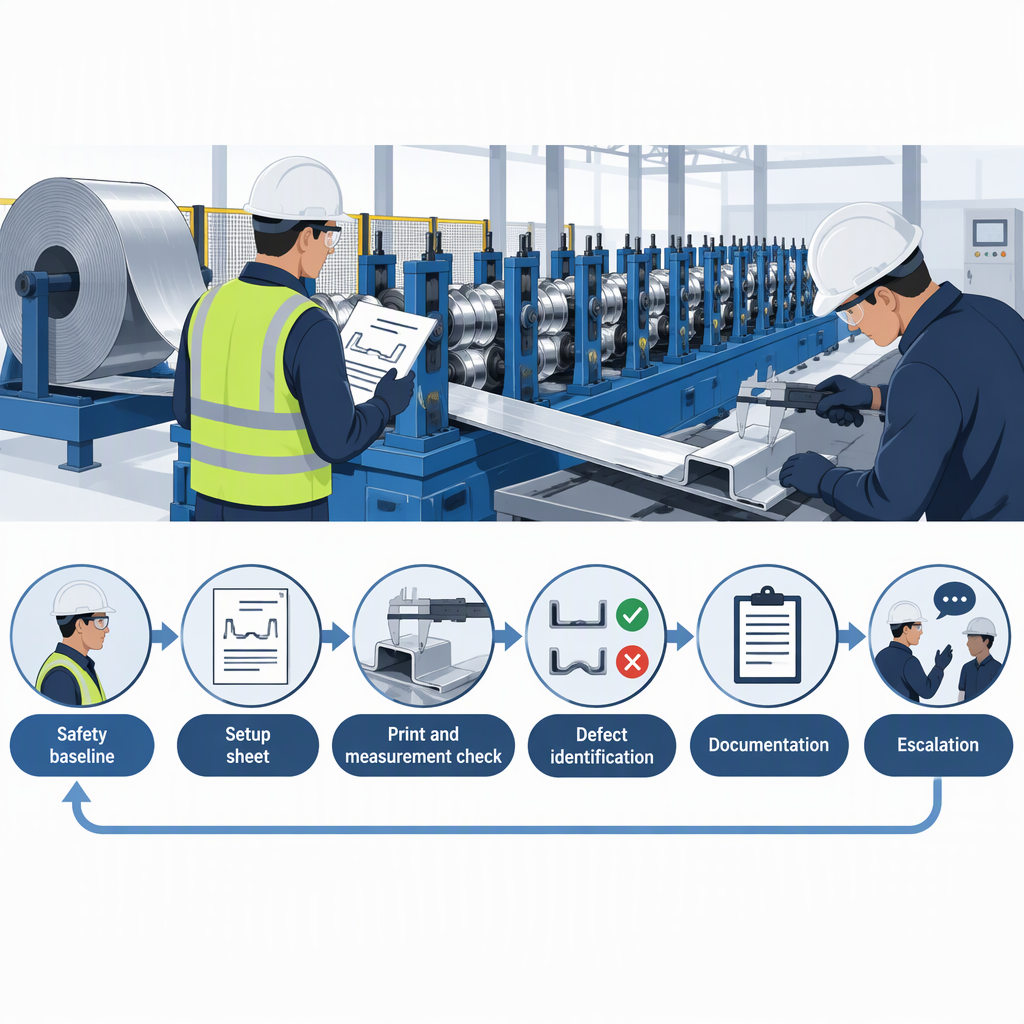
Roll forming operator training should be scoped as a production-control skill set: safety boundaries first, then setup discipline, print and roll-print reading, measuring-tool use, defect recognition, troubleshooting, and documentation routines. For U.S.-regulated workplaces, guarding and hazardous-energy control must be treated as baseline training topics before operators manually access setup, adjustment, servicing, or maintenance areas.
Define the training scope before assigning an operator to production
A complete roll forming operator training scope should cover terminology, die and tooling basics, safety awareness, print reading, measurement, setup and tear-out, setup sheets, common profile-quality issues, troubleshooting logic, and documentation habits.
For metal building manufacturers and cold roll forming process engineers, the point of training is not simply teaching an operator which buttons to press. The operator needs enough process language to communicate with engineering, maintenance, tooling, quality, and procurement teams when the line condition changes.
Include roll forming terminology so operators can describe stands, rolls, tooling, setup sheets, profile shape, and line conditions consistently.
Include die skills and tooling awareness so operators understand how setup condition relates to formed profile condition.
Include blueprint, roll-print, roll-flower, GD&T, and measuring-tool practice so inspection results can be compared with the intended profile.
Include setup, tear-out, documentation, and common quality-issue response so operators know when to record, adjust, stop, or escalate.
Set safety boundaries before setup, adjustment or troubleshooting
Operator training should establish guarded-machine boundaries before production work, because general machine-guarding requirements address hazards such as points of operation, ingoing nip points, rotating parts, and flying chips or sparks.
Forming rolls and calenders are listed among machines that usually require point-of-operation guarding, so a roll forming training program should teach operators what guarded areas are, why guards are not bypassed, and when to stop and involve authorized personnel.
When work involves servicing or maintenance, U.S. hazardous-energy control rules cover setup work performed to prepare equipment for normal production and require an energy-control program with procedures, employee training, and periodic inspections.
Before any manual access for setup, adjustment, clearing, servicing, or maintenance, the operator must switch off and disconnect the relevant power source or follow the site’s authorized lockout/tagout procedure for the machine, then use only the access steps allowed by the current machine manual and site safety program.
Train setup discipline, not only button operation
Setup training should teach operators to prepare from the setup sheet, confirm tooling and machine factors, run controlled checks, document the condition, and escalate abnormal findings instead of improvising unapproved adjustments.
Start from the setup sheet and current job information, including the profile requirement, roll-print references, and the inspection points that must be checked.
Confirm that tooling-related items and machine factors match the planned setup before material is fed for routine production.
Use measuring tools and documented inspection points to compare the formed profile with the drawing or roll-print requirement.
Record setup conditions and first-piece observations so later troubleshooting is based on facts rather than memory.
If setup activity requires manual access beyond normal operation, switch off and disconnect the applicable power source or use the site’s authorized hazardous-energy control procedure before entering the guarded or hazardous area.
This approach helps procurement and engineering teams specify training as an operating discipline. A supplier, internal trainer, or commissioning team should be able to explain how operators learn setup sheets, tooling condition, machine factors, and documentation without promising unsupported gains in speed, scrap reduction, or output.
Make prints, measuring tools and setup records part of the daily routine
Print reading and measuring-tool skills belong in roll forming operator training because operators must compare the produced profile with drawings, roll prints, roll flowers, and dimensional requirements before a quality issue becomes a production dispute.
Training element
What the operator learns to use
Buyer value in production control
Blueprint and GD&T awareness
Drawing features, tolerances, and inspection intent
Reduces ambiguity when operators, quality staff, and engineers discuss whether the profile matches the requirement.
Roll prints and roll flowers
The intended forming progression and profile shape references
Helps the team connect profile symptoms with the forming process rather than treating every issue as an isolated part defect.
Measuring tools
Dimensional checks required for the formed section
Creates a repeatable basis for acceptance, adjustment requests, and escalation.
Setup records
Setup sheets, observations, and documented changes
Gives future shifts and engineers usable history when the same profile is run again.
Teach defect recognition and structured troubleshooting
Operators should be trained to identify profile issues such as bow, sweep, twist, flare, and surface defects, then use a structured troubleshooting method with documentation before changing setup conditions.
Observed issue
Operator response
Escalation trigger
Bow or sweep
Measure and document the direction and amount of deviation, then compare it with the setup sheet and profile requirement.
Escalate when the condition persists after approved checks or points to tooling, straightening, or sweeping decisions.
Twist or flare
Record where the profile changes and review the documented setup condition before making adjustments.
Escalate when the cause appears tied to tooling, machine factors, or an unapproved adjustment path.
Surface defects
Document the defect location, appearance, and recurrence pattern so quality and process teams can separate material, tooling, and machine contributors.
Escalate when the defect may involve tooling condition, material handling, or line components outside the operator’s authority.
Repeated unexplained variation
Use a 5 Why style troubleshooting discussion with recorded facts instead of relying on a single assumed cause.
Escalate when the team cannot confirm cause within the approved troubleshooting procedure.
Use a decision table to evaluate operator training coverage
Engineering and procurement teams can evaluate roll forming operator training by checking whether it covers safety boundaries, setup sheets, measurement, defect recognition, documentation, and escalation—not by accepting a generic machine demonstration as training.
Coverage area
Question to ask before adoption
What a complete answer should address
Guarding awareness
Will operators learn guarded zones and stop-work boundaries?
The answer should address point-of-operation, ingoing nip-point, rotating-part, and flying-chip or spark hazards where applicable.
Hazardous-energy control
Who may perform setup, servicing, maintenance, and access tasks?
The answer should define energy-control training, authorized roles, and the requirement to switch off and disconnect or lock out energy before manual access when required.
Setup and tear-out
Does training use setup sheets and controlled setup routines?
The answer should include setup sheets, setup and tear-out practice, tooling awareness, and machine-factor discussion.
Prints and measurement
Can operators connect inspection results to the profile requirement?
The answer should include blueprint reading, roll prints, roll flowers, GD&T awareness, and measuring-tool use.
Defect response
Are operators trained to describe defects before adjusting?
The answer should include bow, sweep, twist, flare, surface defects, 5 Why troubleshooting, documentation, tooling, and machine factors.
Ask for the training outline and verify that it includes both classroom concepts and production-floor decision routines.
Confirm that machine-guarding expectations are aligned with the workplace’s applicable rules and the installed line configuration.
Confirm that hazardous-energy procedures are handled through the employer’s current safety program and machine-specific instructions.
Require documentation practice so operators record setup conditions, defects, checks, and escalation decisions.
Conclusion
The strongest roll forming operator training plans define the operator’s role in safety, setup, measurement, defect response, documentation, and escalation before the line is expected to run stable production.
Treat roll forming operator training as a production-control requirement, not a one-time machine orientation.
Keep guarding boundaries visible in the training scope, especially around point-of-operation and ingoing nip-point hazards.
For manual access connected with setup, servicing, or maintenance, require power disconnection or the authorized energy-control procedure before work begins.
Use setup sheets, measurement records, and structured troubleshooting to make operator decisions repeatable across shifts.
FAQs about roll forming operator training
Buyers should use these questions to separate complete operator training coverage from a narrow equipment demonstration.
Is an FMA roll forming certificate the same as a professional certification?
No. The FMA roll forming certificate page states that its certificate does not imply a professional certification and does not require renewal.
What skills should be included in roll forming operator training?
Training should include terminology, safety, die and tooling concepts, blueprint and roll-print reading, measuring tools, setup and tear-out, setup sheets, quality issues, troubleshooting, documentation, tooling, machine factors, and straightening or sweeping methods.
Why is safety training part of setup training?
Setup can fall within hazardous-energy control requirements when it prepares equipment for normal production, so training must clarify when operators need authorized procedures before manual access.
Should operators adjust the line as soon as they see bow, sweep or twist?
No. Operators should first identify and document the condition, compare it with the setup requirement, and follow the approved troubleshooting path before making or requesting adjustments.
Why do operators need blueprint and roll-print reading?
Blueprints, roll prints, roll flowers, GD&T, and measuring tools help operators connect the produced profile with the intended dimensional and forming requirements.
Can operator training guarantee higher output or lower scrap?
Training can define skills and routines for setup, measurement, documentation, and troubleshooting, but buyers should request separate, documented performance evidence before accepting claims about output, scrap, speed, or uptime.
How should procurement compare training proposals?
Procurement should compare the actual curriculum: safety boundaries, setup sheets, measurement practice, defect recognition, troubleshooting method, documentation expectations, and escalation rules.
Founded in 1992, BMS Machinery joined XIAMEN BMS GROUP in 2017. Our manufacturing network in China includes 8 factories, 6 machining centers and 1 steel structure company, covering over 30,000 m². Supporting credentials include ISO9001:2015 quality management certification and SGS-issued CE/UKCA machinery compliance verifications. XIAMEN BMS GROUP’s Dun & Bradstreet D‑U‑N‑S Number is 55-379-8879.

 日本語
 한국어
 ไทย
 繁體中文
 العربية
 فارسی
 Français
 Русский
 Español
 Português
 English
 Deutsch
 italiano
 Nederlands
 Tiếng Việt
 Polski
 Türkçe
 አማርኛ
 ພາສາລາວ
 ភាសាខ្មែរ
 Bahasa Melayu
 ဗမာစာ
 தமிழ்
 Filipino
 Bahasa Indonesia
 magyar
 Română
 Čeština
 Монгол
 қазақ
 Српски
 हिन्दी
 Kiswahili
 Slovenčina
 Slovenščina
 Norsk
 Svenska
 українська
 Ελληνικά
 Suomi
 Հայերեն
 עברית
 Latine
 Dansk
 اردو
 Shqip
 বাংলা
 Hrvatski
 Afrikaans
 Gaeilge
 Eesti keel
 Māori
 සිංහල
 नेपाली
 Oʻzbekcha
 latviešu
 অসমীয়া
 Беларуская мова
 Esperanto
 मराठी
 پښتو