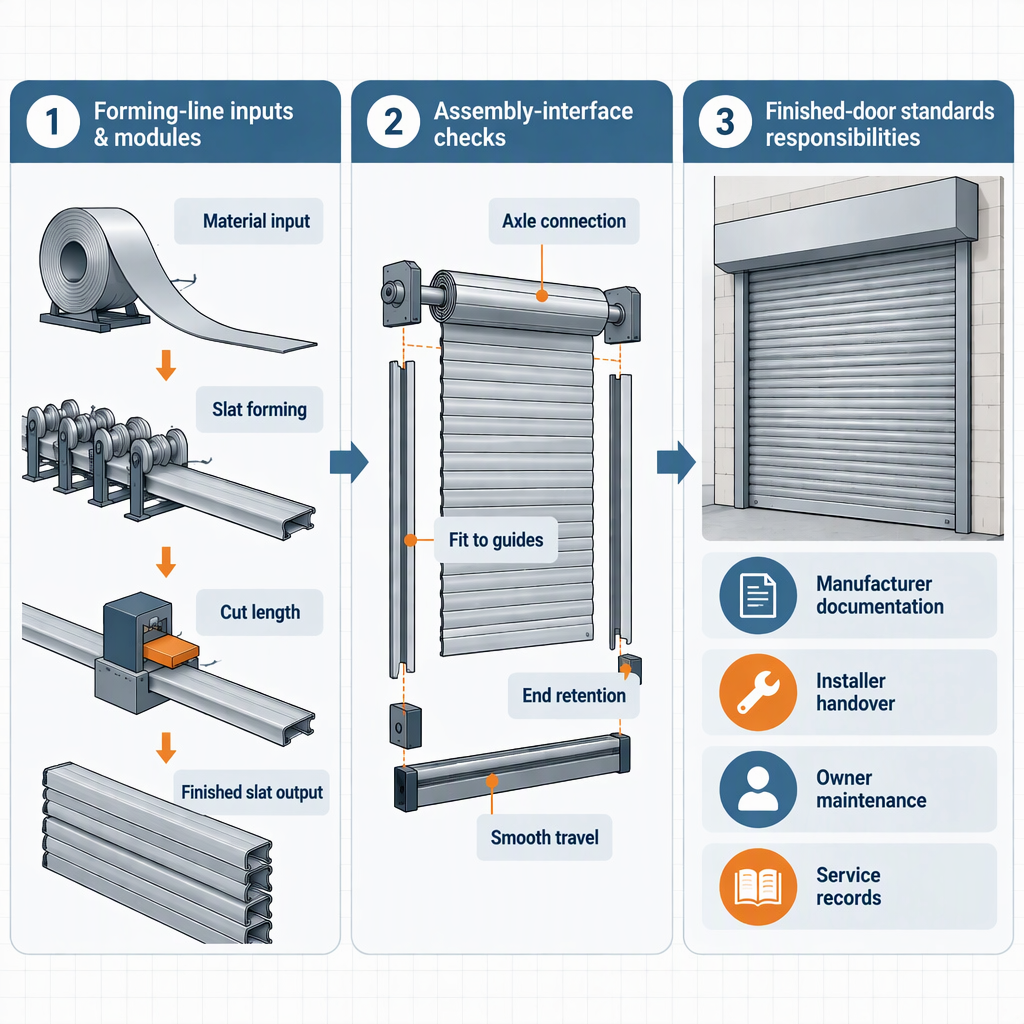
Roller shutter production should be specified as a coordinated flow: coil is uncoiled, shaped through consecutive roll sets, cut off, controlled and then handed to assembly. For a listed galvanized steel roller shutter door slat machine, the stated machine flow includes manual decoiler, feeding guide, roll forming mill, hydraulic post cutter, PLC control system and exit rack. Treat those forming-line facts as the starting point, then define the separate assembly, door-system and local safety responsibilities before procurement.
Start with the forming sequence, not the machine list
Roll forming is a continuous bending process in which coiled metal strip passes through consecutive roll sets at room temperature, so the buyer’s first task is to define the required slat profile and the handoffs before and after forming.
Begin with coil handling and uncoiling so the strip can enter the line in a controlled, repeatable way.
Confirm any required pre-press or preparation operations before the strip reaches the forming stands.
Define the forming sequence around the profile geometry, because the strip is progressively bent through consecutive roll sets.
Plan cutoff as a production handoff, not as an afterthought, because the formed slat must leave the line at the intended length for assembly handling.
For metal building-product factories, this framing helps separate profile creation from curtain assembly. The forming line should make a repeatable slat blank; the assembly process must still address how those slats interlock, how they are staged, and how the final door system is checked.
Map line modules to the handoff points that assembly depends on
A listed roller shutter slat machine flow includes manual decoiler, feeding guide, roll forming mill, hydraulic post cutter, PLC control system and exit rack; each module creates an assembly-relevant handoff.
Line module
Production role
Assembly handoff to define
Manual decoiler
Introduces coil strip to the line.
Coil material and width must match the slat profile plan.
Feeding guide
Guides strip into the forming section.
Misalignment risk should be considered before judging downstream fit.
Roll forming mill
Forms the shutter slat profile through the line.
Profile geometry must suit the intended curtain assembly.
Hydraulic post cutter
Cuts the formed slat after forming.
Cut length, cut quality and handling method should be accepted against the assembly plan.
PLC control system and exit rack
Controls the line and receives finished slats.
Operators need clear staging rules before slats move to assembly.
Coordinate forming variables with assembly requirements
The listed galvanized shutter slat machine states galvanized coil application material, 0.7–1.2 mm material thickness, 14 forming stations, PLC control system, hydraulic post cutter and 12–15 m/min forming speed. Those parameters sit inside the broader roll-forming sequence of uncoiling, possible pre-press work, forming and cutoff.
Decision area
What to confirm
Why it matters for assembly
Material input
Confirm whether the intended galvanized coil and 0.7–1.2 mm thickness range match the project requirement.
The assembly team cannot compensate for a slat material that was outside the chosen line basis.
Profile forming
Confirm the profile drawing against the stated 14-step forming-station concept and any supplier-approved design limits.
The interlock, nesting and curtain build depend on profile geometry.
Cutoff
Confirm the required cut length, post-cut method and acceptance checks for cut edges.
Slat length errors become assembly, packing or installation problems.
Controls and handling
Confirm how the PLC control system and exit rack will support batch identification and staging.
Assembly needs traceable, organized slat batches rather than mixed output.
Use a specification checklist before requesting a quotation
Before requesting a quotation, buyers should convert the listed material range, workflow and line modules into project-specific confirmation points instead of assuming that one slat machine specification covers every door design.
State the coil material and thickness requirement, and compare it with the stated galvanized coil and 0.7–1.2 mm thickness range.
Attach the slat profile drawing, including interlock geometry, visible face requirement and dimensional tolerances required by your assembly process.
Confirm whether the proposed workflow from decoiling through exit rack matches your intended handling layout.
Ask how the hydraulic post cutter will be set up for the slat lengths needed by your curtain assembly plan.
Define inspection points for first-piece approval, routine checks and batch release before the slats move to assembly.
Separate optional commercial questions such as price, delivery time, warranty and spare parts from unproven assumptions; request current written supplier documents for those items.
Separate equipment selection from finished-door standards
SS-EN 13241+A2:2016 is listed by SIS as a valid standard covering safety and performance requirements for industrial, commercial and garage doors and gates, including rolling shutters and rolling grilles in retail premises. Equipment selection should therefore be coordinated with finished-door responsibilities rather than treated as a complete compliance decision.
The SIS public summary also states that fire and smoke characteristics are excluded where EN 16034 applies. Do not use a slat-forming machine quotation as proof that a finished door satisfies every performance, safety, fire or smoke requirement for a target market.
DASMA’s technical data sheet index lists rolling-door topics such as terminology, standard rolling door architectural details, rolling sheet door terminology, maintenance and performance evaluation, loads, wind, component substitution and operation under wind load conditions.
For buyers, the practical boundary is clear: the roll former helps produce slats, while door-system design, component selection, wind/load assessment, maintenance guidance and final acceptance require their own documents and responsible reviewers.
Define the assembly boundary before accepting a slat line
Rolling-door references cover topics beyond slat production, including loads, wind, component substitution, maintenance and operation under wind load conditions, so acceptance of a forming line should not replace door-system assembly review.
Confirm how slats will be counted, staged and protected after the exit rack.
Define which team approves curtain assembly fit, including end locks, guides, barrel interface and packaging rules where applicable.
Assign separate responsibility for load, wind and component-substitution questions instead of placing those decisions only on the forming-line supplier.
Keep maintenance and performance-evaluation topics in the finished-door documentation set, not only in machine acceptance notes.
If your project will use a local door standard, project specification or building-control process, ask the responsible engineer or authority which edition and amendments apply before freezing the line specification.
Use EN 13241 scope carefully
Use EN 13241 as a finished-door scope reference only within its public summary: SIS lists SS-EN 13241+A2:2016 as valid for industrial, commercial and garage doors and gates, including rolling shutters and rolling grilles, while noting exclusions for fire and smoke characteristics covered by EN 16034.
For procurement, the useful action is to ask suppliers and project reviewers for the applicable finished-door conformity route, not to infer conformity from the presence of a roll-forming line. The forming equipment can be part of the production system, but the finished door still needs its own assessment against the applicable market, product type and standard edition.
Set safety requirements through local rules and the machine manual
Do not turn a production-selection guide into a legal machine-safety instruction. For guarded powered equipment, set safety requirements through the current local regulations, the supplier’s machine manual and the site’s competent safety review.
Before any manual access to a powered roll-forming line, cutter area, control cabinet, drive, decoiler or jammed material path, switch off the equipment and disconnect the applicable electrical, hydraulic, pneumatic or battery power source, then follow only the access steps permitted by the specific machine manual. Do not bypass guards, improvise disassembly or clear material while stored energy may remain.
Procurement teams should ask for guarding philosophy, emergency-stop layout, lockout provisions, training documents and maintenance boundaries as current supplier documents for the exact configuration being purchased.
Build a procurement checklist around evidence, not assumptions
A listed slat machine specification can support questions about stated material range, forming stations, cutter, control system, speed and workflow. Finished-door standards scope must be handled separately through the applicable door-system requirements.
Match material, thickness and profile drawing to the proposed forming line.
Confirm the machine flow from decoiler to exit rack against your factory layout.
Define the handoff from formed slat output to curtain assembly, including staging, labeling and first-piece approval.
Request current written documents for quotation scope, optional equipment, warranty, delivery, commissioning and spare parts instead of assuming them.
Identify which finished-door standard, local rule or project specification applies after slat production.
Assign safety review to competent personnel and require the exact machine manual before installation, operation or maintenance planning.
Conclusion
A strong roller shutter production plan starts with the forming sequence, then defines every handoff into assembly, standards review and safety control. Use machine specifications to ask precise questions, but keep finished-door performance, local compliance and site safety as separate approval tracks.
FAQs
These questions help procurement, process engineering and assembly teams align before selecting a roller shutter slat production line.
What is the main decision in roller shutter production planning?
The main decision is how the coil-to-slat forming process will hand off to curtain assembly, inspection and finished-door responsibilities. Do not evaluate the roll former as an isolated machine.
Which line modules should buyers map first?
Start with the stated flow of decoiler, feeding guide, roll forming mill, hydraulic post cutter, PLC control system and exit rack, then connect each module to the assembly process it supports.
Can one slat machine specification prove finished-door compliance?
No. SIS lists EN 13241 scope for door and gate safety and performance, including rolling shutters, while excluding fire and smoke characteristics covered by EN 16034. Finished-door assessment needs its own review.
What material checks matter before quotation?
For the listed galvanized slat machine, compare your project with the stated galvanized coil application and 0.7–1.2 mm material thickness range, then confirm the exact profile drawing and acceptance criteria.
Where should assembly teams become involved?
Assembly teams should be involved before quotation, because slat length, profile interlock, batch staging, guide compatibility and final curtain build rules affect what the forming line must deliver.
Should speed, ROI or delivery time be assumed from a general product page?
No. Treat speed, ROI, delivery time, warranty and service scope as current quotation items that require written supplier confirmation for the exact configuration and destination.
What is the safest way to handle manual access during planning?
Plan manual access only through the machine-specific safety documents. Before access to powered equipment or jammed material paths, switch off and disconnect the applicable power sources, and do not bypass guards.
Founded in 1992, BMS Machinery joined XIAMEN BMS GROUP in 2017. Our manufacturing network in China includes 8 factories, 6 machining centers and 1 steel structure company, covering over 30,000 m². Supporting credentials include ISO9001:2015 quality management certification and SGS-issued CE/UKCA machinery compliance verifications. XIAMEN BMS GROUP’s Dun & Bradstreet D‑U‑N‑S Number is 55-379-8879.

 日本語
 한국어
 ไทย
 繁體中文
 العربية
 فارسی
 Français
 Русский
 Español
 Português
 English
 Deutsch
 italiano
 Nederlands
 Tiếng Việt
 Polski
 Türkçe
 አማርኛ
 ພາສາລາວ
 ភាសាខ្មែរ
 Bahasa Melayu
 ဗမာစာ
 தமிழ்
 Filipino
 Bahasa Indonesia
 magyar
 Română
 Čeština
 Монгол
 қазақ
 Српски
 हिन्दी
 Kiswahili
 Slovenčina
 Slovenščina
 Norsk
 Svenska
 українська
 Ελληνικά
 Suomi
 Հայերեն
 עברית
 Latine
 Dansk
 اردو
 Shqip
 বাংলা
 Hrvatski
 Afrikaans
 Gaeilge
 Eesti keel
 Māori
 සිංහල
 नेपाली
 Oʻzbekcha
 latviešu
 অসমীয়া
 Беларуская мова
 Esperanto
 मराठी
 پښتو