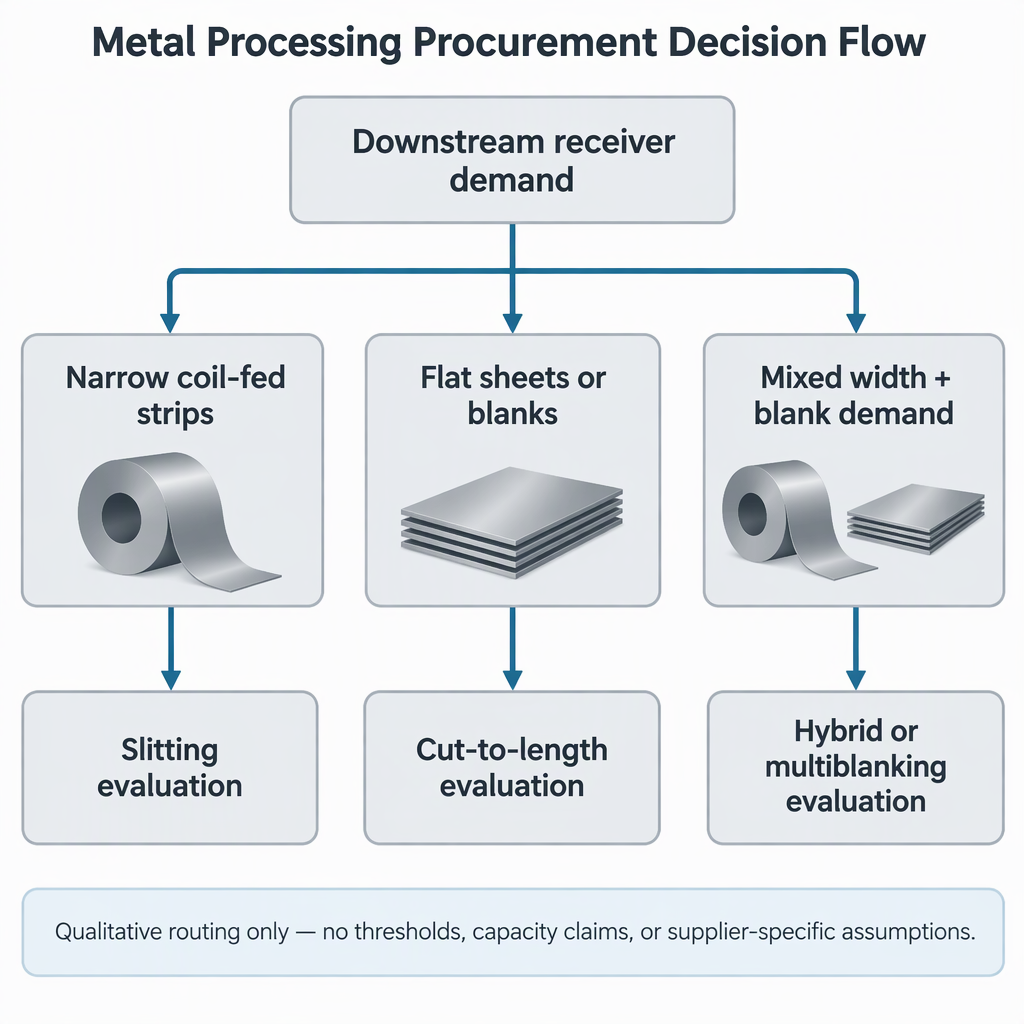
Choose slitting when downstream demand is primarily narrow recoiled mults for coil-fed forming or staging, and choose cut-to-length when the next process needs flat sheets, blanks, or stacks; treat the line name as secondary to the output form your plant must feed.
Slitting vs. cut-to-length: the output difference that matters
The practical difference is the form of material leaving the line: both slitting lines and cut-to-length lines fall within strip, sheet, and plate processing systems, but they prepare different downstream inputs.
Slitting line
A slitting-line project should be evaluated around the product mix, entry-coil handling, tooling changeover, strip tensioning, scrap handling, exit-coil banding, packaging, staffing, training, and preventive maintenance that the plant can support.
Best considered when the downstream process wants strip or coil output rather than flat stacks.
Selection pressure often comes from setup-change frequency, tooling changes, recoiling, and packaging flow.
Cut-to-length line
A cut-to-length project should be evaluated as an early investment decision because fixed-shear, continuous-operation, and multiblanking configurations create different material-handling, flatness, bottleneck, stacking, and packing constraints.
Best considered when the downstream process wants sheets, blanks, or staged stacks.
Selection pressure often comes from shear mode, loop handling, surface risk, flatness expectations, and stacker or packing limits.
When downstream demand points to a slitting line
Favor a slitting line when the plant’s bottleneck is supplying narrow, coil-fed material streams and when changeover, tooling, recoiling, scrap, and packaging control matter more than producing flat blanks.
Demand signal
Why it points toward slitting
Procurement implication
The next process consumes strip or coil stock.
ANSI B11.18’s scope recognizes slitting lines among metal strip, sheet, or plate processing systems.
Ask suppliers how coil entry, strip tensioning, exit recoiling, banding, and packaging are handled for the intended product mix.
Frequent product-mix changes are expected.
Setup-change frequency and slitter tooling changeover are central selection factors.
Compare changeover workflow, tooling access, staffing needs, and operator training requirements instead of asking only for headline speed.
Scrap and edge trim management can affect the line area.
Scrap handling is part of slitting-line efficiency and layout evaluation.
Specify the intended scrap path, handling method, and available floor-space constraints in the RFQ.
When downstream demand points to a cut-to-length line
Favor a cut-to-length line when downstream work is sheet-fed, blank-fed, stack-fed, or packing-driven, especially when the business case depends on material handling, flatness, surface care, and stacker performance.
Demand signal
Why it points toward cut-to-length
Procurement implication
The next operation needs flat sheets or blanks.
Cut-to-length line configuration affects downstream stacker and packing constraints.
Define sheet or blank handling, stack presentation, packing flow, and the receiver’s loading limits before comparing machine layouts.
Surface condition and flatness are important to the next process.
Cut-to-length configurations differ in surface and flatness risks.
Ask how the proposed configuration manages loop pits, leveling, transfer, stacking, and surface-contact points.
Throughput may be constrained after the shear.
Output bottlenecks and stacker or packing limits can shape the investment decision.
Evaluate the full discharge, stacking, and packing system rather than treating the shear as the only capacity driver.
Selection framework: work backward from the next process
Start with the receiver: the ANSI B11 scopes page places slitting and cut-to-length lines within machinery systems for processing strip, sheet, or plate metal, so the useful comparison is the output your next process can consume.
Start with this downstream demand
Primary line direction
What to verify before purchase
A coil-fed forming process needs narrow strips.
Evaluate slitting first.
Confirm product mix, setup-change frequency, ID changes, tooling changeover, strip tensioning, recoiling, banding, packaging, labor, and training needs.
Fabrication, shearing, stamping, panel work, or direct handling needs flat sheets or blanks.
Evaluate cut-to-length first.
Confirm fixed-shear or continuous-operation needs, loop handling, flatness and surface risks, output bottlenecks, stacker requirements, and packing constraints.
The plant needs multiple blanks from a coil in one workflow.
Evaluate a hybrid or multiblanking configuration.
Define where slitting, shearing, stacking, and packing functions occur and which step limits the line.
Operating tradeoffs that change the business case
The business case changes when the line’s surrounding tasks—handling, changeover, tooling, staffing, training, scrap, stacking, and packing—become more difficult than the core cut itself.
For slitting, review entry-coil handling, ID changes, slitter tooling changeover, strip tensioning, exit-coil banding, packaging, staffing, training, and preventive maintenance.
For slitting, include scrap handling and setup-change frequency because they affect floor flow and operating rhythm.
For cut-to-length, compare fixed-shear start-stop layouts, continuous-operation layouts, and multiblanking configurations by their handling and bottleneck effects.
For cut-to-length, review loop pits, surface and flatness risks, stacker constraints, and packing constraints before finalizing layout.
Do not reduce slitting vs cut-to-length to a single speed or price question. A line that looks attractive in isolation can still be a poor fit if downstream stacking, packaging, recoiling, labor, or changeover demands create the real constraint.
Safety and integration boundaries to include in the RFQ
Procurement should require a documented machinery risk-assessment and guarding discussion because slitting and cut-to-length lines are power-driven systems that interact with coils, strip, sheet, rotating components, shear points, and downstream handling equipment.
ANSI B11.0-2023 applies to power-driven machinery used to process materials by cutting, forming, pressure, electrical, thermal, or optical techniques, and it specifies principles and methodology for risk assessment and risk reduction for machinery.
For U.S. projects, 29 CFR § 1910.212 in the current e-CFR text reproduced by Cornell LII requires one or more machine-guarding methods to protect operators and other employees from hazards including point of operation, ingoing nip points, rotating parts, flying chips, and sparks; confirm the adopted edition, state-plan differences, and any local amendments with the local building department or authority having jurisdiction.
Ask suppliers to identify the complete system boundary, including coil entry, processing section, exit handling, stacking, recoiling, scrap, and packaging interfaces.
Require the proposal to describe the risk-assessment approach and risk-reduction responsibilities for the supplied machinery and interfaces.
For U.S. installations, include point-of-operation, nip-point, rotating-part, and flying-material guarding expectations in the specification review.
For maintenance or manual access tasks, require written energy-isolation procedures from the supplier; operators should switch off and disconnect the applicable power source before any permitted manual access and follow the official machine manual.
When the answer may be both, not either/or
A mixed-demand project may need both functions, or at least a hybrid evaluation, when the plant must transform coil into multiple widths and then into flat blanks or stacked products.
Multiblanking configurations make the either/or question less absolute. When the same project involves slitting, shearing, stacking, and packing, compare the total material path, not just the label on the main machine.
Because ANSI B11.18 recognizes cut-to-length lines, press feed lines, and slitting lines as typical systems within metal strip, sheet, or plate processing, procurement can define a project by the complete system output instead of forcing one generic category too early.
RFQ checklist for equipment procurement
Before asking for proposals, collect the downstream receiver’s material form, changeover expectations, handling constraints, staffing assumptions, safety boundaries, and packaging requirements.
State whether the required output is narrow slit coil, flat sheets, blanks, stacked material, or a combined path.
For slitting inquiries, define product mix, setup-change frequency, entry-coil handling, ID changes, tooling changeover, strip tensioning, scrap handling, exit-coil banding, packaging, staffing, training, and preventive maintenance expectations.
For cut-to-length inquiries, define fixed-shear, continuous-operation, or multiblanking expectations and describe loop, surface, flatness, stacker, packing, and bottleneck constraints.
Ask for the supplier’s machinery risk-assessment and risk-reduction approach for the proposed system and interfaces.
Where U.S. regulations apply, require guarding review for point-of-operation, nip-point, rotating-part, and flying-material hazards under 29 CFR § 1910.212, while confirming applicable adopted rules locally.
Conclusion
The safest decision rule is simple: specify the output your downstream process must receive, then compare the line configuration, handling tasks, integration boundaries, and safety responsibilities that make that output reliable.
If the next process wants narrow coil-fed material, begin with slitting. If it wants flat sheets, blanks, or stacks, begin with cut-to-length. If it wants both, define the full material path and evaluate a combined or staged system before committing to a machine category.
FAQs
These buyer questions help turn the slitting vs cut-to-length comparison into a practical specification discussion.
What is the main difference between slitting and cut-to-length?
Both are metal strip, sheet, or plate processing systems, but the decision turns on the output form the downstream process needs.
Which option is usually better for coil-fed forming feed?
When the line needs narrow coil-fed material, evaluate slitting first because product mix, strip tensioning, tooling changeover, recoiling, and packaging are central slitting-line factors.
Which option fits sheet-fed fabrication?
When fabrication needs flat sheets, blanks, or staged stacks, cut-to-length is usually the first configuration to evaluate because stacker, packing, surface, flatness, and output bottlenecks shape the line choice.
Can a cut-to-length project include slitting functions?
Yes. Multiblanking configurations can combine width separation and blank production, so mixed-demand projects should be reviewed by total material path rather than by a single label.
Should price be the first comparison point?
Price should not be isolated from operating demands; setup changes, labor, tooling, scrap handling, recoiling, stacking, packing, and training can change the practical business case.
What safety information should be requested with the proposal?
Request the machinery risk-assessment and risk-reduction approach, the system boundary, and the guarding responsibilities for the supplied equipment and interfaces.
Is one safety rule enough for a global project?
No. U.S. machine-guarding requirements such as 29 CFR § 1910.212 can guide U.S. reviews, but global projects should confirm the current rules, adopted editions, and local amendments with the responsible authority.
Founded in 1992, BMS Machinery joined XIAMEN BMS GROUP in 2017. Our manufacturing network in China includes 8 factories, 6 machining centers and 1 steel structure company, covering over 30,000 m². Supporting credentials include ISO9001:2015 quality management certification and SGS-issued CE/UKCA machinery compliance verifications. XIAMEN BMS GROUP’s Dun & Bradstreet D‑U‑N‑S Number is 55-379-8879.

 日本語
 한국어
 ไทย
 繁體中文
 العربية
 فارسی
 Français
 Русский
 Español
 Português
 English
 Deutsch
 italiano
 Nederlands
 Tiếng Việt
 Polski
 Türkçe
 አማርኛ
 ພາສາລາວ
 ភាសាខ្មែរ
 Bahasa Melayu
 ဗမာစာ
 தமிழ்
 Filipino
 Bahasa Indonesia
 magyar
 Română
 Čeština
 Монгол
 қазақ
 Српски
 हिन्दी
 Kiswahili
 Slovenčina
 Slovenščina
 Norsk
 Svenska
 українська
 Ελληνικά
 Suomi
 Հայերեն
 עברית
 Latine
 Dansk
 اردو
 Shqip
 বাংলা
 Hrvatski
 Afrikaans
 Gaeilge
 Eesti keel
 Māori
 සිංහල
 नेपाली
 Oʻzbekcha
 latviešu
 অসমীয়া
 Беларуская мова
 Esperanto
 मराठी
 پښتو