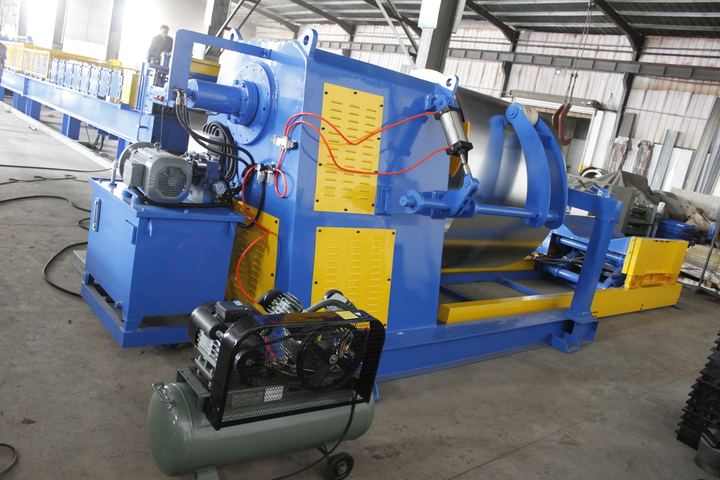
Add a coil car to your hydraulic decoiler quote when moving and lining up the next coil repeatedly delays your line, or when your existing equipment cannot reliably reach the loading position. Add a clamp arm when your material and site safety review call for a defined way to control the coil’s outer wraps.
Price those options separately against the same base machine. You may need just one, both, or neither. The decision starts with the coils you actually run and ends with a quote that shows how each option earns its place.
Match the actual coil envelope
List your real coil jobs, with weight, width, inside diameter (ID) and outside diameter (OD) together for each coil. Include a normal job and any combination that could rule out an offer. Your heaviest coil may be a different job from your widest coil or the one with the smallest bore. Add strip thickness, grade and coating.
Check mandrel and saddle fit
Check those combinations against the mandrel and any car you are considering. Hydraulic expansion grips the bore. The reel drive or brake handles rotation. For a bore near the end of the expansion range, ask the supplier to confirm fit on the quoted mandrel. A narrow coil or partial coil can raise a separate question about fit on the car’s saddle.
Check the 10T package limits
One reference point is the BMS 10T hydraulic decoiler with a clamp arm and coil car. BMS lists a maximum width of 1,250 mm (about 49.2 in.) and a coil ID of 508 ± 30 mm (about 20.0 ± 1.18 in.) for this package. Ask for the approved OD range and separate reel and car ratings in kilograms.
Compare base decoiler and coil-car scope
Base decoiler. Your existing arrangement covers transfer and the site has an approved way to manage the outer wraps.
Add the car. Transfer or alignment is the open issue. Your material and site review support the existing outer-wrap controls.
Add the arm. Transfer already works. The coil needs a specified outer-wrap control function.
Add both. Each option solves a separate problem on your jobs, and the supplier verifies that both fit and work together.
Check the transfer path
A car with the right lift and travel can bring the coil bore to the mandrel center height on a defined path. Confirm the car can receive the coil from your crane or forklift and support it at both ends of travel. If the same crane must be free at the same time, its queue may remain.
Compare the time you can recover
Time the transfer and positioning window on your current line. Ask the supplier for a demonstration or estimate on the same coil job with the same timing boundaries. Count waits for the lift or downstream preparation only if the car changes them.
If the window drops from nine to five minutes and you change coils six times per shift, that is 24 minutes of potential line time per shift. This example assumes all six changes stop production and no new delays occur.
For a discretionary car, compare its added installed cost with the annual value of production time you can realistically recover. Give priority to fit if an existing loading arrangement cannot reach the mandrel for a limiting coil. Ask for a drawing that shows the proposed handoff can work.
Clarify the clamp-arm function and controls
Put the arm in the quote when your coil needs outer-wrap control the base equipment cannot provide. Stiffer strip can spring outward as it is released. A hold-down arm can contact the outside of the coil. A side keeper limits sideways movement, and an outboard support carries the free end of some mandrels. Ask the supplier to identify the offered part and contact point on a drawing.
The curved blue arm beside the steel coil on BMS’s 10T decoiler.
Choose a roller for the job you need
Free-turning roller. The roller follows the coil surface as it turns. Consider this design when the arm needs to keep contact with the outer wraps and the reel or entry equipment already moves the strip forward.
Driven roller. The roller can add traction to help start the strip into the receiving machine. Ask for this function when the existing entry equipment needs powered help with that first feed.
Check which coil widths and ODs the roller can reach and where it can contact coated stock. Confirm when the arm engages, how its position is checked and how the controls respond if it is out of position or the line stops.
Ask for an acceptance check with a typical coil and the grade or size that makes wrap control most demanding. Define acceptable wrap control and coating condition before the check. A clamp arm cannot replace a verified site safety procedure. Have your site team review guarding and hazardous-energy controls for the complete installation.
Check line interface and installed space
Check how the decoiler responds when your downstream machine changes demand. BMS describes a speed sensor that helps match payoff to line feed on the 10T model, which has a self-contained controller. Get a signal list that assigns run request, ready, stop, fault and emergency-stop interface responsibilities. Check minimum and maximum speeds as well as pauses between feeds.
Match the decoiler outlet height, direction and centerline to the receiving machine’s inlet. On the same layout, show the car handoff, travel and parked positions, plus guarded access, service and handling space. Have your installation team compare the supplier’s floor loads and anchor drawing against site conditions.
Give the builder the verified voltage, frequency and phase at the point of installation. Ask what service the package needs and who provides the connections. On a retrofit, have the plant controls owner and supplier agree on the signal list before pricing installation.
Request a complete package quotation
Ask bidders to quote the same base machine and feasible alternates, with your existing handling arrangement as the baseline. For each row, identify what is included, separately priced, or yours to supply.
What to compare in each hydraulic decoiler quote
Item
Base quote
What to confirm for an alternate
Load rating
Rated reel load in kg for your coil jobs.
Separate car rating in kg. Check the same jobs on both.
Coil dimensions
Approved width, ID and OD ranges in mm.
Car saddle and arm reach across the jobs they must serve.
Expansion
Mandrel type and working ID range in mm.
Any bore hardware and its effect on the quoted limits.
Drive and controls
Payoff, brake, speed range and line interface.
Added car or arm controls and who supplies them.
Coil car
Existing loading equipment and handoff.
Travel and lift dimensions, saddle drawing and transfer check.
Clamp arm
Base coil controls and the limits of their scope.
Contact point, roller drive, operating modes, limits and agreed material check.
Layout
Matched outlet and inlet positions, plus service access.
Full travel, parking and guarding areas on the installed drawing.
Coils. Send maximum coil weight, width, ID and OD, with their units, plus a usual coil and each limiting combination. Add grade, thickness and coating.
Line and site. Send the line speed range, stop-start pattern, floor space, receiving machine inlet height and current loading arrangement.
Power. Send the plant’s actual voltage, frequency and phase at the machine connection.
Break out option hardware, controls, electrical connections, commissioning and site work by cost and owner. Request the layout and signal list with the quote. Agree how the supplier will verify the claimed car or arm performance and how it will check the combined package if you buy both.
Send BMS your coil and line data
Request a base quote and separate option prices from BMS. Send your coil list, loading arrangement, line speed range, available space and verified site power. Ask BMS to identify which car and arm combinations it can supply and the drawings or acceptance checks it can include.
Hydraulic decoiler quotation FAQs
What does “10T” mean on a US quotation?
The model label alone leaves the approved rating and unit convention open. Ask for the reel and car ratings separately in kilograms, with a labeled pound equivalent if needed.
Will a car free up my forklift or crane?
Ask whether your site can assign the upstream lift to a different time slot. If staging before the line stops is feasible, ask the bidder to show the receiving position and what site equipment is still needed.
Can the car handle a narrow leftover coil?
Ask whether the saddle needs a narrow-coil support or a different contact surface. Have the bidder state the resulting minimum dimensions and any change in rating.
Can I keep my decoiler and add an arm?
Ask the builder to review the existing frame, mounting space and controls. Request a drawing showing where the arm would reach, and name who will validate the modified installation.
What if you use two different coil bore sizes?
List both bores and ask whether one expansion range covers them. If the supplier proposes alternate hardware, request the approved rating and dimensions for each configuration.
What if your feeder runs intermittently?
Send the time between feeds and how quickly the line resumes. Ask whether a strip loop or another buffer is part of the quote, and include its footprint in the layout.
How do you compare a bundled quote with separate options?
Ask the bidder to itemize the hardware, controls and site work in the bundle. Compare installed scope against the same coil jobs and verification requirements, even if the price is offered only as a package.
Founded in 1992, BMS Machinery joined XIAMEN BMS GROUP in 2017. Our manufacturing network in China includes 8 factories, 6 machining centers and 1 steel structure company, covering over 30,000 m². Supporting credentials include ISO9001:2015 quality management certification and SGS-issued CE/UKCA machinery compliance verifications. XIAMEN BMS GROUP’s Dun & Bradstreet D‑U‑N‑S Number is 55-379-8879.

 日本語
 한국어
 ไทย
 繁體中文
 العربية
 فارسی
 Français
 Русский
 Español
 Português
 English
 Deutsch
 italiano
 Nederlands
 Tiếng Việt
 Polski
 Türkçe
 አማርኛ
 ພາສາລາວ
 ភាសាខ្មែរ
 Bahasa Melayu
 ဗမာစာ
 தமிழ்
 Filipino
 Bahasa Indonesia
 magyar
 Română
 Čeština
 Монгол
 қазақ
 Српски
 हिन्दी
 Kiswahili
 Slovenčina
 Slovenščina
 Norsk
 Svenska
 українська
 Ελληνικά
 Suomi
 Հայերեն
 עברית
 Latine
 Dansk
 اردو
 Shqip
 বাংলা
 Hrvatski
 Afrikaans
 Gaeilge
 Eesti keel
 Māori
 සිංහල
 नेपाली
 Oʻzbekcha
 latviešu
 অসমীয়া
 Беларуская мова
 Esperanto
 मराठी
 پښتو