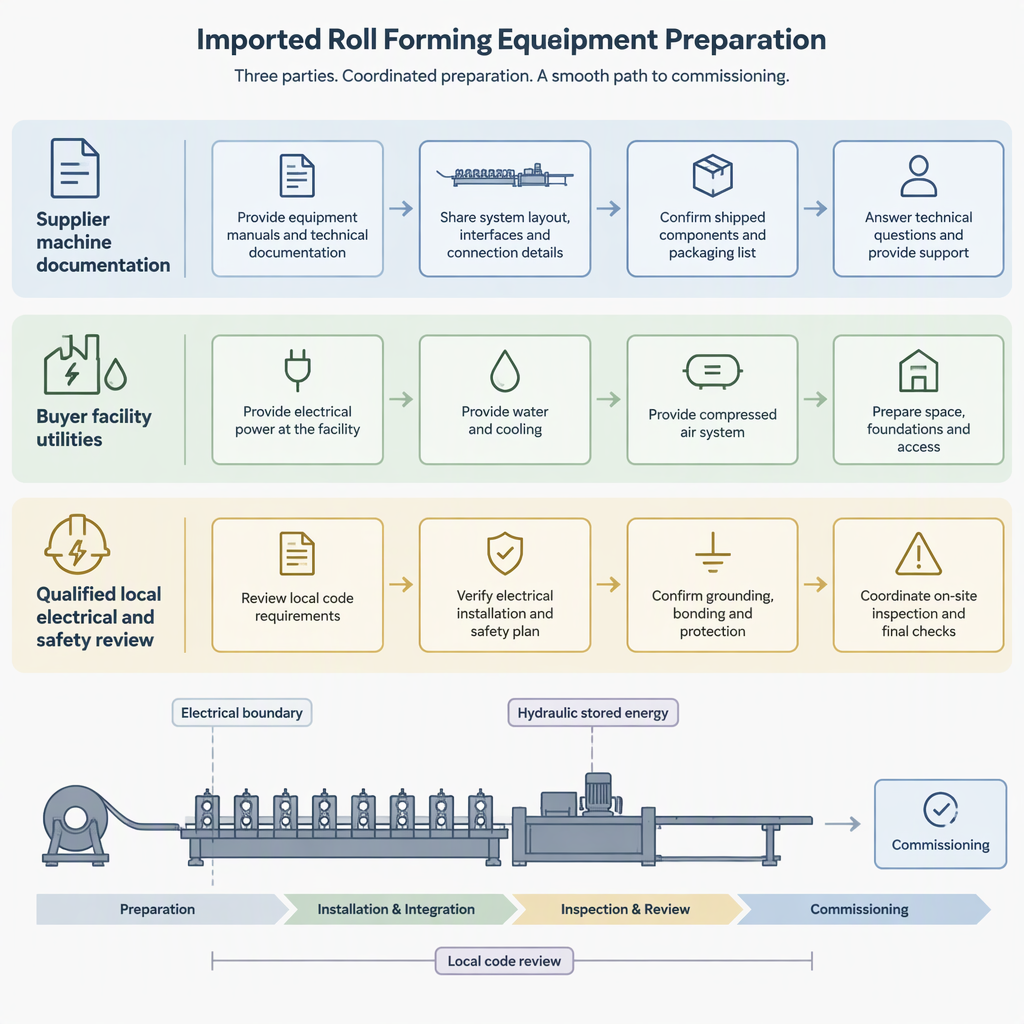
Before importing the equipment, separate the machine-side electrical package from the facility utilities that must be engineered locally; then prepare hydraulic and other stored-energy controls before commissioning or maintenance access.
Start with a pre-import utility readiness map
A useful readiness map lists what the imported machine requires at the supply connection, what the building must provide, and which items need local professional review before the line is energized.
Identify the machine electrical-equipment connection point so the supplier’s machine documents and the buyer’s facility utilities are not mixed into one unclear scope.
List all relevant energy sources for commissioning and maintenance planning, including electrical, mechanical, hydraulic, pneumatic, thermal, chemical, and other stored energy where applicable.
Collect model-specific utility data from the supplier before shipment, then give it to the local electrical engineer, safety team, and installation contractor.
Convert the data into a site action list: incoming supply, disconnecting means, grounding or bonding approach, hydraulic-unit placement, access space, safe maintenance access, and commissioning controls.
Ask for rated electrical supply information for the exact line being purchased.
Confirm whether any hydraulic power unit, pneumatic circuit, cooling system, or auxiliary machine is part of the shipped package.
Assign one owner for local utility engineering and one owner for machine-document review.
Do not treat a general quotation or machine photo as a utility schedule; use model-specific documents.
Define the electrical boundary before discussing utilities
For machinery discussions, the electrical boundary normally starts where the supply connects to the machine electrical equipment, so buyers should distinguish machine wiring from the building-side supply design.
IEC 60204-1:2016+AMD1:2021 describes machine electrical equipment and systems for machines that are not portable by hand while working, with equipment coverage beginning at the point where the supply connects to the machine electrical equipment.
Ask which cabinet, control panel, motors, drives, sensors, and machine-mounted devices are included in the machine electrical package.
Ask what the facility must provide before that supply connection: feeder, protection, grounding or bonding, cable routing, and isolation hardware as required locally.
Keep voltage, phase, frequency, full-load current, short-circuit information, and environmental assumptions tied to the exact model and configuration.
Before any manual cabinet access, inspection, adjustment, or wiring work, switch off and disconnect or isolate the relevant power source, then follow the permitted procedure for the specific equipment.
Route local electrical-code decisions to qualified reviewers
Incoming supply, grounding, protection, permits, and installation acceptance should be decided by qualified local reviewers because electrical rules depend on the jurisdiction and the adopted code edition.
For NEC-using jurisdictions, NFPA identifies NFPA 70 as the National Electrical Code; buyers should confirm the adopted edition, local amendments, inspection process, and any additional building-department requirements with the local authority and electrical professional.
Machine electrical standards help frame the machine-side boundary, but they do not replace local building wiring design, utility coordination, or permitting decisions.
Use the supplier’s machine documentation as an input to local design, not as the final site approval.
Prepare for hydraulic power and stored-energy control
Hydraulic preparation is not only about oil selection or pump placement; hydraulic energy is one of the stored-energy sources that must be controlled when workers service or maintain equipment.
Include hydraulic energy in the same pre-commissioning energy-source inventory as electrical, mechanical, pneumatic, chemical, thermal, and other energy sources.
Ask the supplier which hydraulic unit, hoses, valves, accumulators, guards, and access points belong to the purchased configuration.
Confirm the required oil, filtration, cooling, ambient conditions, containment, and maintenance access from the specific machine manual or technical schedule.
Plan floor space so technicians can reach permitted service points without bypassing guards or climbing over utilities.
Before manual access to hydraulic components, switch off and isolate the relevant power source, secure moving parts, and relieve or control stored hydraulic pressure according to the model manual and site procedure.
NIOSH manufacturing guidance treats hazardous-energy control as broader than lockout alone and includes multiple energy sources, so buyers should prepare procedures before commissioning work begins rather than after the first maintenance event.
Build an energy-control plan before commissioning work
A commissioning-ready factory should have a written hazardous-energy-control approach before personnel inspect, clean, adjust, clear jams, or service the line.
Develop a written hazardous-energy-control program for machine maintenance and servicing activities.
Identify the energy sources covered by the work, including electrical, mechanical, hydraulic, pneumatic, chemical, thermal, or other energy.
Define who is authorized to isolate energy, verify zero-energy or controlled-energy status, and restore the line.
Before anyone reaches into the machine, opens a guarded area, clears a jam, or accesses hydraulic or electrical equipment, switch off and disconnect or isolate the applicable power source and control stored energy using the approved procedure.
Train and communicate the procedure to affected personnel before trial runs and handover.
29 CFR 1910.147 text is useful for U.S. hazardous-energy-control concepts where unexpected energization, startup, or stored-energy release could injure employees.
Use local law, the machine manual, and the employer’s safety program to convert these concepts into site procedures.
Request supplier documentation before shipment
The safest time to request utility and maintenance documents is before shipment, when electrical, hydraulic, and auxiliary requirements can still be reviewed against the buyer’s building conditions.
Electrical schedule for the purchased configuration: voltage, phase, frequency, rated current, cabinet information, motor list, and connection assumptions.
Machine electrical drawings and control-cabinet information needed by the local electrical reviewer.
Hydraulic-unit information when the line includes hydraulic equipment: fluid requirements, tank or unit data, hose routing limits, access points, and pressure-control instructions from the machine manual.
Energy-isolation and maintenance-access instructions for cleaning, adjustment, servicing, jam clearing, and commissioning checks.
Auxiliary utility list for air, water, drainage, lubrication, cooling, or material-handling equipment if those systems are included in the purchased line.
Packing, layout, unloading, and placement drawings so utilities do not block guarded access, operator paths, or maintenance zones.
Use a responsibility table to avoid installation gaps
A responsibility table helps buyers separate supplier machine information, buyer facility preparation, and local engineering decisions before the imported equipment arrives.
Decision area
Supplier document input
Buyer facility action
Local reviewer action
Machine electrical boundary
Machine electrical-equipment connection information
Provide building-side supply and cable route
Confirm local installation method and acceptance process
Electrical code review
Provide model electrical data
Schedule review before shipment or site work
Apply the adopted electrical code and local amendments in NEC-using jurisdictions
Hydraulic stored energy
Provide hydraulic-unit and maintenance instructions
Plan space, containment, access, and isolation points
Integrate hydraulic energy into hazardous-energy control
Commissioning and servicing
Provide permitted checks and manuals
Assign trained personnel and procedures
Align the written energy-control program with site operations
Item type
Treat as machine-side information
Treat as buyer-supplied utility
Treat as local engineering decision
Voltage and frequency
Exact machine requirement
Available supply
Compatibility and protection design
Hydraulic unit
Included components and manual limits
Floor space, access, containment
Energy-control integration
Disconnecting and isolation
Machine instructions and access points
Site procedure and personnel assignment
Jurisdictional code and safety requirements
Utility readiness item
Machine load and auxiliary data
Power, air, cooling, drainage, and layout readiness
Permits, inspection, and final acceptance route
Conclusion
Import readiness depends on a clear split: supplier machine documents, buyer facility utilities, and qualified local review must be aligned before shipment and before any energization.
Use the machine electrical-equipment supply connection as a practical boundary for electrical discussions.
Prepare hazardous-energy control before commissioning and servicing work begins.
Include hydraulic and other stored energy in the same safety planning as electrical energy.
Request exact model documents instead of relying on general assumptions about the equipment.
FAQs about installation utilities
These questions help buyers turn electrical, hydraulic, and safety preparation into practical pre-import actions.
Is lockout/tagout only an electrical issue?
No. Hazardous energy can include electrical, mechanical, hydraulic, pneumatic, chemical, thermal, or other energy, so a line with hydraulics or moving mechanisms needs broader energy-control planning.
What utility documents should I ask for first?
Ask for the exact model’s electrical schedule, electrical drawings, hydraulic-unit information if included, auxiliary-utility list, layout drawings, and maintenance-access instructions.
Can the equipment supplier decide my local electrical code requirements?
The supplier can provide machine data, but adopted electrical-code editions, local amendments, permits, inspection, and building-side installation decisions belong with qualified local reviewers and authorities.
Why review utilities before shipment?
Pre-shipment review gives the buyer time to correct building supply, space, access, or documentation gaps before the imported equipment reaches the factory floor.
Can I choose hydraulic oil from a general recommendation?
Use the specific machine manual or supplier technical schedule for hydraulic fluid and maintenance limits, because oil, filtration, cooling, and access requirements depend on the actual configuration.
What must happen before first energization?
Confirm local electrical review, complete the utility connections permitted by the adopted procedure, establish hazardous-energy controls, and keep untrained personnel away from inspection or adjustment work.
How does layout affect utilities?
Layout affects cable routing, hydraulic-unit placement, operator access, maintenance access, drainage, cooling, and safe isolation points, so utility planning should use the final line arrangement rather than a generic machine footprint.
Founded in 1992, BMS Machinery joined XIAMEN BMS GROUP in 2017. Our manufacturing network in China includes 8 factories, 6 machining centers and 1 steel structure company, covering over 30,000 m². Supporting credentials include ISO9001:2015 quality management certification and SGS-issued CE/UKCA machinery compliance verifications. XIAMEN BMS GROUP’s Dun & Bradstreet D‑U‑N‑S Number is 55-379-8879.

 日本語
 한국어
 ไทย
 繁體中文
 العربية
 فارسی
 Français
 Русский
 Español
 Português
 English
 Deutsch
 italiano
 Nederlands
 Tiếng Việt
 Polski
 Türkçe
 አማርኛ
 ພາສາລາວ
 ភាសាខ្មែរ
 Bahasa Melayu
 ဗမာစာ
 தமிழ்
 Filipino
 Bahasa Indonesia
 magyar
 Română
 Čeština
 Монгол
 қазақ
 Српски
 हिन्दी
 Kiswahili
 Slovenčina
 Slovenščina
 Norsk
 Svenska
 українська
 Ελληνικά
 Suomi
 Հայերեն
 עברית
 Latine
 Dansk
 اردو
 Shqip
 বাংলা
 Hrvatski
 Afrikaans
 Gaeilge
 Eesti keel
 Māori
 සිංහල
 नेपाली
 Oʻzbekcha
 latviešu
 অসমীয়া
 Беларуская мова
 Esperanto
 मराठी
 پښتو