Choose a dedicated Z purlin roll forming machine when booked Z orders fill your shifts and you can buy occasional C sections on acceptable terms. A shared C/Z line earns its place when recurring C orders cover its extra cost and leave enough time to return to Z before dispatch.
Give both bidders the same Z drawing, coil specification and delivery date. Then ask your planner to fit one real C order between two Z jobs. That exercise tells you which changeover and output figures you need the supplier to demonstrate.
Define the Z profile and material envelope
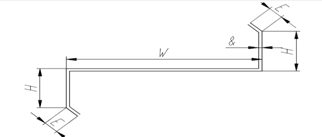
Start with a Z part you sell regularly. Viewed end-on, its flanges project in opposite directions from the web. A C section has both flanges facing the same way. If one Z flange is wider, identify it on the drawing. Someone viewing the part from the other end will read “left flange” the other way round.
BMS end view of a Z section. Use the web and the two flange faces to identify which edge each hole dimension starts from.
What to send for each Z part number
A dimensioned end view. Mark the web depth, both flange widths, any return lips, inside bend radii and viewing direction. State which dimensions are inside measurements and which are outside. Those details let a bidder check whether the rolls cover that particular combination.
A length view with the same revision number. Identify the cut ends and show the holes on the correct face. If your two views show different revisions, resolve the difference before anyone prices the tooling or prepares the inspection sheet.
The actual trial-coil certificate. Match the grade, strength values and thickness to your purchase specification. For coated strip, state whether thickness in millimetres refers to the base metal or includes the coating. Record the finish against the same part number.
BMS lists a Z purlin roll forming machine for 201 stainless steel at 1.5–3.0 mm. For a galvanized order, send the grade, coating and thickness you buy. Ask for written coverage of your Z and C drawings in that steel, and use the agreed coil specification for the trial.
Have each bidder mark the drawings it can run as supplied, those needing extra tools, and those outside its offer. Take your deepest Z section as a check. A catalogue can list maximum depth and maximum thickness separately without answering whether the line can handle both on the same part.
Compare dedicated and interchangeable tooling
Two changes can appear as one line on a quotation. A new Z size may require different strip width, guide positions, punch settings or a cutter insert. A switch from Z to C also changes the direction of one flange. Your crew needs to know which adjustments it will make for each job.
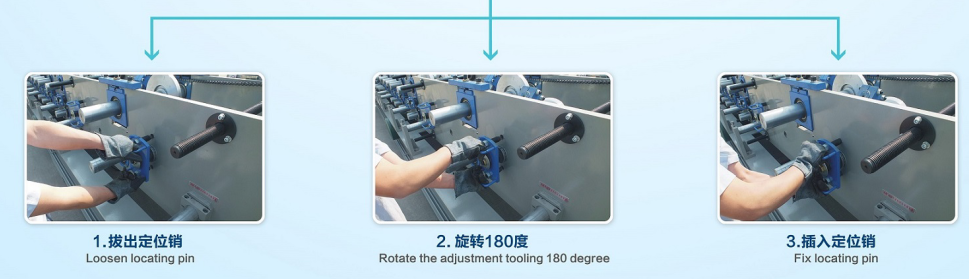
On the BMS Auto Change Type C&Z Purlin Machine, the controller sets sizes within a family. The family switch is manual. The photo shows the operator repositioning a tool through 180 degrees. A saved recipe can load a cut length while the crew still has physical work to do.
On this BMS configuration, the operator releases the locating pin, rotates the tool and secures it in the new position. Time both directions through the first inspected part.
What to compare in a dedicated Z bid and a shared C/Z bid
What you need to establish
Dedicated Z line
Interchangeable C/Z line
Profile coverage
Match each Z drawing to its roll set and size settings.
Add each C drawing. C and Z may have different size limits.
Material envelope
Pair each Z size with the grade and thickness you buy.
Confirm each grade and thickness for the relevant family and size.
Changeover mechanism
Allow for adjustments between Z sizes.
Add the family switch, including any manual tooling work.
Hole pattern
Check die reach on the web and the correct Z flange.
Repeat for C. A saved pattern still needs the die on the correct side.
Cutoff
Identify the insert or blade for each Z end.
Establish whether that tool also clears the C section or needs changing.
Complete-line trial
Measure accepted output from the common Z order.
Run that same Z order, switch to C, then reproduce the original Z part.
When you browse the BMS purlin roll forming machine range, take the same drawing list into each enquiry. Ask the bidder to price the tools that stay on the machine and those your crew must lift or store. A line can form your Z section yet still lack the punch needed to ship it.
Compare punching and cutoff integration
Use a part with a slot near one end of the wider Z flange. That single feature exposes two errors a plain profile can hide: a hole in the wrong face and a hole measured from the wrong end. Follow it from the flat strip to the exit rack.
At the punch. On the listed BMS stainless Z line, the punch acts on the strip before forming. Give the bidder the round-hole diameter or slot dimensions, the slot direction and the edge from which you locate it. Mark which end of the finished piece leads into the line.
Through the rolls. The punched strip becomes a section with two opposing flanges. On the formed sample, check that the slot is on the wider flange and measure it from the edge named on the drawing. A correct hole pitch alone cannot identify a reversed part.
After cutoff. This BMS example cuts the formed section hydraulically. Measure from the specified cut end to the first hole, then check pitch along the part. A whole row can have the right spacing and still sit too close to the end.
Suppose your drawing places three hole centres 80, 180 and 280 mm from the same cut end. At 84, 184 and 284 mm, both pitches would still be 100 mm. Recording the first-hole offset alongside pitch exposes the 4 mm shift. Judge it against your drawing tolerance. The measurements alone cannot tell you which station caused it.
Measure the rate at the exit rack
BMS lists 20 m/min for its 201 stainless Z example, excluding punching and cutting. Your shortest length with its usual holes makes a useful comparison: it can need more punch strokes and cuts per metre than a long, lightly punched part.
Accepted output during a production run
Accepted m/min = total metres of conforming, punched and cut parts at the rack ÷ elapsed running minutes.
For a batch of one length, multiply accepted pieces by ordered length in metres. Include in-cycle pauses for punching and cutting. Record setup time separately and use the same clock boundaries on both bids.
Watch the cut and discharge on each offer. A stop-to-cut shear pauses the feed. A flying cutter moves with the section during the cut. Check the insert needed for each shape and whether the rack supports your longest order. Log rejected lengths and offcuts separately so you can cost the steel you use.
Assess the actual C/Z order mix
Use a recent month of released orders. For each job, record the family, drawing revision, coil, length, piece count and promised dispatch date. Multiply length by quantity to get metres. Keep potential C enquiries in a separate forecast so your buying decision shows what is already booked.
One C batch or four deliveries?
Suppose your planner first reserves the Z runs and allows for planned stops. The following inputs are illustrative. Replace them with your order book and measured trial results before you price the shared line.
Monthly demand. 12,000 m of Z and 3,000 m of C. C accounts for 20% of total metres. Assume the same C size, material and hole program for all four deliveries.
Running rate. Assume 6 accepted m/min on C, including normal rejects, punching and cutting. The C order needs 3,000 ÷ 6 = 500 running minutes under either schedule.
Family switch. Allow 20 minutes in each direction, from the last approved part of one family to the first approved part of the next. Treat that first piece as setup material and give it no credit towards the order.
In the single-batch case you have a continuous 10-hour opening. In the four-delivery case the openings between Z jobs add up to 10 hours. Each delivery sends the line back to Z, which is where the two schedules diverge.
C production against 10 available hours before dispatch
C delivery plan
Time calculation
Effect on Z dispatch
One C batch
500 min running + 2 switches × 20 min = 9 h
Fits if at least 9 hours are available together.
Four C batches, each between Z jobs
500 min running + 8 switches × 20 min = 11 h
Needs 1 h more than the four openings provide in total.
You can also work backwards from the deadline. Of the 600 minutes available, the C run takes 500. Four batches leave 100 minutes for four Z–C–Z round trips, or 25 minutes per round trip on average. Ask the bidder to demonstrate both directions and check that each batch and its switches fit its own opening.
Put those hours on the dispatch calendar. If a C order needs a different coil or die, add that stop once. Spare time after the truck leaves cannot cover a shortfall before it. Grouping deliveries helps only if you can store the parts and meet the dates your customer agreed.
What one shift can ship under these assumptions
An eight-hour shift leaves 420 minutes after breaks and planned stops. One switch each way leaves 420 − 40 = 380 minutes for C.
380 min × 6 accepted m/min = 2,280 m. Check how many complete pieces of the ordered length fit within that allowance.
Compare the cost of delivering the same C orders
Buy finished C parts. Use the delivered price, including freight, minimum batch and lead time. Check the vendor can release each lot on the dates your Z production cannot accommodate.
Run C on the shared line. Include coil, setup scrap, labour, electricity, maintenance and tooling. For an annual comparison, charge one year’s share of the extra machine cost against the same annual volume of C parts.
For a C job that would displace booked Z work, include the overtime you would actually pay or the Z margin you would lose. This gives you a cost and a delivery date for each route. A lower part cost helps only if you can get the order onto the truck.
Request equivalent acceptance trials
Issue one Z trial sheet to both suppliers before they quote. Specify the drawing revision, actual trial coil, consecutive piece count, inspection method and drawing tolerances. Include punches, cutter and discharge in the trial. Agree who provides the coil, who witnesses the run and which conditions require a repeat.
Run the common Z order. Check the coil identity against its certificate. Run the same hole program and cut length with the quoted tools on each machine. Log crew size, clock boundaries, accepted metres and scrap. Keep the first and last pieces in the sequence.
Measure finished parts. Check web, both flanges, lips, length, holes and cut ends. Use the named end and edge for hole positions. Record twist or surface marks against the agreed limits. Label each sample with the drawing, coil and sequence number.
Prove the extra capability. On the shared line, run a real C drawing and then return to the original Z. Time each direction through first-piece inspection, including manual adjustments and die changes. On the dedicated line, try a second Z size if that reflects your usual schedule.
Recalculate the schedule. Use each family’s accepted output during running time, then add measured setup minutes once. If a bidder substitutes another coil, omits a hole or bypasses discharge, identify which result is affected and agree what must be rerun.
Keep the original Z setup sheet. After the C run, call up that same Z drawing and hole program again. Compare the first approved return piece with the original Z sample, using the same end and flange as references. Record any correction, extra strip and inspection time needed to get it right.
Use the common Z run to compare bids. For capacity, group Z jobs by comparable lengths and hole patterns. Divide each group’s metres by its own representative trial rate, in m/min. Sum the resulting minutes and add setup time once. A slower Z run can leave the shared line less time for C.
What the receiving plant in Russia must confirm
Electrical supply. Your plant engineer provides the actual voltage, frequency, phase and available capacity. Get written confirmation that the quoted line is suitable for that supply.
Documents and languages. Have your receiving team and importer list what they require. Ask for a delivery schedule for the machine manual, wiring and hydraulic diagrams, tool list, spare-part identifiers, inspection records and any applicable conformity documents they identify.
Commissioning and spares. Agree who commissions the line and trains your operators, and how to order a replacement punch or shear insert. Assign someone to keep the signed measurements and labelled samples for comparison after installation.
What to put in your request for quotation
Once both bids have passed the Z trial, the decision rests on the C orders. Keep Z dedicated if buying finished C parts meets the dates at a better total cost. Choose the shared line if its measured C output and return-to-Z time make those jobs profitable within the available shifts.
Request comparable quotations from BMS. Send your Z drawings and any C drawings, material grade, thickness, hole pattern, cut lengths and monthly split between C and Z. Attach the material certificate, site electrical supply and required document list. Ask BMS to itemize the tooling, trial and commissioning for each option.
Founded in 1992, BMS Machinery joined XIAMEN BMS GROUP in 2017. Our manufacturing network in China includes 8 factories, 6 machining centers and 1 steel structure company, covering over 30,000 m². Supporting credentials include ISO9001:2015 quality management certification and SGS-issued CE/UKCA machinery compliance verifications. XIAMEN BMS GROUP’s Dun & Bradstreet D‑U‑N‑S Number is 55-379-8879.

 日本語
 한국어
 ไทย
 繁體中文
 العربية
 فارسی
 Français
 Русский
 Español
 Português
 English
 Deutsch
 italiano
 Nederlands
 Tiếng Việt
 Polski
 Türkçe
 አማርኛ
 ພາສາລາວ
 ភាសាខ្មែរ
 Bahasa Melayu
 ဗမာစာ
 தமிழ்
 Filipino
 Bahasa Indonesia
 magyar
 Română
 Čeština
 Монгол
 қазақ
 Српски
 हिन्दी
 Kiswahili
 Slovenčina
 Slovenščina
 Norsk
 Svenska
 українська
 Ελληνικά
 Suomi
 Հայերեն
 עברית
 Latine
 Dansk
 اردو
 Shqip
 বাংলা
 Hrvatski
 Afrikaans
 Gaeilge
 Eesti keel
 Māori
 සිංහල
 नेपाली
 Oʻzbekcha
 latviešu
 অসমীয়া
 Беларуская мова
 Esperanto
 मराठी
 پښتو