A CZ purlin roll forming machine price is comparable only when both quotations cover the same finished C and Z parts, accepted production rate and handover at the same factory. A standard package can be the better buy when it meets those requirements with the necessary tooling and modules included. A heavier-duty package earns its premium when a quoted upgrade solves a specific problem, such as forming a demanding part within tolerance or keeping up with a hole pattern that slows the base line.
Suppliers use “standard” and “heavy-duty” for their own configurations. The buyer can compare what those labels buy by identifying required work, confirming which equipment and services are included, and pricing the gaps before ranking the offers.
Fix the quotation baseline before comparing prices
The quotation baseline is a schedule of the parts and production conditions both suppliers must support. Each entry should identify a real combination of profile, coil and finished length. A wide Z section and a thick, high-strength C section might both be required, even if the widest section never uses the thickest coil. Listing those jobs separately makes it clear which combinations must be covered and which can be offered as options.
Finished parts. The buyer’s drawing schedule should give the revision, web, flanges, lips, bend radii and tolerances for each C and Z section. It should also state the finished lengths, hole and slot schedule, and how the quality team will check the parts. A quote that includes one family of flange holes can still exclude another even when both section sizes are listed.
Incoming steel. The material schedule should pair each drawing with the steel grade, required yield-strength range, thickness and coating where relevant. It should give coil width and dimensions as supplied. If two approved grades are expected on the same drawing, both belong in the schedule. A thickness limit in isolation leaves the supplier free to assume a different grade.
Production and site. Both bidders should receive the usual batch sizes, change frequency and target output in accepted parts or metres per minute for each representative job. Any shift target should be stated separately. For equipment destined for Saudi Arabia, the quote should use the actual receiving factory’s location and available voltage, frequency and phases. The buyer’s project team should supply the applicable documents and site requirements.
The bid should return the same drawing schedule with any deviations marked. One supplier might quote a thinner substitute at the original rate, while another quotes the specified steel but assumes unpunched parts for its production figure. Both departures matter before price enters the decision. Giving the suppliers the same revised schedule also makes it easier to spot a bid based on an earlier drawing or an outdated hole pattern.
Compare forming and drive scope
The forming and drive premium is worth examining when a required part challenges the base package. WorldAutoSteel explains in its guidelines for advanced high-strength steel that successive pairs of rolls bend the strip toward its final section. Steel grade, part shape and mill design influence how many roll pairs are needed. A change in flange or lip geometry alters where the strip is bent. A stronger coil can change the forming load and how far the metal springs back after leaving the rolls.
What the forming package includes
Roll tooling. Each quote should identify the roll tooling for both shapes, which sizes share tooling and which need a new setting or roll set.
Frame, stands and shafts. These parts help keep the rolls in position under load. Tooling design and support help maintain the required profile, and a trial on the specified coil confirms the final dimensions.
Drive and transmission. The motor and transmission drive the strip through the forming passes. A larger motor can supply more power.
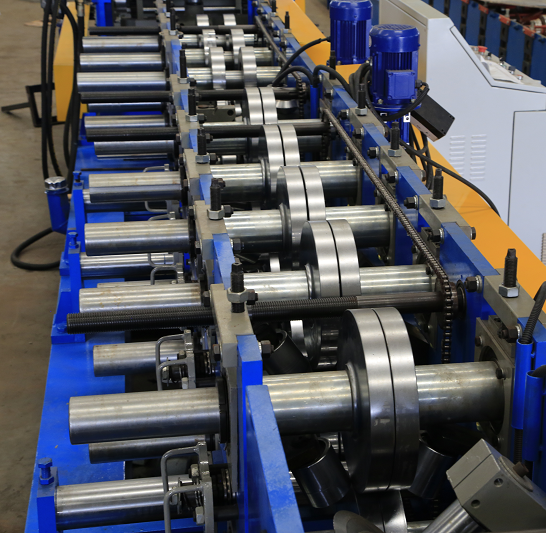
Roll tooling, shafts and drive components on a separate BMS automatic-change C/Z line. Each quote should specify the roll sets and drive arrangement it includes.
A BMS catalog example
BMS lists its heavy-duty automatic CZ purlin roll forming machine under model C100-400/Z120-400. Its catalog gives a 0.95–3.0 mm thickness example for galvanized steel (GI) or hot-rolled steel. The written offer should match the quoted strength and thickness to the specific C and Z drawings and list the equipment supplied for those combinations.
When heavier forming hardware earns its price
A standard package can cover a stable schedule if it meets the material, tolerance and output requirements. If the heavier bid adds better-supported rolls, different tooling or a different drive, the quote should identify the scheduled job that benefits. A part that is hard to form gives both suppliers a useful acceptance check. The same material and drawing limits should apply to both trials.
Compare punching, cutting and size-change scope
Punching and cutoff can set production pace even when the roll former has speed to spare. A useful quotation states the forming, punching and cutting sequence and identifies the tooling needed for the same jobs in both bids. A price for a punch unit says little about whether it will produce every required hole or slot.
Punch stations and dies
The hole schedule should show the position on the web or flange, size and shape, distance from the part end and pitch between holes. The quote should identify included punch stations and dies, which features can share a stroke, and which require the strip to advance to another position. A dense group of slots can take several feed-and-punch steps on one layout. That distinction matters when suppliers are asked to quote output for the same part.
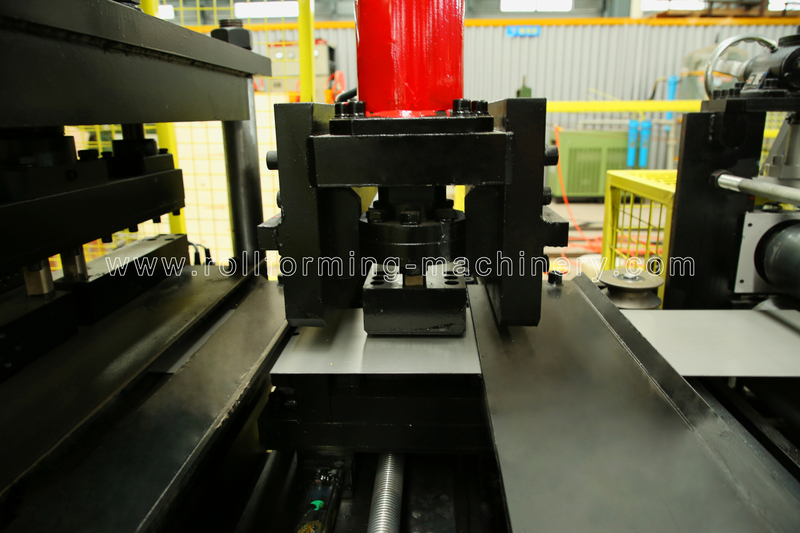
Movable punching unit pictured in the BMS C100-400/Z120-400 catalog. The written quotation should identify the stations and dies supplied for the required hole schedule.
Cutoff method and cut frequency
The offer should state whether it cuts flat strip before forming or cuts the finished section. A stop-to-cut system pauses feeding for the cut. A flying cutoff travels with the material during the cut, then returns for the next cycle. At the same line speed, shorter parts require more cuts per minute. Each offer should name the blades or inserts for the required C and Z shapes and the agreed checks for finished length, burr and end distortion.
Size adjustment and C-to-Z changeover
Automatic size adjustment can move forming rolls to a stored position while leaving a guide, die or insert for the operator to change. Switching from one C size to another and switching from C to Z can involve different tasks. A comparable changeover starts with the last accepted part of the outgoing job and ends with the first accepted part of the next job. Both quotations should state what happens to punch settings, cutoff tooling and trial pieces during that interval.
Compare accepted output on the same jobs
BMS’s separate automatic-change C/Z specification ties its stated forming rate to the number of punched holes. A long unpunched section and a short part with several slots can have different output rates on the same line.
Match the jobs. Both bidders should use a routine run and a demanding run for the comparison. The approved coil, hole schedule, finished lengths and inspection limits should match.
Count good parts at discharge. The timed run should count parts that pass inspection after punching, cutoff and discharge. The quote should state which stops count and whether coil changes and profile changes are included or timed separately.
Use the rate that fits the order. Pieces per minute can work for a fixed-length order. A shift estimate also needs the batch mix, expected change frequency and time allowed for coil changes.
The timed comparison can show whether a faster cutter or a more automated changeover increases useful output. If both bids meet the accepted output target with the same setup work, an added speed feature needs another clear use to warrant its price. If punching is the slow step, a faster forming drive alone leaves that limit in place. A separately priced punch arrangement can show whether the necessary improvement is available without changing the entire forming package.
Separate auxiliary equipment and service costs
A bare mill price and a price for a commissioned production line cover different work. The buyer can bring them to a common basis by listing what is needed from packing through the first accepted run at the receiving factory. Each quote should show the supplier’s items, the buyer’s items and those still to be priced.
Coil handling and discharge
The line layout should identify the decoiler, any loading car, entry guides, feed and leveling equipment, and the discharge rack or stacker. Decoiler capacity has to be checked against the actual coil mass, bore, outside diameter and width together. The discharge arrangement has a different job. It must handle the finished lengths at the planned production rate. Either end of the line can create extra handling or staffing even when the former reaches its quoted rate.
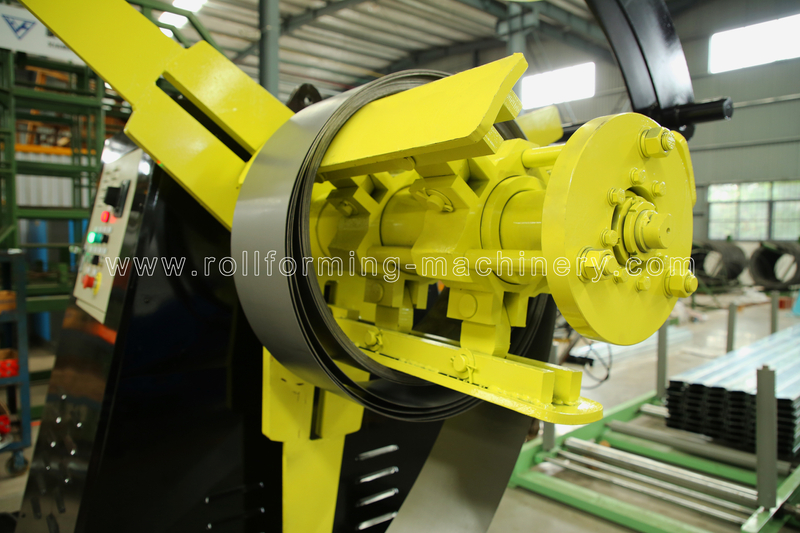
BMS catalog photo of a hydraulic decoiler with a steel coil on its mandrel. The written quotation should confirm whether a decoiler is included and give its coil limits.
Delivery, unloading and site work
Both bids should name the same point for the comparison. The International Chamber of Commerce explains that when Incoterms are used, the rule version and the named place or point matter to how delivery, cost and risk are allocated. Packing, freight, unloading, positioning and connections can therefore sit on different sides of two quoted totals. The buyer’s site team should confirm responsibility for local work and the project documents required at handover.
Electrical supply and connections
At the receiving factory, the facilities team should provide the actual electrical supply and the supplier should return the complete line’s utility schedule and connection points. The forming motor’s rating does not state the electrical needs of the punch, cutoff, controls and other powered modules. A supplier quote can include the control cabinet while leaving incoming cabling and site work to the plant.
Commissioning and after-sales support
Testing and start-up. The quote should identify factory testing before shipment, on-site start-up and what the supplier will demonstrate after installation. It should name the party responsible for the first accepted production run.
People, materials and visits. The quote should state who provides trial coil, staff, travel and any repeat visit, with a price for each required item. Where remote support is included, the plant can get a separate price for any on-site work left to the buyer.
Handover and ongoing support. Training, controls backups, wear parts and warranty service should have written limits so the buyer can see which costs remain after the first run.
Use a like-for-like quotation checklist
A like-for-like checklist gives the team one row for each required item. Both bids should use the same drawing revision. For each line item below, the buyer can record the equipment, price and responsible party for each offer. Each entry should say whether the item is included, priced separately or still open. A separate option can stay outside the required total if the factory can produce the agreed order without it.
What to record for each C/Z equipment quotation
Line item
What to compare across the two bids
Material and profile limits
Match the approved C and Z drawings to steel grade, yield strength and thickness. Record covered jobs and deviations for both offers. Identify any extra grade, thickness and profile combinations in the heavier-duty offer.
Forming tooling and drive
Use the same profiles and tolerances, and time the same changeovers. Record included roll sets, required extras, optional spares, drive and manual steps for both offers. Name the job or setup step each upgrade affects.
Punching
Use the same web and flange hole schedule. Record each offer’s stations and dies and price every required missing die. Identify the features or strokes covered by each added station.
Cutoff and discharge
Use the same lengths, burr and end distortion limits, and accepted output. Record each offer’s cut method, inserts and discharge scope, with any verified difference at the target rate.
Coil handling
Use the same coil dimensions, mass and incoming line layout. Record each offer’s included handling modules and priced omissions. Identify any added capacity that the order requires.
Controls and utilities
Use the same required functions, site supply and connection points. Record each offer’s included controls, utility needs and site connections. Identify what work any added control performs.
Site start-up
Match the delivery point, commissioning trial, handover documents and training. Record who supplies each service in each offer, any travel charge and what the quoted service adds.
Excluded costs
Use the same currency, price basis and costs to reach the first accepted run. Price each offer’s required buyer work and mark unresolved items.
Worked example with a missing die and commissioning
In this example, the standard bid excludes a required flange die and site commissioning. Assume the heavier-duty bid includes both, all other costs are equal, and both configurations meet the same part and output requirements.
Comparable standard total Quoted standard price + the required flange die + site commissioning.
Comparable heavier-duty total Quoted heavier-duty price, with the die and commissioning included.
If the two additions exceed the difference between headline prices, the heavier bid costs less on that basis. A required item with no price leaves the ranking open.
Compare the final totals
The comparison should use the same currency, with an agreed exchange rate and date where conversion is needed. The buyer should also confirm a common delivery and tax basis. Each cost belongs in the total once, including a required buyer-side allowance if the bidder excludes that work.
Any remaining premium can be tied to the exact part, production gain or service responsibility it buys. A bid that misses a mandatory drawing or rate needs a revised configuration before its price can be compared with eligible offers.
Questions about C/Z machine quotations
Can a buyer reuse a decoiler already in the factory?
Possibly. The bidder should check the existing unit’s coil limits and how its controls and feed interface will work with the new line. The quote should assign responsibility for integration and name the reused unit in the acceptance plan. That makes it possible to compare the reuse cost with a new decoiler and determine who supports the connection.
How should a future-only upgrade appear in the quote?
It can be a separate option with a price, any integration work and the production limits of the line as originally supplied. If the factory expects to add it later, the bidder should identify which wiring, controls or floor space must be reserved now and whether a new trial will be needed.
Request an itemized C/Z machine quotation
A procurement team can select the lower comparable cost when both packages meet the agreed production and acceptance terms. A remaining premium is easier to approve when the supplier can identify the required job, throughput improvement or service it covers and state how the buyer will verify it.
For an itemized BMS quotation, the procurement team can send the C and Z drawing revisions, steel grade and strength range, thicknesses, hole schedule, cut lengths and target accepted output from the full line. The request should include the actual factory location, electrical supply, project documentation, delivery point and service scope, with separate prices for required modules and proposed upgrades.
Founded in 1992, BMS Machinery joined XIAMEN BMS GROUP in 2017. Our manufacturing network in China includes 8 factories, 6 machining centers and 1 steel structure company, covering over 30,000 m². Supporting credentials include ISO9001:2015 quality management certification and SGS-issued CE/UKCA machinery compliance verifications. XIAMEN BMS GROUP’s Dun & Bradstreet D‑U‑N‑S Number is 55-379-8879.

 日本語
 한국어
 ไทย
 繁體中文
 العربية
 فارسی
 Français
 Русский
 Español
 Português
 English
 Deutsch
 italiano
 Nederlands
 Tiếng Việt
 Polski
 Türkçe
 አማርኛ
 ພາສາລາວ
 ភាសាខ្មែរ
 Bahasa Melayu
 ဗမာစာ
 தமிழ்
 Filipino
 Bahasa Indonesia
 magyar
 Română
 Čeština
 Монгол
 қазақ
 Српски
 हिन्दी
 Kiswahili
 Slovenčina
 Slovenščina
 Norsk
 Svenska
 українська
 Ελληνικά
 Suomi
 Հայերեն
 עברית
 Latine
 Dansk
 اردو
 Shqip
 বাংলা
 Hrvatski
 Afrikaans
 Gaeilge
 Eesti keel
 Māori
 සිංහල
 नेपाली
 Oʻzbekcha
 latviešu
 অসমীয়া
 Беларуская мова
 Esperanto
 मराठी
 پښتو