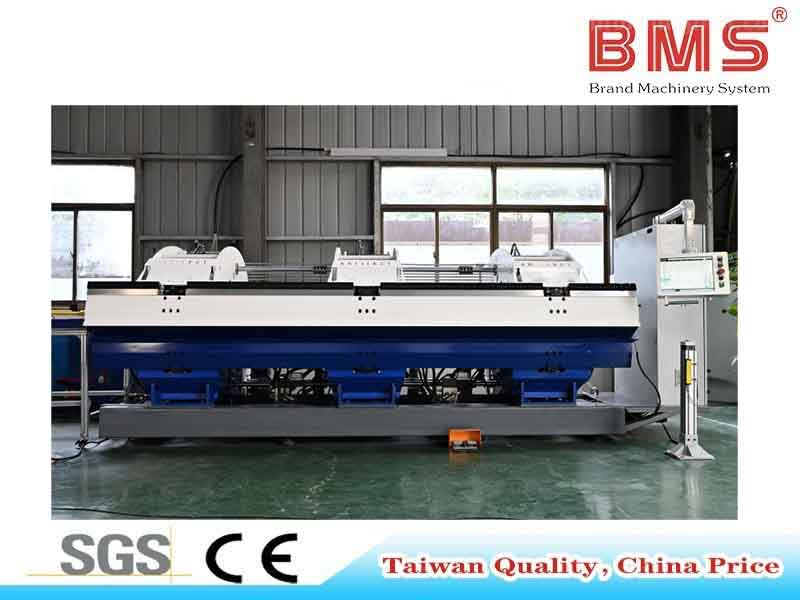
If you're considering a Thalmann folder for architectural sheet metal, roofing, or cladding work, the decision comes down to more than brand reputation. You need to weigh machine specifications, configuration options, cost, and how a folder compares with alternatives like press brakes, panel benders, anddedicated folder-slitters.
This article breaks down those factors so you can understand what to look for, estimate your investment, and ask the right questions before choosing a Thalmann folder.
What Is a Thalmann Folder
A Thalmann folder is a high-end sheet metal folding machine designed for precise, repeatable bending of long metal sheets and profiles. Swiss manufacturer Thalmann has built its reputation around machines for roofing, cladding, and architectural metalwork.
Unlike a traditional press brake, a folder uses a folding beam to bend the sheet. This makes it well suited to long workpieces and fast, consistent production with minimal material handling.
Key Specifications to Evaluate Before Buying
Working Length
The working length is defined as the largest sheet length that a folder can fold at one stretch, and therefore it is among the early factors to be determined. For instance, Thalmann’s TZ folder has a capacity range of 3.20 – 12.00 meters while the TC folder is within the range of 4,000 – 12,000 mm.
Do not assume that you should select the longest folder available in the market. The folder size should depend on your actual output mix. In case your work involves mostly folders of less than 4 meters in length, it does not make sense for you to invest in a 12-meter-long folder.
Material Capacity
The capacity will depend on the type of Thalmann model that you select. The TZ series will be able to fold up to 3 mm material with 400 N/mm² tensile strength, whereas the TD double folder will have a capacity of up to 2.50 mm material at the same strength level. TC double folder is capable of handling 3.0 mm steel and thus is more powerful than the other models.
The main idea here is that there might be some tradeoffs between capacity, speed, and automation. You should think about whether your business requires higher capacity, higher folding speed, greater automation, or a combination of all three options.
Bend radius and throat depth
Most Thalmann machines share a 1,250 mm throat depth, which sets how far into a sheet you can feed it for folding. When comparing models, ask specifically about bend radius range and whether the machine can multi-bend or box-fold in a single cycle — Thalmann's double folders use curved clamping cheeks that add capability here.
Drive Type: Hydraulic vs. Electric
The TZ range of machines uses Vertical Force Drive by Thalmann that allows applying clamping forces of higher magnitude to the clamping point. The force is then distributed evenly by a synchronized shaft mechanism along the whole length of the machine.
Even better is the Dynamic Folding Technology used in TC and TD ranges, where several axes of the machine coordinate their efforts to reduce folding cycle time.
In practice, this would mean less downtime in between bends. This is especially important in high-mix production with changeovers; otherwise, there is not much time saved in long runs of the same profile.
Control System and Programmability
There is an enormous gap between using the manual back gauge and employing CNC-controlled programmed technology. There is no doubt that the latter requires less time for changeovers and eliminates the risk of making a fatal mistake during setup. However, the entry cost increases dramatically.
Frame Construction and Rigidity
A folder is only as accurate as it is rigid, especially at the far ends of a long working length. Ask about frame construction and how the machine maintains consistent clamping pressure across its full length; this is exactly the kind of detail that separates a machine that folds true for twenty years from one that starts drifting after five.
Footprint and Installation Requirements
Don't skip this. Long folders need serious floor space, adequate clearance for material handling on both ends, and the right power supply. Get the foundation and utility requirements in writing before delivery day, not on it.
Thalmann Folder Configuration Options
Single vs. double folder: While the TZ single folder works well with applications involving flexibility and long folds, the TD and TC double folders enable up-and-down folding, increased productivity, and automation. If your application involves mostly one-way folding, go for a single folder; otherwise, a double folder will do for profiles needing both directions without changing the position.
Gripper configurations: Additional gripper units can be added in case of TC models when working with short workpieces. For instance, spring-loaded fingers and double gripper systems provide better sheet orientation, making the machine more applicable for shops working with small parts.
Roll forming and slitting add-ons: These integrate into the guiding system to cut handling and protect sheets from scratches, and can often be retrofitted onto existing machines. BMS builds this combination as a standard line rather than an add-on — see the8M Long Folder Slitter andDouble Bending Slitter Folder for comparison.
Automation and material handling: Some models of TC offer automatic sheet unloading, while the Base combines slitting, feeding, and folding in one line. It is designed for factories aiming to increase automation in their manufacturing process.
Safety and remote service: Features such as adjustable LED lighting improve visibility around the clamping area, while M-Guard provides a secure remote connection to Thalmann's service team for faster diagnostics and support.
A quick buyer's tip: not every option pays for itself. Automated unloading and remote diagnostics tend to earn their keep fast in high-volume shops. A premium tooling package for profile geometries you use twice a year usually doesn't. Have your supplier walk through the payback logic on each add-on rather than bundling everything into one number.
How Much Does a Thalmann Folder Cost?
Here are a few tips about the cost of a Thalmann Folder:
Expect a wide price range: A shorter, manually operated TZ folder will cost far less than a 12-meter TC with automated unloading and a full accessory package.
Calculate the total investment: Don't focus only on the machine price. Freight, rigging, installation, foundation work, and operator training can add significantly to the final cost.
Consider the used market: Well-maintained Thalmann folders can retain their value for years. A used machine with a documented service history and remote diagnostics can be a smart option if you don't need the latest automation features.
Look at financing options: Financing and leasing can make a high-value folder easier to justify when cash flow is the main concern. If the ROI makes sense, discuss these options with your supplier before ruling out the purchase.
Thalmann Folder vs. Alternatives
Thalmann Folders vs. Press Brakes
This is the comparison the consumer needs to understand clearly. The press brake can shape the metal sheet by pushing a punch into the die, thus making it highly versatile for complicated formings and high-tonnage work, plus its capability of forming smaller and thicker metal sheets compared to the long folder, which cannot form such sizes.
The folder, on the other hand, holds the metal sheet in a clamp and then bends it along a fixed line. Therefore, the folder makes it possible for a user to make long and consistent folding on panels used in architecture, roofs, and cladding. It is safer to operate than a press brake since it has fewer pinch point hazards from the punch and die operation, and it is faster when doing repeatable folds because it has no dies to change from one job to another.
If the work to be done is of the type of long panels and repeating folds, a folder is recommended.
Thalmann Folders vs. Panel Benders
Panel bending machines go a step further than folders by using computer-controlled tooling to perform multi-stage bends with little manual intervention, making them excellent choices for high production quantities where parts are repetitive, such as electrical panels or HVAC units. However, the drawback is that the initial cost will be much higher, and daily operation less flexible.
Long folders, like the Thalmann series, tend to be chosen if flexibility on various sizes of panels and different types of profiles is required, or if it doesn’t pay off to be fully automated due to low volume production in your business. There are many facilities that have both of these machines.
New Thalmann vs. Used Thalmann vs. Other Used Equipment
The purchase of used industrial machinery invariably entails a common fundamental question: the condition of its maintenance and by whom? In the case of Thalmann machines, one may confidently rely upon its good name as the guarantee of quality, but it holds for any other brands as long as there are proper maintenance reports.
Request the maintenance reports, clarify if there is an ongoing maintenance service contract for this machine, and, if possible, check out the operation of the machine on similar material.
If your main interest in a folder is pairing long-panel bending with integrated slitting, it's worth comparing Thalmann's price point against BMS'sBending Machine line, which covers the same folder-slitter category at a different cost structure. For a related bending option on smaller, boxier parts, see ourMagnetic Sheet Metal Brake Buying Guide.
Who Should (and Shouldn't) Buy a Thalmann Folder
Who Should Buy a Thalmann Folder
Architectural sheet metal shops: Ideal for producing long, precise folds across varied projects.
HVAC fabricators: A good choice when flexibility and consistent bending accuracy matter.
Roofing and cladding contractors: Well suited to long panels and different profile types.
Industrial manufacturers: Makes sense for operations that need reliable, repeatable folding over many years.
High-mix production shops: A strong fit when panel lengths and profile types change regularly.
Who Shouldn’t Buy a Thalmann Folder
High-volume, single-profile operations: A fully automated panel bender may deliver better productivity and a faster return on investment.
Budget-conscious shops: If a premium machine would stretch the capital budget too far, a capable mid-range folder may be the better choice.
Low-utilization operations: If the machine won't be used frequently enough to justify its cost, investing in a premium folder may tie up capital unnecessarily.
Questions to Ask Before You Buy
What's the realistic lead time from order to installation, including freight from the manufacturing site?
Which tooling and accessories are included in the base price, and which are sold separately?
What does the warranty cover, and what's the actual service response time in my region?
Can I see the exact model running on material similar to what my shop processes?
What's the total landed cost, including freight, rigging, installation, and operator training?
Is remote diagnostic support (like Thalmann's M-Guard) included, or is it an add-on?
Conclusion
The best Thalmann folder depends on your working length, material mix, production volume, and automation needs. Compare the TZ, TD, and TC series based on total cost of ownership, not just the purchase price.
Need help choosing the right configuration? Contact BMS for guidance based on your production requirements.
FAQ
What's the difference between a folder and a press brake?
Press brakes use a top punch and bottom V die to press and force the sheet metal to bend. On the other hand, folders clamp the sheet metal in place while raising a folding beam from below to fold it at the needed angle.
How long does a Thalmann folder typically last?
Thalmann long folders usually last for decades because of their sturdy Swiss build quality, and most of these machines keep functioning for 20 to 30 years and beyond.
Can Thalmann folders handle stainless steel?
Yes, Thalmann long folders can work with stainless steel so long as it fits into the gauge range of that particular machine. As you know, stainless steel is much stronger compared to mild steel or aluminum; hence, folders cannot process stainless steel sheets as thick as mild steel or aluminum.
Is a used Thalmann folder a good investment?
Yes, buying a used Thalmann sheet metal folder is a good idea for professional fabrication shops because of its high Swiss precision, durability, and affordability compared to a new one.
What's the typical delivery and installation timeline?
Typical delivery and installation timelines range from a single day for standard home appliances or HVAC units to several weeks or months for custom manufacturing equipment or modular structures.
Founded in 1992, BMS Machinery joined XIAMEN BMS GROUP in 2017. Our manufacturing network in China includes 8 factories, 6 machining centers and 1 steel structure company, covering over 30,000 m². Supporting credentials include ISO9001:2015 quality management certification and SGS-issued CE/UKCA machinery compliance verifications. XIAMEN BMS GROUP’s Dun & Bradstreet D‑U‑N‑S Number is 55-379-8879.

 日本語
日本語 한국어
한국어 ไทย
ไทย 繁體中文
繁體中文 العربية
 فارسی
فارسی Français
 Русский
 Español
 Português
 English
 Deutsch
 italiano
 Nederlands
 Tiếng Việt
 Polski
 Türkçe
 አማርኛ
አማርኛ ພາສາລາວ
 ភាសាខ្មែរ
 Bahasa Melayu
 ဗမာစာ
ဗမာစာ தமிழ்
தமிழ் Filipino
 Bahasa Indonesia
 magyar
 Română
 Čeština
 Монгол
 қазақ
қазақ Српски
 हिन्दी
 Kiswahili
 Slovenčina
 Slovenščina
 Norsk
Norsk Svenska
 українська
 Ελληνικά
 Suomi
Suomi Հայերեն
 עברית
עברית Latine
 Dansk
Dansk اردو
اردو Shqip
Shqip বাংলা
বাংলা Hrvatski
 Afrikaans
 Gaeilge
 Eesti keel
 Māori
Māori සිංහල
සිංහල नेपाली
 Oʻzbekcha
 latviešu
 অসমীয়া
 Беларуская мова
 Esperanto
 मराठी
मराठी پښتو
پښتو